Liu Zhibin, de Bruijn Wouter J C, Sanders Mark G, Wang Sisi, Bruins Marieke E, Vincken Jean-Paul
Laboratory of Food Chemistry, Wageningen University, P.O. Box 17, Wageningen 6700 AA , The Netherlands.
Institute of Food Science & Technology, Fuzhou University, Fuzhou 350108, P.R. China.
J Agric Food Chem. 2021 Mar 3;69(8):2477-2484. doi: 10.1021/acs.jafc.1c00727. Epub 2021 Feb 23.
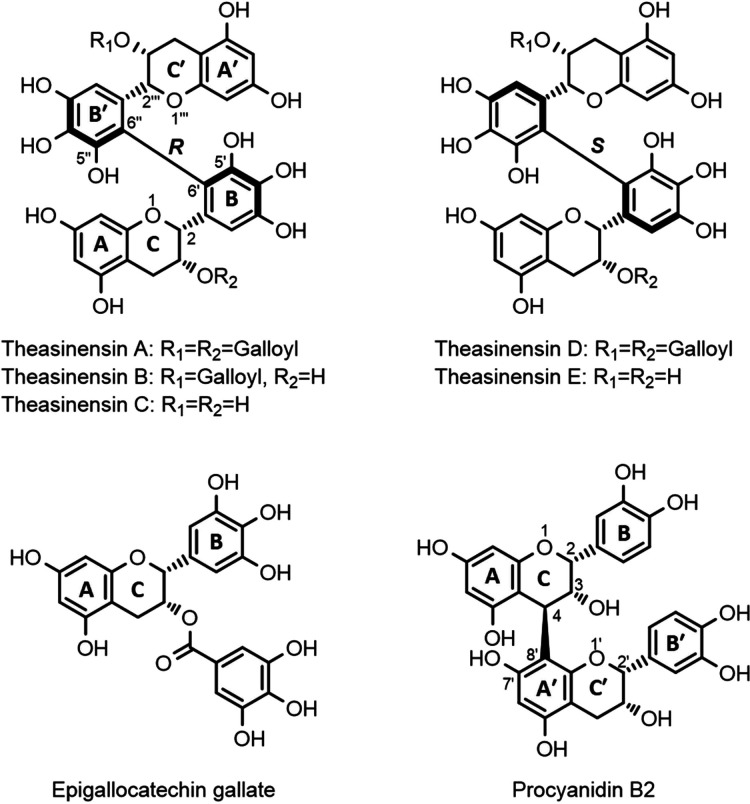
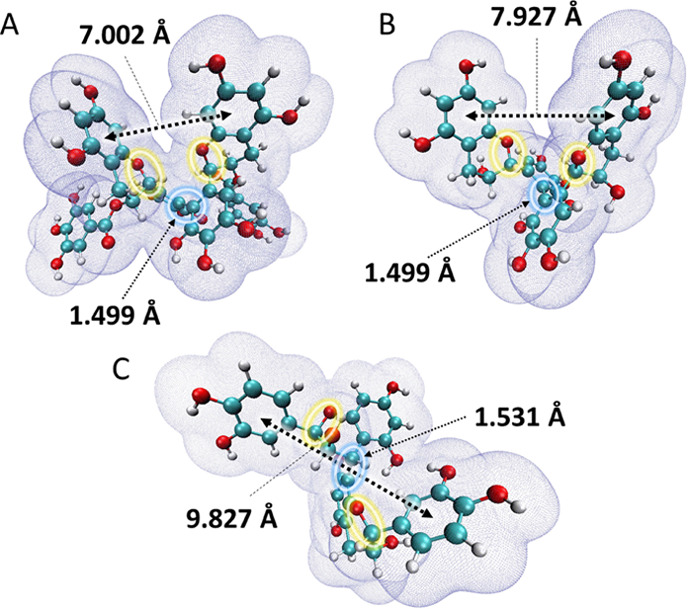
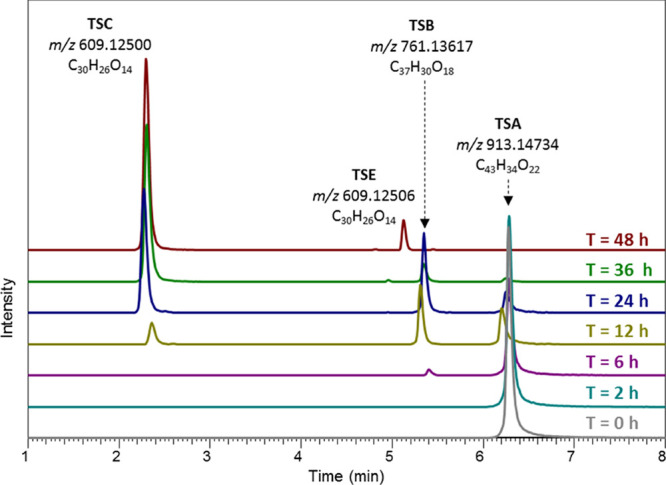
Due to low bioavailability of dietary phenolic compounds in small intestine, their metabolism by gut microbiota is gaining increasing attention. The microbial metabolism of theasinensin A (TSA), a bioactive catechin dimer found in black tea, has not been studied yet. Here, TSA was extracted and purified for fermentation by human fecal microbiota, and epigallocatechin gallate (EGCG) and procyanidin B2 (PCB2) were used for comparison. Despite the similarity in their flavan-3-ol skeletons, metabolic fate of TSA was distinctively different. After degalloylation, its core biphenyl-2,2',3,3',4,4'-hexaol structure remained intact during fermentation. Conversely, EGCG and PCB2 were promptly degraded into a series of hydroxylated phenylcarboxylic acids. Computational analyses comparing TSA and PCB2 revealed that TSA's stronger interflavanic bond and more compact stereo-configuration might underlie its lower fermentability. These insights in the recalcitrance of theasinensins to degradation by human gut microbiota are of key importance for a comprehensive understanding of its health benefits.
由于膳食酚类化合物在小肠中的生物利用度较低,它们通过肠道微生物群的代谢越来越受到关注。茶黄素A(TSA)是一种在红茶中发现的具有生物活性的儿茶素二聚体,其微生物代谢尚未得到研究。在此,提取并纯化了TSA,用于人粪便微生物群的发酵,并使用表没食子儿茶素没食子酸酯(EGCG)和原花青素B2(PCB2)进行比较。尽管它们的黄烷-3-醇骨架相似,但TSA的代谢命运却明显不同。脱没食子酰化后,其核心联苯-2,2',3,3',4,4'-六醇结构在发酵过程中保持完整。相反,EGCG和PCB2迅速降解为一系列羟基化苯羧酸。对TSA和PCB2进行的计算分析表明,TSA更强的黄烷间键和更紧凑的立体构型可能是其发酵性较低的原因。这些关于茶黄素对人类肠道微生物群降解具有抗性的见解对于全面了解其健康益处至关重要。