Department of Pharmacy Practice and Science, College of Pharmacy, University of Arizona, 1295 N Martin Ave, PO Box 210202, Tucson, AZ, 85721, USA.
Department of Pharmacy Practice, College of Pharmacy, Midwestern University, 19555 N 59th Ave, Glendale, AZ, 85308, USA.
Crit Care. 2021 Feb 23;25(1):77. doi: 10.1186/s13054-021-03495-8.
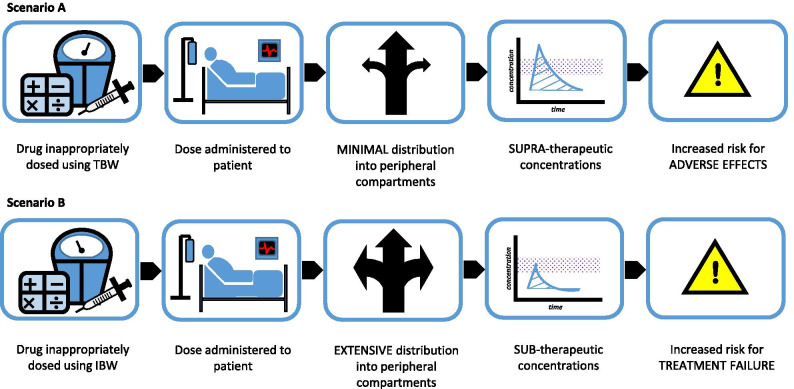
Medications used for supportive care or prophylaxis constitute a significant portion of drug utilization in the intensive care unit. Evidence-based guidelines are available for many aspects of supportive care but drug doses listed are typically for patients with normal body habitus and not morbid obesity. Failure to account for the pharmacokinetic changes that occur with obesity can lead to an incorrect dose and treatment failure or toxicity. This paper is intended to help clinicians design initial dosing regimens in critically ill obese patients for medications commonly used for hemodynamic support or prophylaxis. A detailed literature search of medications used for supportive care or prophylaxis listed in practice guidelines was conducted with an emphasis on obesity, pharmacokinetics and dosing. Relevant manuscripts were reviewed and strategies for dosing are provided. For medications used for hemodynamic support, a similar strategy can be used as in non-obese patients. Similarly, medications for stress ulcer prophylaxis do not need to be adjusted. Anticoagulants for venous thromboembolism prophylaxis, on the other hand, require an individualized approach where higher doses are necessary.
用于支持性治疗或预防的药物在重症监护病房的药物利用中占很大一部分。许多支持性治疗方面都有循证指南,但列出的药物剂量通常适用于身体形态正常而非病态肥胖的患者。如果不考虑肥胖引起的药代动力学变化,可能会导致剂量错误、治疗失败或毒性。本文旨在帮助临床医生为重症肥胖患者设计常用的用于血流动力学支持或预防的药物的初始给药方案。对循证指南中列出的用于支持性治疗或预防的药物进行了详细的文献检索,重点关注肥胖、药代动力学和给药。对相关文献进行了回顾,并提供了给药策略。对于用于血流动力学支持的药物,可以使用与非肥胖患者相似的策略。同样,应激性溃疡预防药物无需调整。另一方面,用于预防静脉血栓栓塞的抗凝剂需要个体化治疗,需要使用更高的剂量。