Bykowski Michał, Mazur Radosław, Wójtowicz Joanna, Suski Szymon, Garstka Maciej, Mostowska Agnieszka, Kowalewska Łucja
Department of Plant Anatomy and Cytology, Institute of Plant Experimental Biology and Biotechnology, Faculty of Biology, University of Warsaw, Warsaw 02-096, Poland.
Department of Metabolic Regulation, Institute of Biochemistry, Faculty of Biology, University of Warsaw, Warsaw 02-096, Poland.
Plant Physiol. 2021 Feb 25;185(1):210-227. doi: 10.1093/plphys/kiaa009.
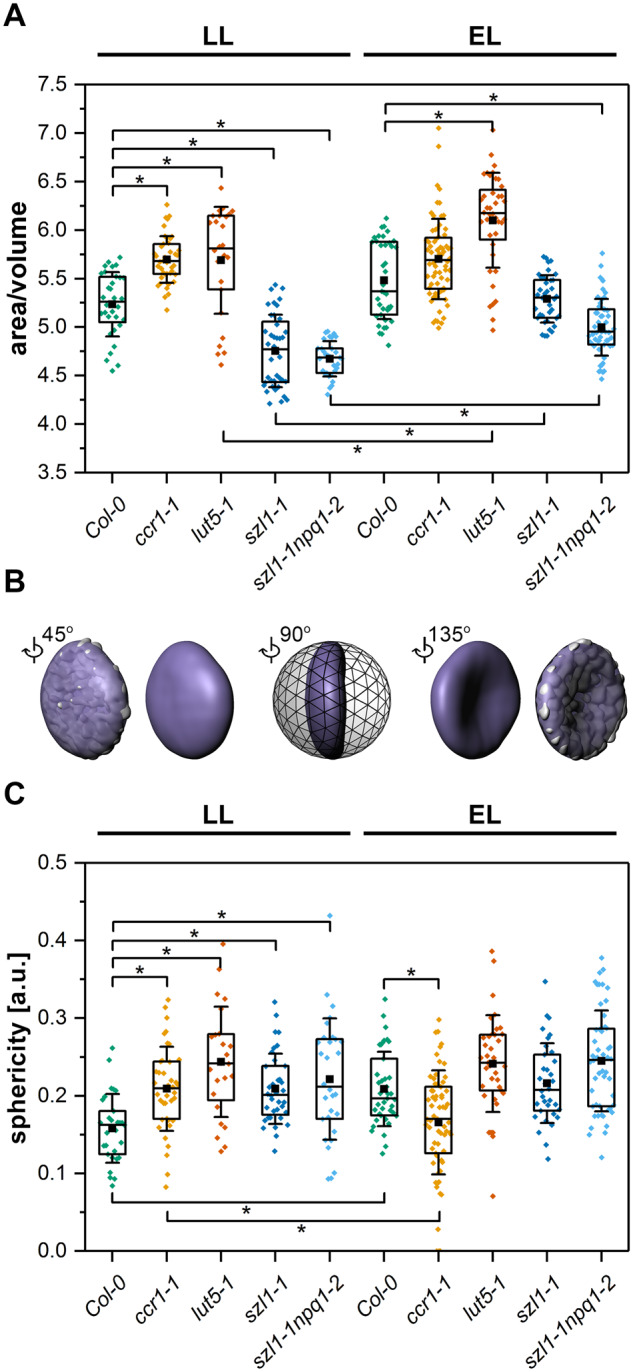
In chloroplasts of land plants, the thylakoid network is organized into appressed regions called grana stacks and loosely arranged parallel stroma thylakoids. Many factors determining such intricate structural arrangements have been identified so far, including various thylakoid-embedded proteins, and polar lipids that build the thylakoid matrix. Although carotenoids are important components of proteins and the lipid phase of chloroplast membranes, their role in determining the thylakoid network structure remains elusive. We studied 2D and 3D thylakoid network organization in carotenoid-deficient mutants (ccr1-1, lut5-1, szl1-1, and szl1-1npq1-2) of Arabidopsis (Arabidopsis thaliana) to reveal the structural role of carotenoids in the formation and dynamics of the internal chloroplast membrane system. The most significant structural aberrations took place in chloroplasts of the szl1-1 and szl1-1npq1-2 plants. Increased lutein/carotene ratio in these mutants impaired the formation of grana, resulting in a significant decrease in the number of thylakoids used to build a particular stack. Further, combined biochemical and biophysical analyses revealed that hampered grana folding was related to decreased thylakoid membrane fluidity and significant changes in the amount, organization, and phosphorylation status of photosystem (PS) II (PSII) supercomplexes in the szl1-1 and szl1-1npq1-2 plants. Such changes resulted from a synergistic effect of lutein overaccumulation in the lipid matrix and a decreased level of carotenes bound with PS core complexes. Moreover, more rigid membrane in the lutein overaccumulating plants led to binding of Rubisco to the thylakoid surface, additionally providing steric hindrance for the dynamic changes in the level of membrane folding.
在陆地植物的叶绿体中,类囊体网络被组织成称为基粒堆叠的紧密区域和松散排列的平行基质类囊体。到目前为止,已经确定了许多决定这种复杂结构排列的因素,包括各种嵌入类囊体的蛋白质以及构成类囊体基质的极性脂质。尽管类胡萝卜素是蛋白质和叶绿体膜脂质相的重要组成部分,但其在决定类囊体网络结构中的作用仍然难以捉摸。我们研究了拟南芥类胡萝卜素缺陷突变体(ccr1-1、lut5-1、szl1-1和szl1-1npq1-2)中的二维和三维类囊体网络组织,以揭示类胡萝卜素在叶绿体内部膜系统形成和动态中的结构作用。最显著的结构畸变发生在szl1-1和szl1-1npq1-2植物的叶绿体中。这些突变体中叶黄素/类胡萝卜素比率的增加损害了基粒的形成,导致用于构建特定堆叠的类囊体数量显著减少。此外,结合生化和生物物理分析表明,基粒折叠受阻与szl1-1和szl1-1npq1-2植物中类囊体膜流动性降低以及光系统(PS)II(PSII)超复合物的数量、组织和磷酸化状态的显著变化有关。这种变化是由脂质基质中叶黄素过度积累和与PS核心复合物结合的类胡萝卜素水平降低的协同作用引起的。此外,叶黄素过度积累的植物中更刚性的膜导致Rubisco与类囊体表面结合,这也为膜折叠水平的动态变化提供了空间位阻。