Jiangsu Key Laboratory of New Drug Research and Clinical Pharmacy, College of Pharmacy, Xuzhou Medical University, 209 Tongshan Road, Xuzhou, 221004, China.
Department of Pharmacy, The First People's Hospital of Yancheng, The Yancheng Clinical College of Xuzhou Medical University, Yancheng, China.
BMC Cancer. 2021 Feb 25;21(1):194. doi: 10.1186/s12885-021-07896-4.
Multiple common variants identified by genome-wide association studies have shown limited evidence of the risk of breast cancer in Chinese individuals. In this study, we aimed to uncover the relationship between estrogen levels and the genetic polymorphism of estrogen metabolism-related enzymes in breast cancer (BC) and establish a risk prediction model composed of estrogen-metabolizing enzyme genes and GWAS-identified breast cancer-related genes based on a polygenic risk score.
Unrelated BC patients and healthy subjects were recruited for analysis of estrogen levels and single nucleotide polymorphisms (SNPs) in genes encoding estrogen metabolism-related enzymes. The polygenic risk score (PRS) was used to explore the combined effect of multiple genes, which was calculated using a Bayesian approach. An independent sample t-test was used to evaluate the differences between PRS scores of BC and healthy subjects. The discriminatory accuracy of the models was compared using the area under the receiver operating characteristic (ROC) curve.
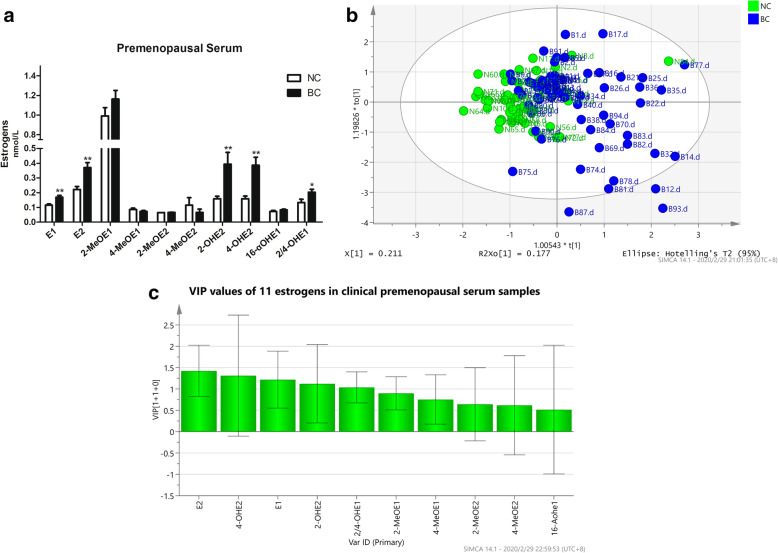
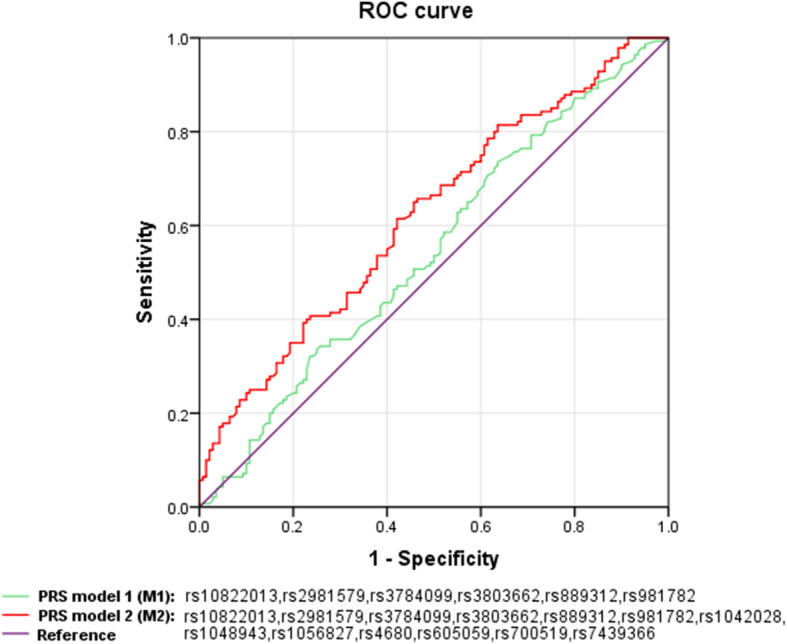
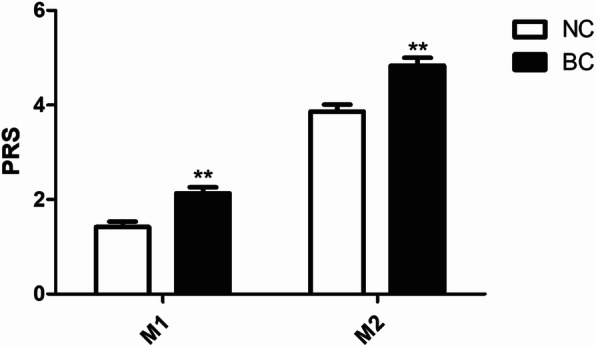
The estrogen homeostasis profile was disturbed in BC patients, with parent estrogens (E1, E2) and carcinogenic catechol estrogens (2/4-OHE1, 2-OHE2, 4-OHE2) significantly accumulating in the serum of BC patients. We then established a PRS model to evaluate the role of SNPs in multiple genes. PRS model 1 (M1) was established from SNPs in 6 GWAS-identified high risk genes. On the basis of M1, we added SNPs from 7 estrogen metabolism enzyme genes to establish PRS model 2 (M2). The independent sample t-test results showed that there was no difference between BC and healthy subjects in M1 (P = 0.17); however, there was a significant difference between BC and healthy subjects in M2 (P = 4.9*10). The ROC curve results showed that the accuracy of M2 (AUC = 62.18%) in breast cancer risk identification was better than that of M1 (AUC = 54.56%).
Estrogen and related metabolic enzyme gene polymorphisms are closely related to BC. The model constructed by adding estrogen metabolic enzyme gene SNPs has a good predictive ability for breast cancer risk, and the accuracy is greatly improved compared with that of the PRS model that only includes GWAS-identified gene SNPs.
全基因组关联研究鉴定的多个常见变异在中国人中对乳腺癌风险的证据有限。在这项研究中,我们旨在揭示雌激素水平与乳腺癌(BC)中雌激素代谢相关酶的遗传多态性之间的关系,并基于多基因风险评分建立由雌激素代谢酶基因和 GWAS 鉴定的乳腺癌相关基因组成的风险预测模型。
招募无关的 BC 患者和健康受试者进行雌激素水平和编码雌激素代谢相关酶的基因中单核苷酸多态性(SNP)分析。使用贝叶斯方法计算多基因风险评分(PRS),以探索多个基因的综合效应。使用独立样本 t 检验评估 BC 和健康受试者 PRS 评分之间的差异。使用受试者工作特征(ROC)曲线下的面积比较模型的判别准确性。
BC 患者的雌激素内稳态谱受到干扰,母雌激素(E1、E2)和致癌儿茶酚雌激素(2/4-OHE1、2-OHE2、4-OHE2)在 BC 患者血清中明显积累。然后,我们建立了一个 PRS 模型来评估多个基因中 SNP 的作用。PRS 模型 1(M1)是从 6 个 GWAS 鉴定的高风险基因中的 SNP 建立的。在 M1 的基础上,我们添加了 7 个雌激素代谢酶基因中的 SNP 以建立 PRS 模型 2(M2)。独立样本 t 检验结果显示,M1 中 BC 和健康受试者之间没有差异(P=0.17);然而,M2 中 BC 和健康受试者之间有显著差异(P=4.9*10)。ROC 曲线结果表明,M2(AUC=62.18%)在乳腺癌风险识别中的准确性优于 M1(AUC=54.56%)。
雌激素和相关代谢酶基因多态性与 BC 密切相关。添加雌激素代谢酶基因 SNP 构建的模型对乳腺癌风险具有良好的预测能力,与仅包含 GWAS 鉴定基因 SNP 的 PRS 模型相比,准确性大大提高。