Faculty of Information Management, Universiti Teknologi MARA, Shah Alam, Selangor, Malaysia.
School of Computer Sciences, Universiti Sains Malaysia, Gelugor, Pulau Pinang, Malaysia.
BMC Med Inform Decis Mak. 2021 Feb 25;21(1):75. doi: 10.1186/s12911-021-01447-4.
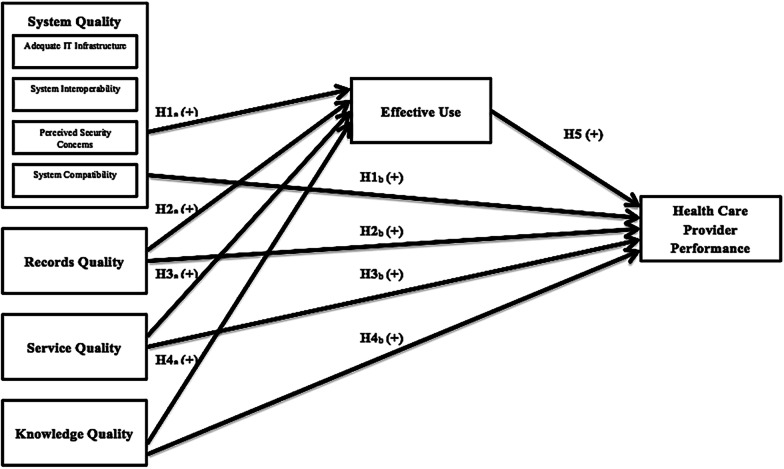
The Ministry of Health of Malaysia has invested significant resources to implement an electronic health record (EHR) system to ensure the full automation of hospitals for coordinated care delivery. Thus, evaluating whether the system has been effectively utilized is necessary, particularly regarding how it predicts the post-implementation primary care providers' performance impact.
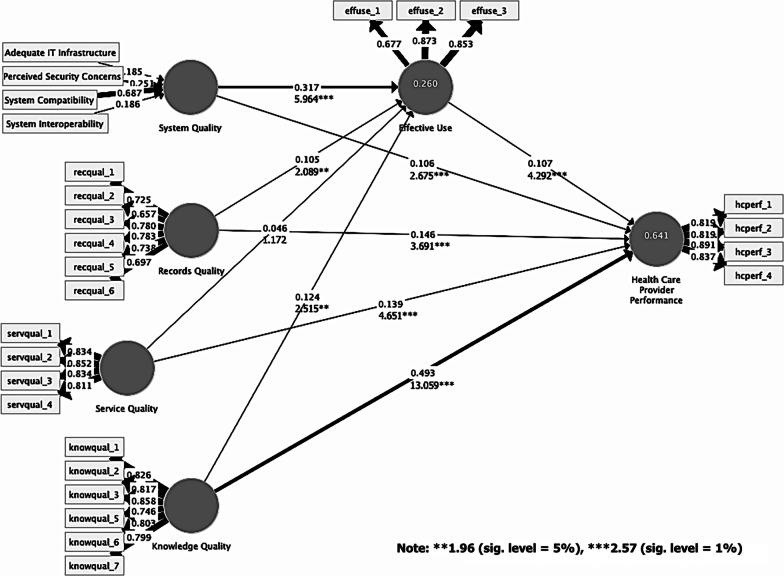
Convenience sampling was employed for data collection in three government hospitals for 7 months. A standardized effectiveness survey for EHR systems was administered to primary health care providers (specialists, medical officers, and nurses) as they participated in medical education programs. Empirical data were assessed by employing partial least squares-structural equation modeling for hypothesis testing.
The results demonstrated that knowledge quality had the highest score for predicting performance and had a large effect size, whereas system compatibility was the most substantial system quality component. The findings indicated that EHR systems supported the clinical tasks and workflows of care providers, which increased system quality, whereas the increased quality of knowledge improved user performance.
Given these findings, knowledge quality and effective use should be incorporated into evaluating EHR system effectiveness in health institutions. Data mining features can be integrated into current systems for efficiently and systematically generating health populations and disease trend analysis, improving clinical knowledge of care providers, and increasing their productivity. The validated survey instrument can be further tested with empirical surveys in other public and private hospitals with different interoperable EHR systems.
马来西亚卫生部投入了大量资源来实施电子健康记录 (EHR) 系统,以确保医院全面实现自动化,从而提供协调的护理服务。因此,有必要评估该系统是否得到了有效利用,特别是要评估其对实施后基层医疗服务提供者绩效的影响。
在 3 家政府医院进行了为期 7 个月的便利抽样数据收集。在医疗教育计划中,向初级保健提供者(专家、医师和护士)进行了电子健康记录系统有效性的标准化评估调查。采用偏最小二乘结构方程建模对假设进行检验,对实证数据进行评估。
结果表明,知识质量在预测绩效方面得分最高,具有较大的效应量,而系统兼容性是最重要的系统质量组成部分。研究结果表明,EHR 系统支持医疗服务提供者的临床任务和工作流程,从而提高了系统质量,而知识质量的提高则提高了用户的绩效。
鉴于这些发现,在评估医疗机构的 EHR 系统有效性时,应纳入知识质量和有效使用。可以将数据挖掘功能集成到当前系统中,以便有效地、系统地生成人群健康数据和疾病趋势分析,提高医疗服务提供者的临床知识水平,提高他们的工作效率。可以使用其他具有不同互操作性 EHR 系统的公共和私人医院进行进一步测试。