Department of Orthopedics, King Faisal Specialist Hospital and Research Center, Riyadh, Saudi Arabia.
College of Medicine, Alfaisal University, Riyadh, Saudi Arabia.
Orphanet J Rare Dis. 2021 Feb 25;16(1):100. doi: 10.1186/s13023-021-01738-z.
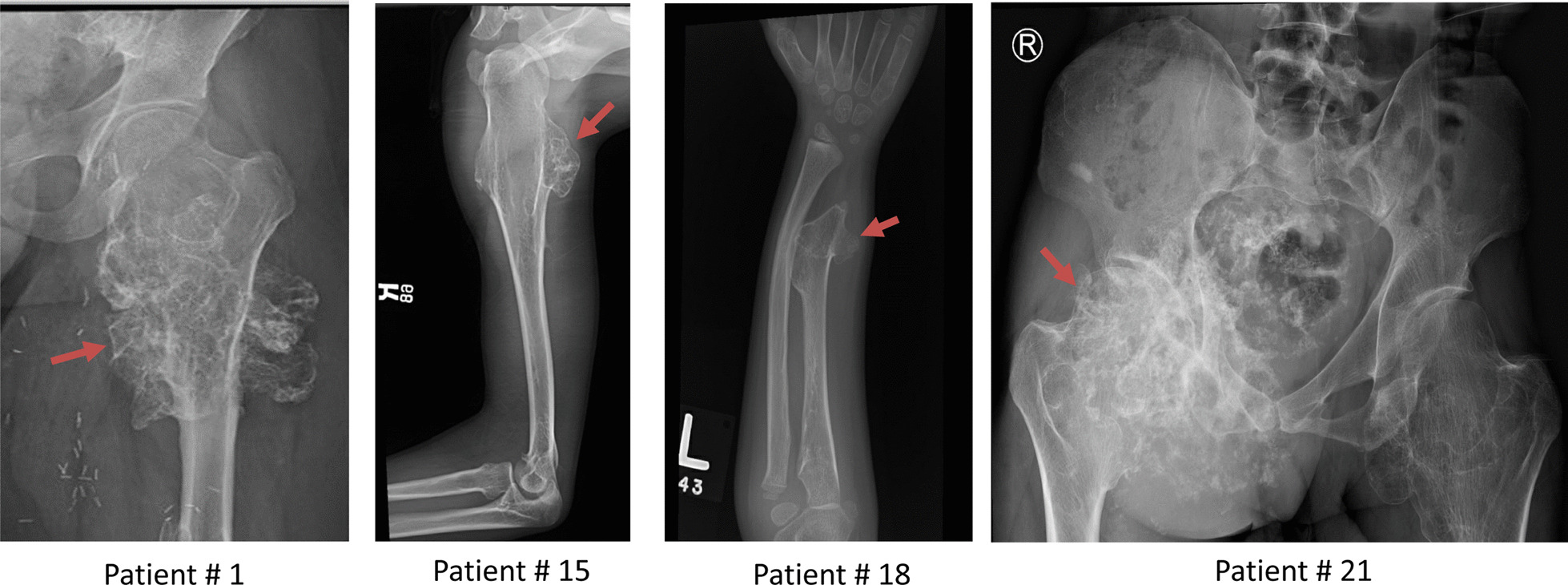
Hereditary Multiple Exostoses (HME), also known as Multiple Osteochondromas (MO) is a rare genetic disorder characterized by multiple benign cartilaginous bone tumors, which are caused by mutations in the genes for exostosin glycosyltransferase 1 (EXT1) and exostosin glycosyltransferase 2 (EXT2). The genetic defects have not been studied in the Saudi patients.
We investigated mutation spectrum of EXT1 and EXT2 in 22 patients from 17 unrelated families.
Genomic DNA was extracted from peripheral leucocytes. The coding regions and intron-exon boundaries of both EXT1 and EXT2 genes were screened for mutations by PCR-sequencing analysis. Gross deletions were analyzed by MLPA analysis.
EXT1 mutations were detected in 6 families (35%) and 3 were novel mutations: c.739G > T (p. E247*), c.1319delG (p.R440Lfs4), and c.1786delA (p.S596Afs25). EXT2 mutations were detected in 7 families (41%) and 3 were novel mutations: c.541delG (p.D181Ifs89), c.583delG (p.G195Vfs75), and a gross deletion of approximately 10 kb including promoter and exon 1. Five patients from different families had no family history and carried de novo mutations (29%, 5/17). No EXT1 and EXT2 mutations were found in the remaining four families. In total, EXT1 and EXT2 mutations were found in 77% (13/17) of Saudi HME patients.
EXT1 and EXT2 mutations contribute significantly to the pathogenesis of HME in the Saudi population. In contrast to high mutation rate in EXT 1 (65%) and low mutation rate in EXT2 (25%) in other populations, the frequency of EXT2 mutations are much higher (41%) and comparable to that of EXT1 among Saudi patients. De novo mutations are also common and the six novel EXT1/EXT2 mutations further expands the mutation spectrum of HME.
遗传性多发性外生性骨软骨瘤病(HME),也称为多发性骨软骨瘤(MO),是一种罕见的遗传性疾病,其特征为多个良性软骨源性骨肿瘤,由 EXT1 和 EXT2 基因的突变引起。沙特患者的遗传缺陷尚未研究。
我们研究了 17 个无关家庭的 22 名患者的 EXT1 和 EXT2 基因突变谱。
从外周血白细胞中提取基因组 DNA。通过 PCR-测序分析筛选 EXT1 和 EXT2 基因的编码区和内含子-外显子边界的突变。通过 MLPA 分析分析大片段缺失。
在 6 个家庭(35%)中检测到 EXT1 突变,其中 3 个为新突变:c.739G>T(p.E247*),c.1319delG(p.R440Lfs4)和 c.1786delA(p.S596Afs25)。在 7 个家庭(41%)中检测到 EXT2 突变,其中 3 个为新突变:c.541delG(p.D181Ifs89),c.583delG(p.G195Vfs75)和大约 10kb 的大片段缺失,包括启动子和外显子 1。来自不同家庭的 5 名患者无家族史,携带从头突变(29%,5/17)。在其余 4 个家庭中未发现 EXT1 和 EXT2 突变。总的来说,在 17 名沙特 HME 患者中,EXT1 和 EXT2 突变分别占 77%(13/17)。与其他人群中 EXT1 突变率高(65%)和 EXT2 突变率低(25%)相比,沙特患者的 EXT2 突变率更高(41%),与 EXT1 相当。从头突变也很常见,6 个新的 EXT1/EXT2 突变进一步扩展了 HME 的突变谱。