School of Psychology, University of Birmingham, Birmingham, B15 2TT, UK.
South West Yorkshire Partnership NHS Foundation Trust, Wakefield, WF1 3SP, UK.
Mol Autism. 2021 Feb 25;12(1):18. doi: 10.1186/s13229-021-00426-w.
Sleep disorders are common in people with intellectual disability (ID) and autism, with growing evidence of diverse sleep profiles across ID associated genetic syndromes. Documenting the prevalence and profile of specific sleep disorders in syndromes will quantify syndrome-driven 'risk', inform prognosis and enhance understanding of aetiology of sleep disorders.
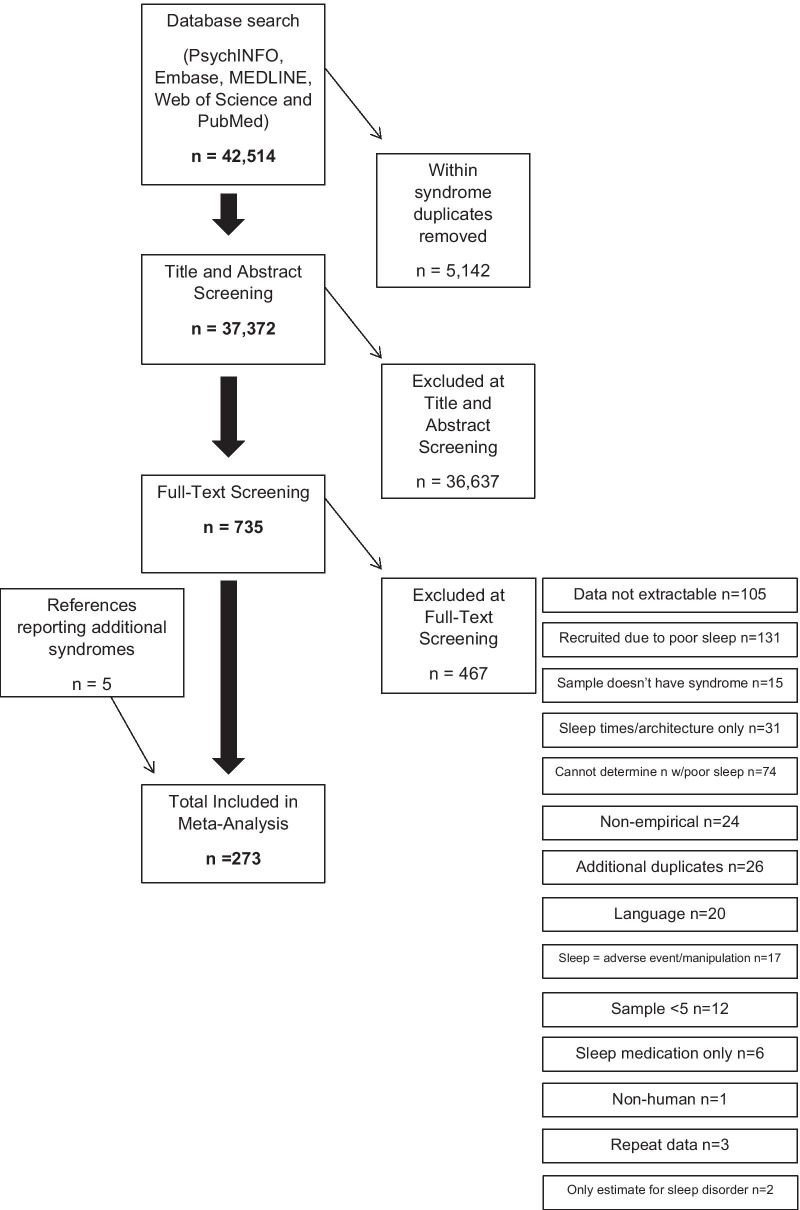
Following PRISMA guidelines for meta-analysis, we searched Ovid PsycINFO, Ovid MEDLINE, Ovid Embase, Web of Science and PubMed Central with use of syndrome-specific keywords and 60 sleep-related search terms. We screened and extracted papers that reported sleep disorder prevalence data for five or more individuals within a genetic syndrome, and applied quality criteria to produce a quality-effects prevalence model of six types of sleep disorder across nineteen syndromes. Relative risk estimates were calculated for the prevalence of each sleep disorder in each syndrome.
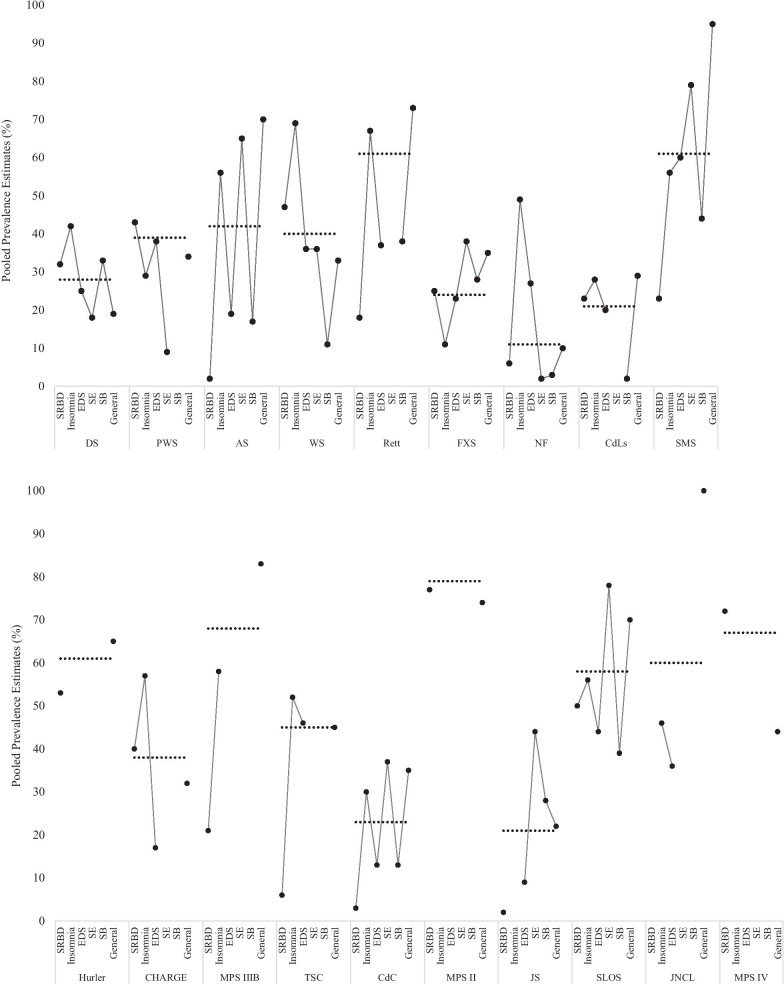
Two hundred and seventy three papers were identified, generating 463 prevalence estimates for Angelman, CHARGE, Cornelia de Lange, Down, fragile X, Prader-Willi, Rett, Smith-Magenis and Williams syndromes, mucopolysaccharidoses (MPS disorders), neurofibromatosis and tuberous sclerosis complex. Prevalence estimates were higher in genetic syndromes than published equivalents for typically developing individuals, with few exceptions. Between-syndrome differences for some disorders were evident; sleep-disordered breathing was most prevalent in MPS disorders (72-77%), while excessive daytime sleepiness was highest in Smith-Magenis syndrome (60%). Conversely, insomnia, which was reported at a higher rate than TD estimates in all syndromes except fragile X, was not associated with specific genetic risk. This suggests insomnia could emerge because of the individual's environment or associated developmental delay, rather than any specific genetic syndromes.
Due to the broad scope of the meta-analysis, only syndromes previously identified as reporting preliminary sleep research were included. Other syndromes may also experience elevated prevalence rates of specific types of sleep disorder. Only English language papers were included.
Differing prevalence rates between types of sleep disorder suggest differing causal mechanisms, such as cranio-facial morphology in Down and Prader-Willi syndromes and the build-up of mucopolysaccharides in MPS disorders. Priorities for clinical assessment and intervention for sleep disorders are discussed.
睡眠障碍在智力障碍(ID)和自闭症患者中很常见,越来越多的证据表明,与 ID 相关的遗传综合征存在不同的睡眠模式。记录综合征中特定睡眠障碍的患病率和特征将量化综合征驱动的“风险”,为预后提供信息,并增强对睡眠障碍病因的理解。
根据荟萃分析的 PRISMA 指南,我们使用综合征特异性关键词和 60 个与睡眠相关的搜索词,在 Ovid PsycINFO、Ovid MEDLINE、Ovid Embase、Web of Science 和 PubMed Central 中进行了搜索。我们筛选并提取了报告五个或更多个体遗传综合征中睡眠障碍患病率数据的论文,并应用质量标准制作了 19 个综合征中六种睡眠障碍的质量效应患病率模型。计算了每个综合征中每种睡眠障碍的相对风险估计值。
确定了 273 篇论文,产生了 Angelman、CHARGE、Cornelia de Lange、Down、脆性 X、Prader-Willi、Rett、Smith-Magenis 和 Williams 综合征、黏多糖贮积症(MPS 障碍)、神经纤维瘤病和结节性硬化症的 463 个患病率估计值。与典型发育个体的已发表数据相比,遗传综合征中的患病率估计值更高,但也有一些例外。一些障碍的综合征间差异明显;在 MPS 障碍中,睡眠呼吸障碍最为常见(72-77%),而在 Smith-Magenis 综合征中,日间嗜睡最为常见(60%)。相反,失眠症在除脆性 X 以外的所有综合征中的报告率均高于 TD 估计值,但与特定的遗传风险无关。这表明失眠可能是由于个体的环境或相关发育迟缓引起的,而不是任何特定的遗传综合征。
由于荟萃分析的范围广泛,仅包括以前被确定为报告初步睡眠研究的综合征。其他综合征也可能经历特定类型睡眠障碍的患病率升高。仅包括英语论文。
不同类型睡眠障碍的患病率差异表明存在不同的因果机制,例如 Down 和 Prader-Willi 综合征中的颅面形态和 MPS 障碍中的黏多糖积聚。讨论了睡眠障碍临床评估和干预的优先事项。