Wu Zhongxia, Yang Libin, He Qiongjie, Zhou Shutang
State Key Laboratory of Cotton Biology, Key Laboratory of Plant Stress Biology, School of Life Sciences, Henan University, Kaifeng, China.
Front Cell Dev Biol. 2021 Jan 28;8:593613. doi: 10.3389/fcell.2020.593613. eCollection 2020.
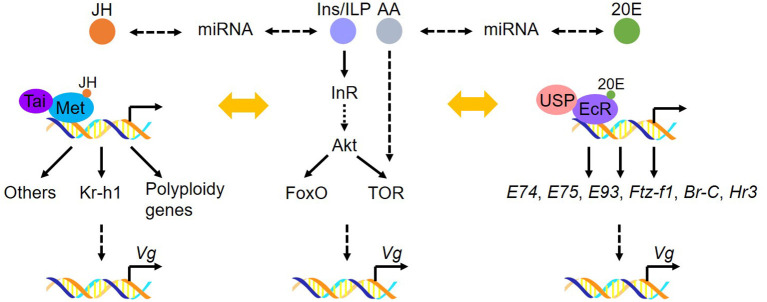
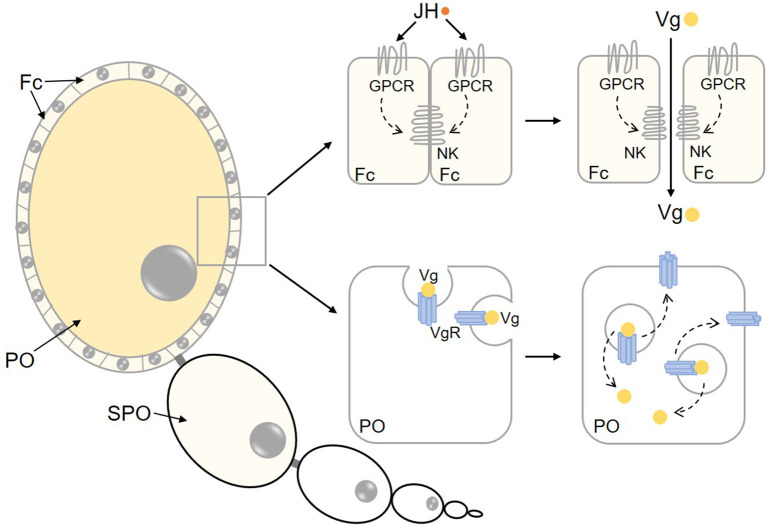
Vitellogenesis is pre-requisite to insect egg production and embryonic development after oviposition. During insect vitellogenesis, the yolk protein precursor vitellogenin (Vg) is mainly synthesized in the fat body, transported by the hemolymph through the intercellular spaces (known as patency) in the follicular epithelium to reach the membrane of maturing oocytes, and sequestered into the maturing oocytes via receptor-mediated endocytosis. Insect vitellogenesis is governed by two critical hormones, the sesquiterpenoid juvenile hormone (JH) and the ecdysteriod 20-hydroxyecdysone (20E). JH acts as the principal gonadotropic hormone to stimulate vitellogenesis in basal hemimetabolous and most holometabolous insects. 20E is critical for vitellogenesis in some hymenopterans, lepidopterans and dipterans. Furthermore, microRNA (miRNA) and nutritional (amino acid/Target of Rapamycin and insulin) pathways interplay with JH and 20E signaling cascades to control insect vitellogenesis. Revealing the regulatory mechanisms underlying insect vitellogenesis is critical for understanding insect reproduction and helpful for developing new strategies of insect pest control. Here, we outline the recent research progress in the molecular action of gonadotropic JH and 20E along with the role of miRNA and nutritional sensor in regulating insect vitellogenesis. We highlight the advancements in the regulatory mechanisms of insect vitellogenesis by the coordination of hormone, miRNA and nutritional signaling pathways.
卵黄生成是昆虫产卵及产卵后胚胎发育的前提条件。在昆虫卵黄生成过程中,卵黄蛋白前体卵黄原蛋白(Vg)主要在脂肪体中合成,通过血淋巴经卵泡上皮细胞间的间隙(称为开放期)运输,到达成熟卵母细胞的膜,并通过受体介导的内吞作用被隔离到成熟卵母细胞中。昆虫卵黄生成受两种关键激素调控,即倍半萜类保幼激素(JH)和蜕皮甾体20-羟基蜕皮酮(20E)。JH作为主要的促性腺激素,刺激基础半变态昆虫和大多数全变态昆虫的卵黄生成。20E对某些膜翅目、鳞翅目和双翅目昆虫的卵黄生成至关重要。此外,微小RNA(miRNA)和营养(氨基酸/雷帕霉素靶蛋白和胰岛素)途径与JH和20E信号级联相互作用,以控制昆虫卵黄生成。揭示昆虫卵黄生成的调控机制对于理解昆虫繁殖至关重要,并且有助于开发新的害虫防治策略。在此,我们概述了促性腺激素JH和20E的分子作用以及miRNA和营养传感器在调节昆虫卵黄生成中的作用的最新研究进展。我们强调了通过激素、miRNA和营养信号通路的协调作用在昆虫卵黄生成调控机制方面取得的进展。