Stanford University, Stanford, CA, USA.
Harvard School of Public Health, Boston, MA, USA.
J Digit Imaging. 2021 Apr;34(2):397-403. doi: 10.1007/s10278-021-00433-6. Epub 2021 Feb 25.
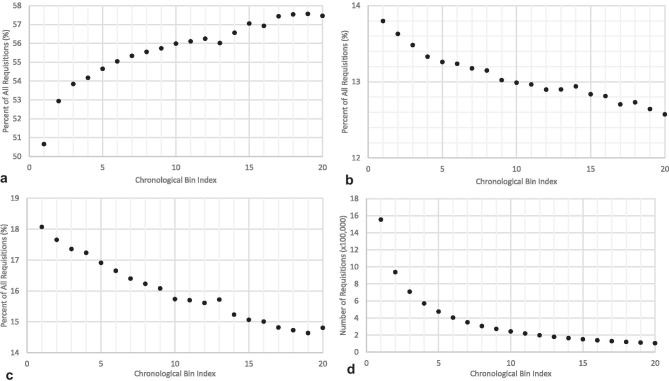
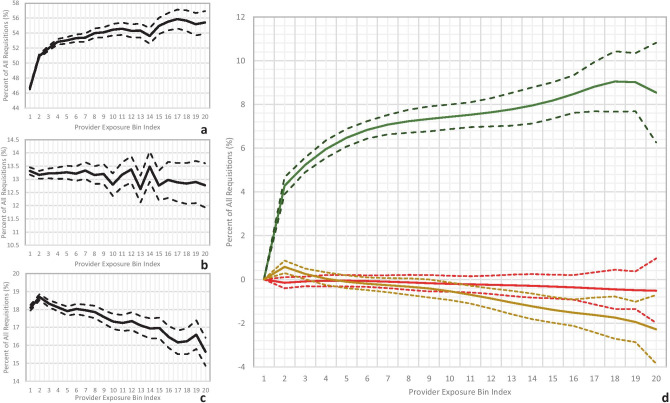
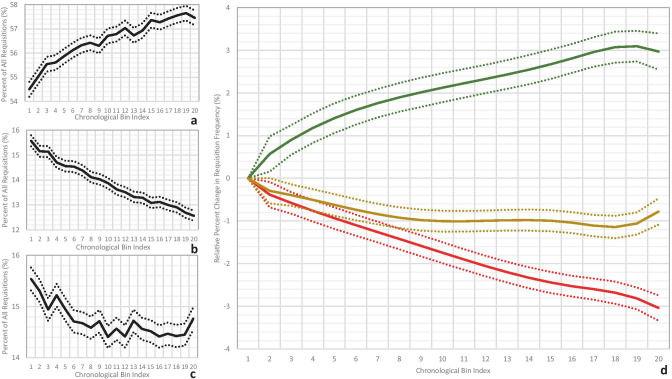
The Protecting Access to Medicare Act (PAMA) mandates clinical decision support mechanism (CDSM) consultation for all advanced imaging. There are a growing number of studies examining the association of CDSM use with imaging appropriateness, but a paucity of multicenter data. This observational study evaluates the association between changes in advanced imaging appropriateness scores with increasing provider exposure to CDSM. Each provider's first 200 consecutive anonymized requisitions for advanced imaging (CT, MRI, ultrasound, nuclear medicine) using a single CDSM (CareSelect, Change Healthcare) between January 1, 2017 and December 31, 2019 were collected from 288 US institutions. Changes in imaging requisition proportions among four appropriateness categories ("usually appropriate" [green], "may be appropriate" [yellow], "usually not appropriate" [red], and unmapped [gray]) were evaluated in relation to the chronological order of the requisition for each provider and total provider exposure to CDSM using logistic regression fits and Wald tests. The number of providers and requisitions included was 244,158 and 7,345,437, respectively. For 10,123 providers with ≥ 200 requisitions (2,024,600 total requisitions), the fraction of green, yellow, and red requisitions among the last 10 requisitions changed by +3.0% (95% confidence interval +2.6% to +3.4%), -0.8% (95% CI -0.5% to -1.1%), and -3.0% (95% CI 3.3% to -2.7%) in comparison with the first 10, respectively. Providers with > 190 requisitions had 8.5% (95% CI 6.3% to 10.7%) more green requisitions, 2.3% (0.7% to 3.9%) fewer yellow requisitions, and 0.5% (95% CI -1.0% to 2.0%) fewer red (not statistically significant) requisitions relative to providers with ≤ 10 requisitions. Increasing provider exposure to CDSM is associated with improved appropriateness scores for advanced imaging requisitions.
《保护 Medicare 法案》(PAMA)要求对所有高级影像检查使用临床决策支持机制(CDSM)进行咨询。越来越多的研究检查了 CDSM 使用与成像适宜性之间的关联,但缺乏多中心数据。这项观察性研究评估了随着提供者接触 CDSM 的增加,高级成像适宜性评分的变化与评分变化之间的关联。从 2017 年 1 月 1 日至 2019 年 12 月 31 日,从 288 家美国医疗机构收集了每位提供者的前 200 个连续匿名高级影像(CT、MRI、超声、核医学)的请求,这些请求均使用单个 CDSM(CareSelect,Change Healthcare)进行。使用逻辑回归拟合和 Wald 检验,根据每位提供者的请求顺序和提供者接触 CDSM 的总次数,评估了四个适宜性类别(“通常适宜”[绿色],“可能适宜”[黄色],“通常不适宜”[红色]和未映射[灰色])的影像请求比例的变化。对于具有≥200 个请求的 10123 名提供者(2024600 个总请求),最后 10 个请求中绿色、黄色和红色请求的分数分别增加了+3.0%(95%置信区间为+2.6%至+3.4%),-0.8%(95%CI-0.5%至-1.1%),与前 10 个相比,红色请求分别减少了-3.0%(95%置信区间为 3.3%至-2.7%)。与请求数≤10 的提供者相比,请求数>190 的提供者有 8.5%(95%置信区间为 6.3%至 10.7%)的绿色请求更多,2.3%(0.7%至 3.9%)的黄色请求更少,以及 0.5%(95%置信区间为-1.0%至 2.0%)的红色请求更少(无统计学意义)。提供者接触 CDSM 的增加与高级影像请求的适宜性评分的提高有关。