Tang Lisa Y W, Hawkins Nathaniel M, Ho Kendall, Tam Roger, Deyell Marc W, Macle Laurent, Verma Atul, Khairy Paul, Sheldon Robert, Andrade Jason G
Data Science Institute University of British Columbia Vancouver Canada.
Center for Cardiovascular Innovation Vancouver Canada.
J Am Heart Assoc. 2021 Feb;10(5):e018610. doi: 10.1161/JAHA.120.018610. Epub 2021 Feb 26.
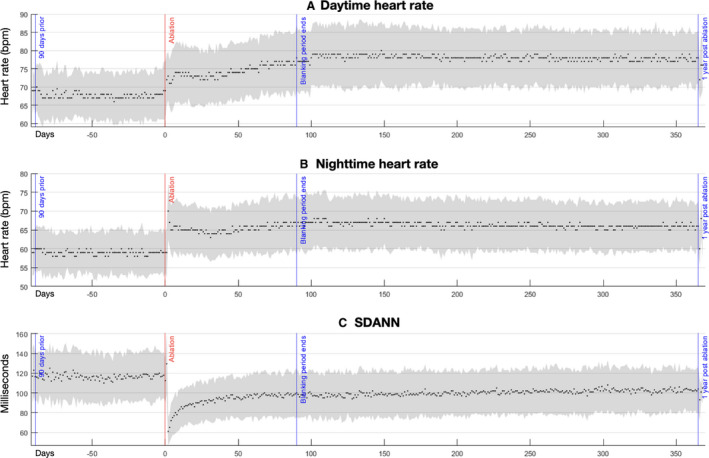
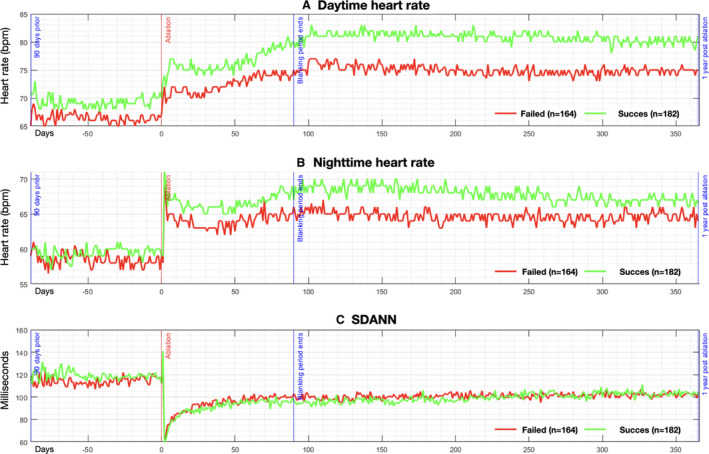
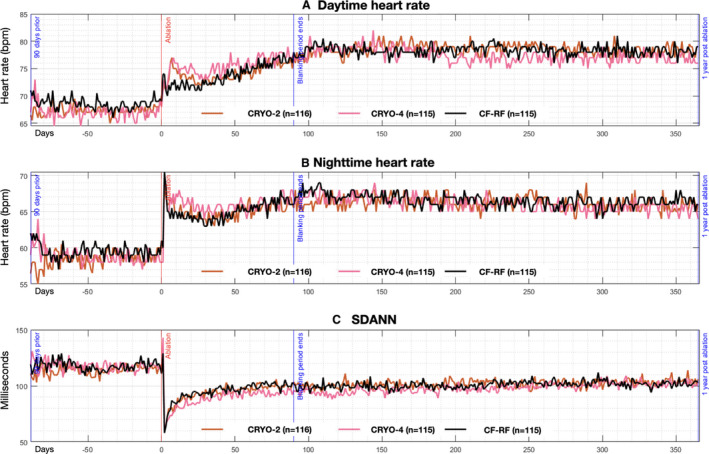
Background The natural history of autonomic alterations following catheter ablation of drug-refractory paroxysmal atrial fibrillation is poorly defined, largely because of the historical reliance on non-invasive intermittent rhythm monitoring for outcome ascertainment. Methods and Results The study included 346 patients with drug-refractory paroxysmal atrial fibrillation undergoing pulmonary vein isolation using contemporary advanced-generation ablation technologies. All patients underwent insertion of a Reveal LINQ (Medtronic) implantable cardiac monitor before ablation. The implantable cardiac monitor continuously recorded physical activity, heart rate variability (measured as the SD of the average normal-to-normal), daytime heart rate, and nighttime heart rate. Longitudinal autonomic data in the 2-month period leading up to the date of ablation were compared with the period from 91 to 365 days following ablation. Following ablation there was a significant decrease in SD of the average normal-to-normal (mean difference versus baseline of 19.3 ms; range, 12.9-25.7; <0.0001), and significant increases in daytime and nighttime heart rates (mean difference versus baseline of 9.6 bpm; range, 7.4-11.8; <0.0001, and 7.4 bpm; range, 5.4-9.3; <0.0001, respectively). Patients free of arrhythmia recurrence had significantly faster daytime (11±11 versus 8±12 bpm, =0.001) and nighttime heart rates (8±9 versus 6±8 bpm, =0.049), but no difference in SD of the average normal-to-normal (=0.09) compared with those with atrial fibrillation recurrence. Ablation technology and cryoablation duration did not influence these autonomic nervous system effects. Conclusions Pulmonary vein isolation results in significant sustained changes in the heart rate parameters related to autonomic function. These changes are correlated with procedural outcome and are independent of the ablation technology used. Registration URL: https://www.clinicaltrials.gov; Unique identifier: NCT01913522.
药物难治性阵发性心房颤动导管消融术后自主神经改变的自然病程尚不明确,主要是因为以往一直依赖非侵入性间歇性心律监测来确定预后。方法与结果:本研究纳入346例采用当代先进一代消融技术进行肺静脉隔离的药物难治性阵发性心房颤动患者。所有患者在消融术前均植入了Reveal LINQ(美敦力公司)植入式心脏监测器。该植入式心脏监测器持续记录身体活动、心率变异性(以平均正常RR间期标准差衡量)、日间心率和夜间心率。将消融术前2个月的纵向自主神经数据与消融术后91至365天的时间段进行比较。消融术后,平均正常RR间期标准差显著降低(与基线相比平均差值为19.3毫秒;范围为12.9 - 25.7;<0.0001),日间和夜间心率显著升高(与基线相比平均差值分别为9.6次/分;范围为7.4 - 11.8;<0.0001,以及7.4次/分;范围为5.4 - 9.3;<0.0001)。无心律失常复发的患者日间心率(11±11对8±12次/分,P = 0.001)和夜间心率(8±9对6±8次/分,P = 0.049)显著更快,但与有心房颤动复发的患者相比,平均正常RR间期标准差无差异(P = 0.09)。消融技术和冷冻消融持续时间并未影响这些自主神经系统效应。结论:肺静脉隔离导致与自主神经功能相关的心率参数发生显著持续变化。这些变化与手术结果相关,且独立于所使用的消融技术。注册网址:https://www.clinicaltrials.gov;唯一标识符:NCT01913522。