De Sousa Alceu Machado, Dantas Thinali Sousa, Barros Silva Paulo Goberlânio De, Martins Conceição Da Silva, Freire Gildenio Estevam, Junior Howard Lopes Ribeiro, Brito Gerly Anne De Castro, Pereira Karuza Maria Alves, Leitão Renata Ferreira De Carvalho
Department of Morphology, Faculty of Medicine, Federal University of Ceará, Fortaleza, Ceará, Brazil.
Division of Oral Pathology, Faculty of Pharmacy, Dentistry and Nursing, Federal University of Ceará, Fortaleza, Ceará, Brazil.
Asian Pac J Cancer Prev. 2021 Feb 1;22(2):633-640. doi: 10.31557/APJCP.2021.22.2.633.
Breast cancer is a disease of great concern. The prognosis of this tumor is related to its staging. Opioids are widely used to minimize pain in oncology clinics; however, the relationship between the administration of opioids and their effects on tumor cells has yet to be elucidated. Therefore, this study aimed to evaluate the immunoexpression of mu- (μ) and kappa- (κ) opioid receptors and their correlation with markers of angiogenesis, cell proliferation, and apoptosis in biopsies of breast tumors.
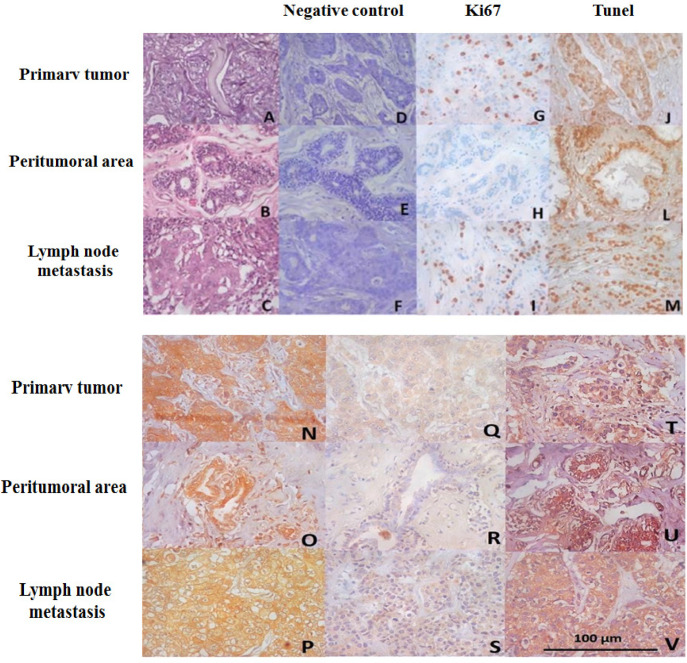
Demographic data, tumor characteristics, opioid use, and prognostic factors were collected from medical records. After the selection of the excisional biopsies, immunohistochemistry was performed for μ- and κ-opioid receptors, vascular endothelial growth factor (VEGF), Ki-67, and TUNEL.
A significant predominance of Ki-67 and μ-opioid receptor immunoexpression in the lymph nodes was observed in patients administered opioid medications. The luminal A subtype showed higher apoptosis levels (TUNEL) compared to the luminal B subtype. Patients with T4 tumor who had recurrence demonstrated a reduced expression of κ-opioid receptors at the lymph node location. Correlation analyses between the μ and κ opioid markers, VEGF, Ki-67, and TUNEL showed that these findings are likely involved in the same mechanisms the cancer of T4 stage breast cancer.
The κ-opioid receptor has a lower immunoexpression in nodal tumor metastasis with recurrence, whereas the μ-opioid receptor is directly related to expression of TUNEL-positive cells in tumors and indirectly to Ki-67 in nodal metastasis. Neither of the two receptors was expressed in the primary tumor or nodal metastasis in relation to VEGF.
乳腺癌是一种备受关注的疾病。该肿瘤的预后与其分期有关。阿片类药物在肿瘤诊所中广泛用于减轻疼痛;然而,阿片类药物的使用与其对肿瘤细胞的影响之间的关系尚未阐明。因此,本研究旨在评估乳腺肿瘤活检中μ-(μ)和κ-(κ)阿片受体的免疫表达及其与血管生成、细胞增殖和凋亡标志物的相关性。
从病历中收集人口统计学数据、肿瘤特征、阿片类药物使用情况和预后因素。在选择切除活检后,对μ-和κ-阿片受体、血管内皮生长因子(VEGF)、Ki-67和TUNEL进行免疫组织化学检测。
在接受阿片类药物治疗的患者中,观察到淋巴结中Ki-67和μ-阿片受体免疫表达显著占优势。与管腔B亚型相比,管腔A亚型显示出更高的凋亡水平(TUNEL)。发生复发的T4期肿瘤患者在淋巴结部位κ-阿片受体表达降低。μ和κ阿片标志物、VEGF与Ki-67和TUNEL之间的相关性分析表明,这些发现可能与T4期乳腺癌的相同机制有关。
κ-阿片受体在伴有复发的淋巴结肿瘤转移中免疫表达较低,而μ-阿片受体与肿瘤中TUNEL阳性细胞的表达直接相关,与淋巴结转移中的Ki-67间接相关。两种受体在原发性肿瘤或淋巴结转移中均未发现与VEGF相关的表达。