Szarka Gergely, Balogh Márton, Tengölics Ádám J, Ganczer Alma, Völgyi Béla, Kovács-Öller Tamás
János Szentágothai Research Centre, University of Pécs, Pécs; Retinal Electrical Synapses Research Group, National Brain Research Program (NAP 2.0), Hungarian Academy of Sciences, Budapest; Department of Experimental Zoology and Neurobiology, University of Pécs, Pécs, Hungary.
János Szentágothai Research Centre, University of Pécs, Pécs; Retinal Electrical Synapses Research Group, National Brain Research Program (NAP 2.0), Hungarian Academy of Sciences, Budapest; Department of Experimental Zoology and Neurobiology; Medical School, University of Pécs, Pécs, Hungary.
Neural Regen Res. 2021 Oct;16(10):1911-1920. doi: 10.4103/1673-5374.308069.
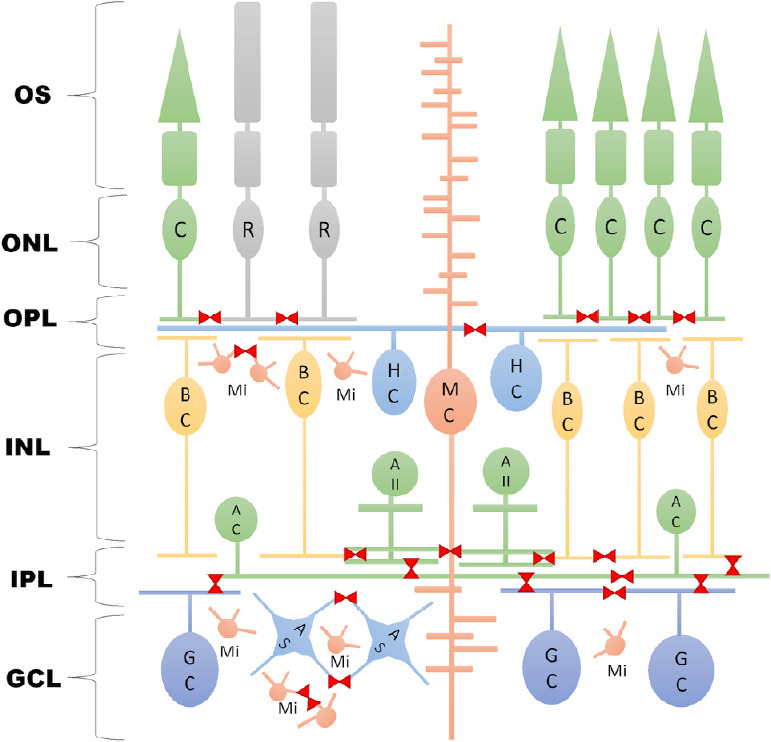
Vision altering diseases, such as glaucoma, diabetic retinopathy, age-related macular degeneration, myopia, retinal vascular disease, traumatic brain injuries and others cripple many lives and are projected to continue to cause anguish in the foreseeable future. Gap junctions serve as an emerging target for neuromodulation and possible regeneration as they directly connect healthy and/or diseased cells, thereby playing a crucial role in pathophysiology. Since they are permeable for macromolecules, able to cross the cellular barriers, they show duality in illness as a cause and as a therapeutic target. In this review, we take recent advancements in gap junction neuromodulation (pharmacological blockade, gene therapy, electrical and light stimulation) into account, to show the gap junction's role in neuronal cell death and the possible routes of rescuing neuronal and glial cells in the retina succeeding illness or injury.
视力改变性疾病,如青光眼、糖尿病视网膜病变、年龄相关性黄斑变性、近视、视网膜血管疾病、创伤性脑损伤等,使许多人的生活陷入困境,并且预计在可预见的未来仍将继续造成痛苦。间隙连接作为神经调节和可能的再生的新兴靶点,因为它们直接连接健康和/或患病细胞,从而在病理生理学中发挥关键作用。由于它们对大分子具有通透性,能够穿过细胞屏障,因此在疾病中既作为病因又作为治疗靶点表现出双重性。在本综述中,我们考虑了间隙连接神经调节(药物阻断、基因治疗、电刺激和光刺激)的最新进展,以展示间隙连接在神经元细胞死亡中的作用以及在视网膜疾病或损伤后拯救神经元和神经胶质细胞的可能途径。