Department of Urology and Renal Transplantation, Yokohama City University Medical Center, 4-57 Ufafune-cho Minami-ku, Yokohama, Kanagawa, 232-0024, Japan.
Department of Urology, Yokohama City University Graduate School of Medicine, 3-9 Fukuura Kanazawa-ku, Yokohama, Kanagawa, 236-0004, Japan.
World J Urol. 2021 Sep;39(9):3323-3328. doi: 10.1007/s00345-021-03639-z. Epub 2021 Mar 1.
We evaluated the predictive factors for completion of all six cycles of radium-223 (Ra-223) treatment in patients with metastatic castration-resistant prostate cancer (mCRPC). We also developed a novel prediction model for Ra-223 treatment completion using these predictors.
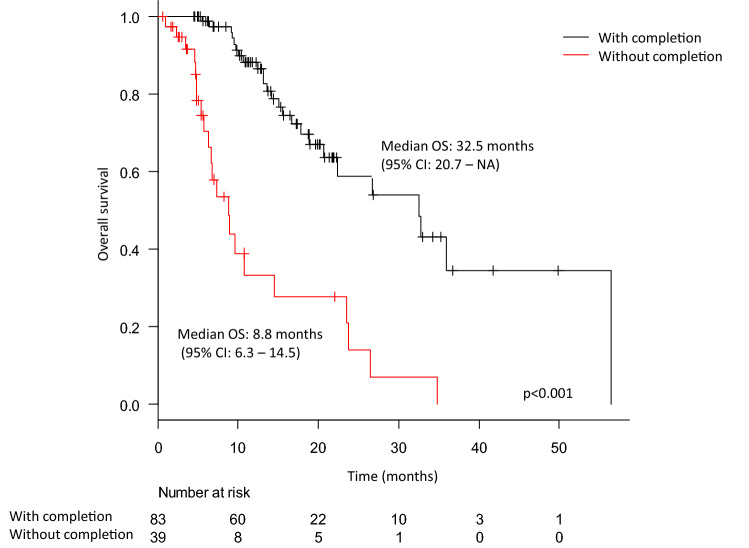
We retrospectively reviewed data from 122 patients with mCRPC who were treated with Ra-223. The predictive factors for the completion of six cycles of Ra-223 treatment were evaluated. Statistically significant predictive factors were then used to develop a prediction model for treatment completion. Finally, using this prediction model, we classified the overall survival (OS) of the entire cohort into three groups.
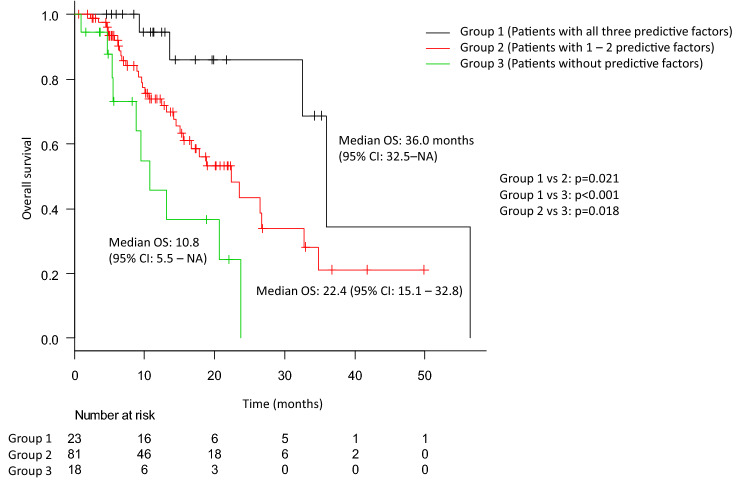
We identified three significant variables as the predictive factors for treatment completion: baseline alkaline phosphatase (ALP) level, baseline hemoglobin (Hb) level, and baseline pain. The three groups generated using the prediction model were: group 1 (patients with three predictive factors, i.e., ALP < median, Hb ≥ median, and no pain), group 2 (patients with one to two predictive factors), and group 3 (patients without any predictive factors). The treatment completion rates differed between the three groups significantly. Furthermore, the OS also differed among the groups significantly.
Our study suggested that the baseline ALP level, baseline Hb level, and baseline pain were the predictive factors of completion of all six cycles of Ra-223 treatment in patients with mCRPC. Our prediction model consisting of these factors could predict not only the completion of Ra-223 treatment, but also the post-treatment survival. This model can thus be useful for selection of patients for Ra-223 treatment.
我们评估了转移性去势抵抗性前列腺癌(mCRPC)患者完成镭-223(Ra-223)治疗所有六周期的预测因素。我们还使用这些预测因素开发了一种新的 Ra-223 治疗完成预测模型。
我们回顾性分析了 122 例接受 Ra-223 治疗的 mCRPC 患者的数据。评估了完成六个周期 Ra-223 治疗的预测因素。然后使用统计学上显著的预测因素来开发治疗完成预测模型。最后,使用该预测模型,我们将整个队列的总生存期(OS)分为三组。
我们确定了三个显著变量作为治疗完成的预测因素:基线碱性磷酸酶(ALP)水平、基线血红蛋白(Hb)水平和基线疼痛。使用预测模型生成的三组分别为:组 1(三个预测因素均满足的患者,即 ALP<中位数、Hb≥中位数且无疼痛)、组 2(存在一到两个预测因素的患者)和组 3(没有任何预测因素的患者)。三组之间的治疗完成率差异显著。此外,各组之间的 OS 也存在显著差异。
我们的研究表明,基线 ALP 水平、基线 Hb 水平和基线疼痛是 mCRPC 患者完成所有六周期 Ra-223 治疗的预测因素。由这些因素组成的预测模型不仅可以预测 Ra-223 治疗的完成情况,还可以预测治疗后的生存情况。因此,该模型可用于选择接受 Ra-223 治疗的患者。