Department of Clinical Science and Services, Royal Veterinary College, University of London, London, UK.
CVCA Cardiac Care for Pets, Towson, Maryland, USA.
J Vet Intern Med. 2021 Mar;35(2):755-770. doi: 10.1111/jvim.16083. Epub 2021 Mar 1.
Treatment is indicated in dogs with preclinical degenerative mitral valve disease (DMVD) and cardiomegaly (stage B2). This is best diagnosed using echocardiography; however, relying upon this limits access to accurate diagnosis.
To evaluate whether cardiac biomarker concentrations can be used alongside other clinical data to identify stage B2 dogs.
Client-owned dogs (n = 1887) with preclinical DMVD prospectively sampled in Germany, the United Kingdom, and the United States.
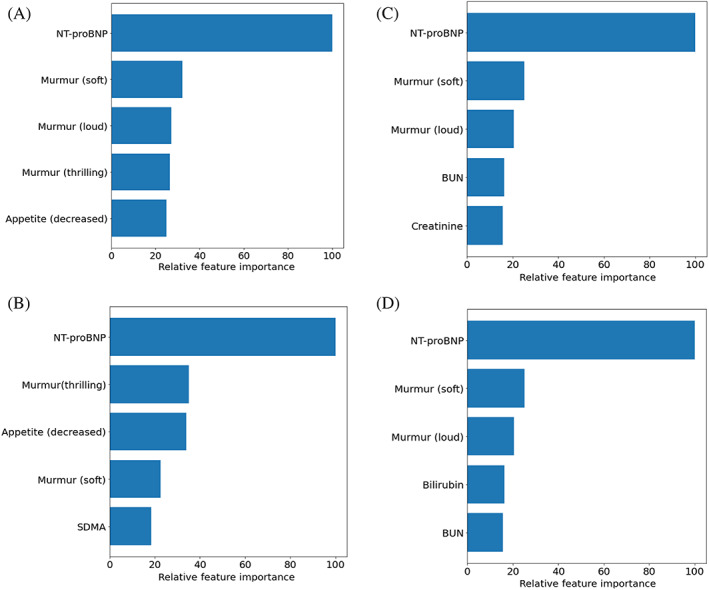
Dogs that met inclusion criteria and were not receiving pimobendan (n = 1245) were used for model development. Explanatory (multivariable logistic regression) and predictive models were developed using clinical observations, biochemistry, and cardiac biomarker concentrations, with echocardiographically confirmed stage B2 disease as the outcome. Receiver operating characteristic curves assessed the ability to identify stage B2 dogs.
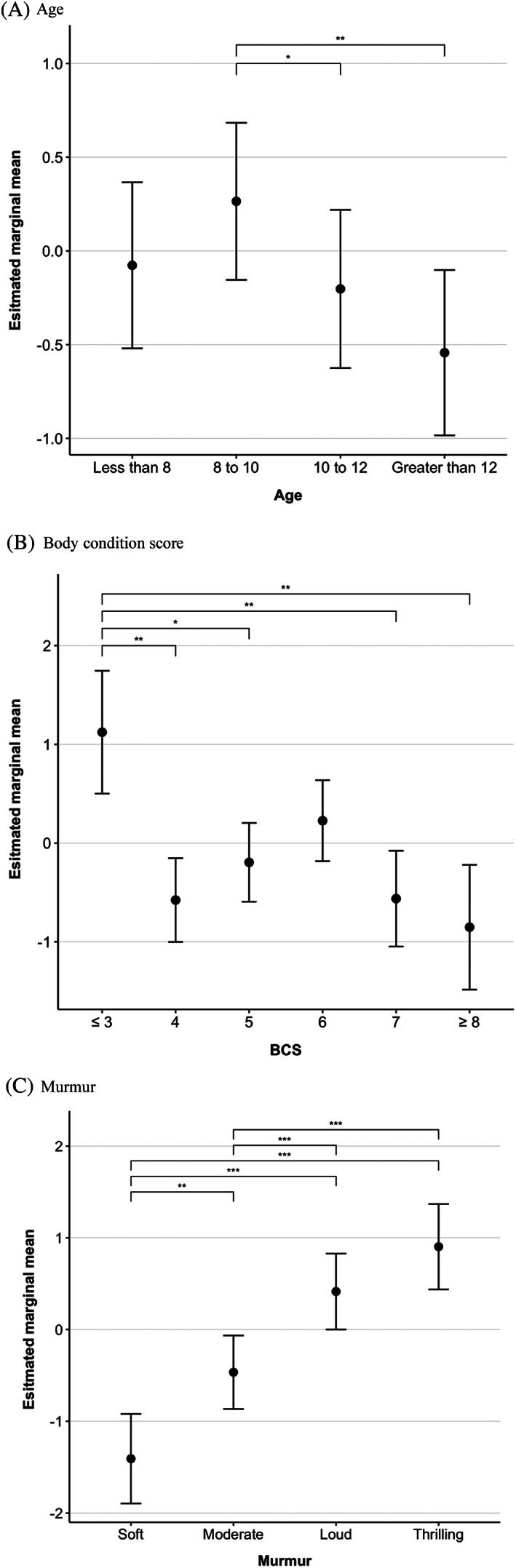
Age, appetite, serum alanine aminotransferase activity, body condition, serum creatinine concentration, murmur intensity, and plasma N-terminal propeptide of B-type natriuretic peptide (NT-proBNP) concentration were independently associated with the likelihood of being stage B2. The discriminatory ability of this explanatory model (area under curve [AUC], 0.84; 95% confidence interval [CI], 0.82-0.87) was superior to NT-proBNP (AUC, 0.77; 95% CI, 0.74-0.80) or the vertebral heart score alone (AUC, 0.76; 95% CI, 0.69-0.83). A predictive logistic regression model could identify the probability of being stage B2 (AUC test set, 0.86; 95% CI, 0.81-0.91).
Our findings indicate accessible measurements could be used to screen dogs with preclinical DMVD. Encouraging at-risk dogs to seek further evaluation could result in a greater proportion of cases being appropriately managed.
对于患有临床前退行性二尖瓣瓣膜病(DMVD)和心脏扩大(B2 期)的犬,建议进行治疗。使用超声心动图可对此做出最佳诊断;然而,仅依赖超声心动图会限制准确诊断的机会。
评估心脏生物标志物浓度是否可与其他临床数据结合使用,以识别 B2 期犬。
在德国、英国和美国进行前瞻性采样的患有临床前 DMVD 的客户拥有的犬(n=1887)。
符合纳入标准且未接受匹莫苯丹治疗的犬(n=1245)用于模型开发。使用临床观察、生化和心脏生物标志物浓度进行解释性(多变量逻辑回归)和预测性模型开发,将超声心动图确认的 B2 期疾病作为结局。接受者操作特征曲线评估识别 B2 期犬的能力。
年龄、食欲、血清丙氨酸氨基转移酶活性、身体状况、血清肌酐浓度、杂音强度和血浆 N 末端脑利钠肽前体(NT-proBNP)浓度与处于 B2 期的可能性独立相关。该解释性模型的判别能力(曲线下面积[AUC],0.84;95%置信区间[CI],0.82-0.87)优于 NT-proBNP(AUC,0.77;95% CI,0.74-0.80)或单独的椎体心脏评分(AUC,0.76;95% CI,0.69-0.83)。预测性逻辑回归模型可以识别处于 B2 期的概率(测试集 AUC,0.86;95% CI,0.81-0.91)。
我们的研究结果表明,可获取的测量值可用于筛查患有临床前 DMVD 的犬。鼓励处于风险中的犬进行进一步评估可能会使更多的病例得到适当的管理。