Centre for Neuroscience and Cell Biology (CNC), University of Coimbra, Rua Larga, Pólo I, Coimbra 3004-504, Portugal; Centre for Innovation in Biomedicine and Biotechnology (CIBB), University of Coimbra, Portugal; PhD Programme in Experimental Biology and Biomedicine (PDBEB), Institute for Interdisciplinary Research (IIIUC), University of Coimbra, Coimbra, Portugal.
Institute for Theoretical Biology (ITB), Charité-Universitätsmedizin Berlin, corporate member of Freie Universität Berlin, Humboldt-Universität zu Berlin, and Berlin Institute of Health, Berlin 10117, Germany; Molecular Cancer Research Center (MKFZ), Medical Department of Hematology, Oncology, and Tumour Immunology, Charité-Universitätsmedizin Berlin, Corporate Member of Freie Universität Berlin, Humboldt-Universität zu Berlin, and Berlin Institute of Health, Berlin 10117, Germany; Department of Human Medicine, Institute for Systems Medicine and Bioinformatics, MSH Medical School Hamburg-University of Applied Sciences and Medical University, Am Kaiserkai 1, Hamburg 20457, Germany.
EBioMedicine. 2021 Mar;65:103248. doi: 10.1016/j.ebiom.2021.103248. Epub 2021 Feb 26.
Obstructive Sleep Apnea (OSA) is a highly prevalent and underdiagnosed sleep disorder. Recent studies suggest that OSA might disrupt the biological clock, potentially causing or worsening OSA-associated comorbidities. However, the effect of OSA treatment on clock disruption is not fully understood.
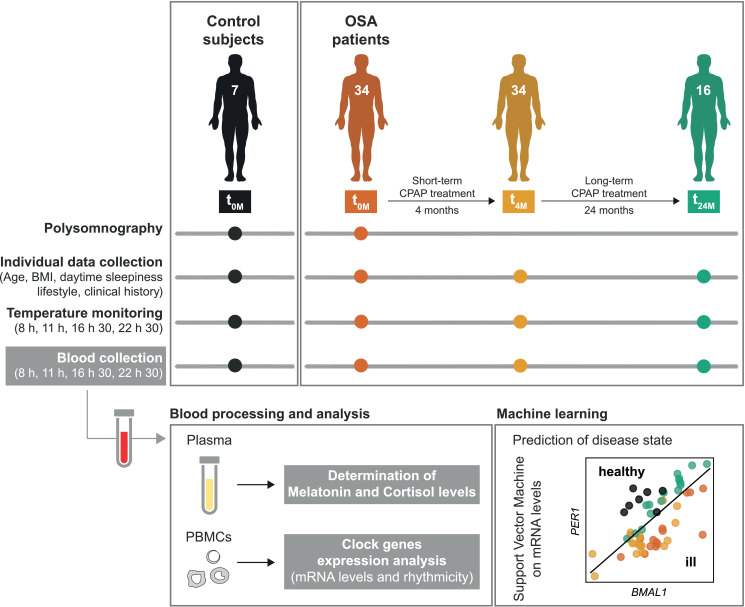
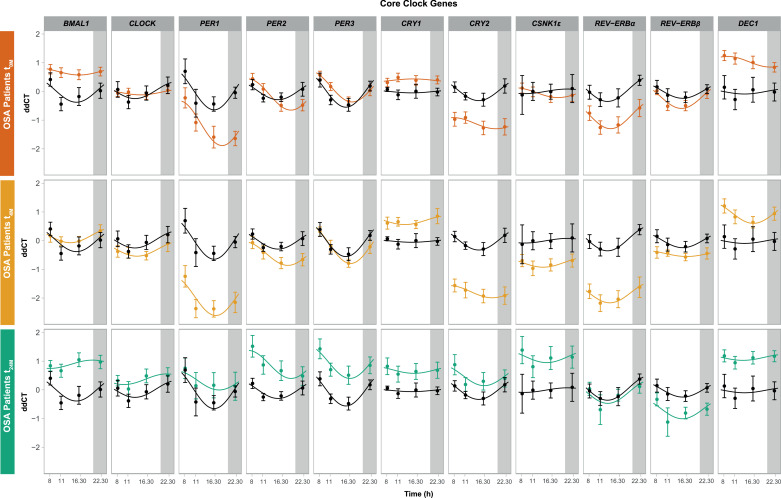
The impact of OSA and short- (four months) and long-term (two years) OSA treatment, with Continuous Positive Airway Pressure (CPAP), on the biological clock was investigated at four time points within 24 h, in OSA patients relative to controls subjects (no OSA) of the same sex and age group, in a case-control study. Plasma melatonin and cortisol, body temperature and the expression levels and rhythmicity of eleven clock genes in peripheral blood mononuclear cells (PBMCs) were assessed. Additional computational tools were used for a detailed data analysis.
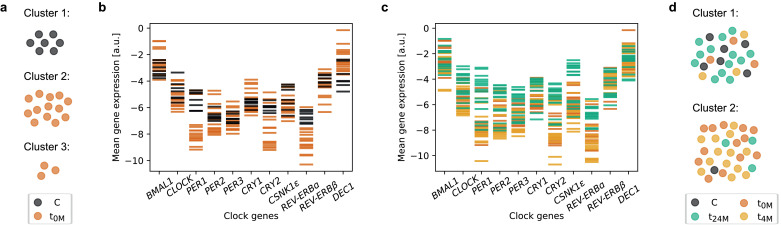
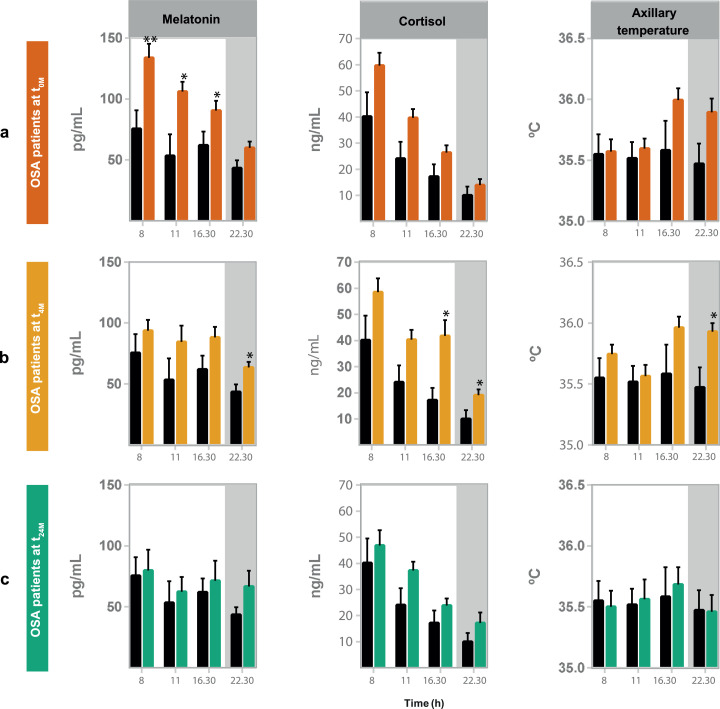
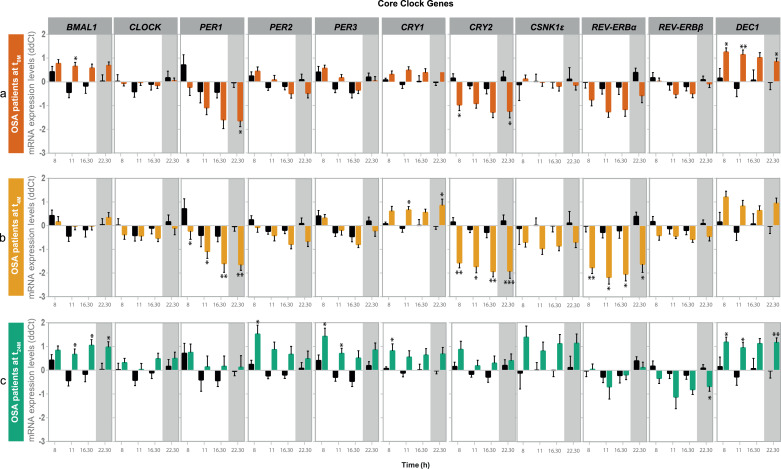
OSA impacts on clock outputs and on the expression of several clock genes in PBMCs. Neither short- nor long-term treatment fully reverted OSA-induced alterations in the expression of clock genes. However, long-term treatment was able to re-establish levels of plasma melatonin and cortisol and body temperature. Machine learning methods could discriminate controls from untreated OSA patients. Following long-term treatment, the distinction between controls and patients disappeared, suggesting a closer similarity of the phenotypes.
OSA alters biological clock-related characteristics that differentially respond to short- and long-term CPAP treatment. Long-term CPAP was more efficient in counteracting OSA impact on the clock, but the obtained results suggest that it is not fully effective. A better understanding of the impact of OSA and OSA treatment on the clock may open new avenues to OSA diagnosis, monitoring and treatment.
阻塞性睡眠呼吸暂停(OSA)是一种高发且未被充分诊断的睡眠障碍。最近的研究表明,OSA 可能会扰乱生物钟,从而导致或加重与 OSA 相关的合并症。然而,OSA 治疗对时钟紊乱的影响尚不完全清楚。
在一项病例对照研究中,我们在 24 小时内的四个时间点,对 OSA 患者(与同性别和年龄组的对照组相比)进行了 OSA 及短期(四个月)和长期(两年)持续气道正压通气(CPAP)治疗对生物钟的影响研究。评估了外周血单核细胞(PBMCs)中血浆褪黑素和皮质醇、体温以及 11 个时钟基因的表达水平和节律性。使用额外的计算工具进行了详细的数据分析。
OSA 影响时钟输出和 PBMCs 中几个时钟基因的表达。短期和长期治疗均未完全逆转 OSA 诱导的时钟基因表达改变。然而,长期治疗能够恢复血浆褪黑素和皮质醇以及体温水平。机器学习方法可以区分对照组和未经治疗的 OSA 患者。经过长期治疗后,对照组和患者之间的区别消失,表明表型更相似。
OSA 改变了生物钟相关特征,对短期和长期 CPAP 治疗的反应不同。长期 CPAP 更有效地对抗 OSA 对生物钟的影响,但结果表明它并非完全有效。更好地了解 OSA 和 OSA 治疗对生物钟的影响可能为 OSA 的诊断、监测和治疗开辟新途径。