Donders Center for Brain, Cognition and Behavior, Radboud University Nijmegen, Nijmegen, The Netherlands.
Department for Cognitive Neuroscience, Radboud University Medical Center Nijmegen, Nijmegen, The Netherlands.
Mol Autism. 2021 Mar 1;12(1):19. doi: 10.1186/s13229-021-00415-z.
Marked sex differences in autism prevalence accentuate the need to understand the role of biological sex-related factors in autism. Efforts to unravel sex differences in the brain organization of autism have, however, been challenged by the limited availability of female data.
We addressed this gap by using a large sample of males and females with autism and neurotypical (NT) control individuals (ABIDE; Autism: 362 males, 82 females; NT: 409 males, 166 females; 7-18 years). Discovery analyses examined main effects of diagnosis, sex and their interaction across five resting-state fMRI (R-fMRI) metrics (voxel-level Z > 3.1, cluster-level P < 0.01, gaussian random field corrected). Secondary analyses assessed the robustness of the results to different pre-processing approaches and their replicability in two independent samples: the EU-AIMS Longitudinal European Autism Project (LEAP) and the Gender Explorations of Neurogenetics and Development to Advance Autism Research.
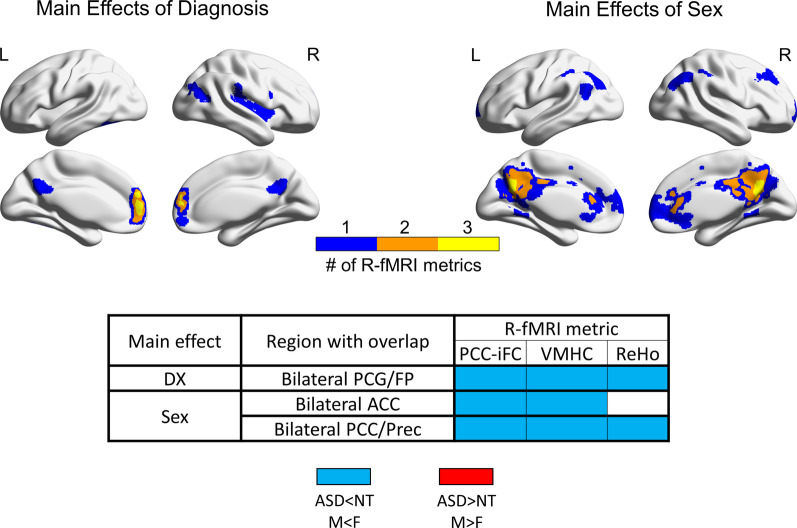
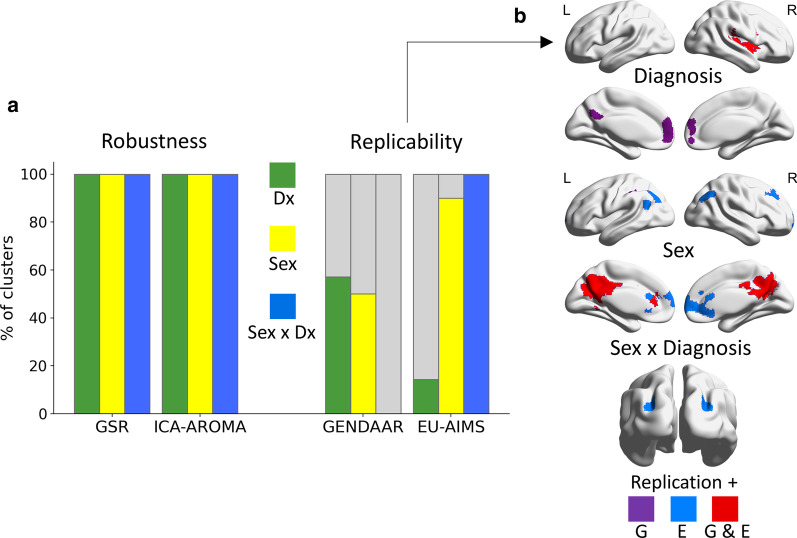
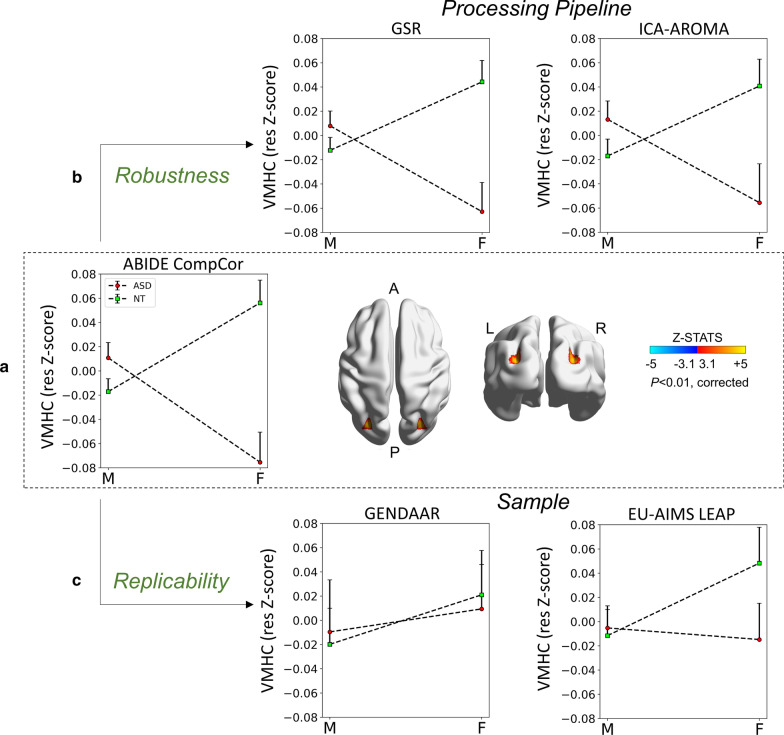
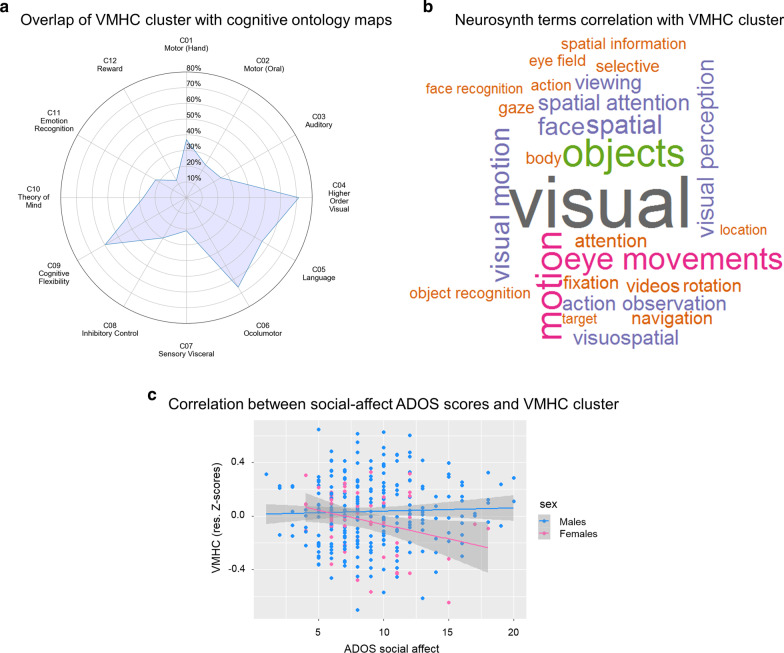
Discovery analyses in ABIDE revealed significant main effects of diagnosis and sex across the intrinsic functional connectivity of the posterior cingulate cortex, regional homogeneity and voxel-mirrored homotopic connectivity (VMHC) in several cortical regions, largely converging in the default network midline. Sex-by-diagnosis interactions were confined to the dorsolateral occipital cortex, with reduced VMHC in females with autism. All findings were robust to different pre-processing steps. Replicability in independent samples varied by R-fMRI measures and effects with the targeted sex-by-diagnosis interaction being replicated in the larger of the two replication samples-EU-AIMS LEAP.
Given the lack of a priori harmonization among the discovery and replication datasets available to date, sample-related variation remained and may have affected replicability.
Atypical cross-hemispheric interactions are neurobiologically relevant to autism. They likely result from the combination of sex-dependent and sex-independent factors with a differential effect across functional cortical networks. Systematic assessments of the factors contributing to replicability are needed and necessitate coordinated large-scale data collection across studies.
自闭症患病率存在明显的性别差异,这凸显了了解与生物性别相关因素在自闭症中的作用的必要性。然而,由于女性数据的缺乏,人们在揭示自闭症大脑组织结构中的性别差异方面遇到了挑战。
我们通过使用大量自闭症和神经典型(NT)对照个体的男性和女性样本(ABIDE;自闭症:362 名男性,82 名女性;NT:409 名男性,166 名女性;7-18 岁)来解决这一差距。发现分析检查了诊断、性别及其相互作用对五个静息态 fMRI(R-fMRI)指标的主要影响(体素水平 Z>3.1,簇水平 P<0.01,高斯随机场校正)。二次分析评估了结果对不同预处理方法的稳健性及其在两个独立样本中的可重复性:欧盟-目标纵向欧洲自闭症项目(LEAP)和性别探索神经遗传学和发展以推进自闭症研究。
ABIDE 的发现分析显示,在几个皮质区域的后扣带回皮质的内在功能连接、局部一致性和体素镜像同伦连接(VMHC)中,诊断和性别都有显著的主要影响,这些影响主要集中在默认网络中线。性别与诊断的相互作用仅限于背外侧枕叶皮质,自闭症女性的 VMHC 减少。所有发现都对不同的预处理步骤具有稳健性。在独立样本中的可重复性因 R-fMRI 测量和效应而异,目标性别与诊断的相互作用在较大的两个复制样本之一的欧盟-目标 LEAP 中得到了复制。
鉴于迄今为止可用的发现和复制数据集缺乏先验的协调,样本相关的变异仍然存在,并且可能影响了可重复性。
跨半球的异常相互作用与自闭症有关。它们可能是由依赖于性别的因素和独立于性别的因素共同作用的结果,对功能皮质网络有不同的影响。需要对影响可重复性的因素进行系统评估,这需要在研究之间进行协调的大规模数据收集。