Peking University People's Hospital, Peking University Institute of Hematology, National Clinical Research Center for Hematologic Disease, No. 11 Xizhimen South Street, Xicheng District, Beijing, 100044, China.
Sci Rep. 2021 Mar 1;11(1):4856. doi: 10.1038/s41598-021-84190-0.
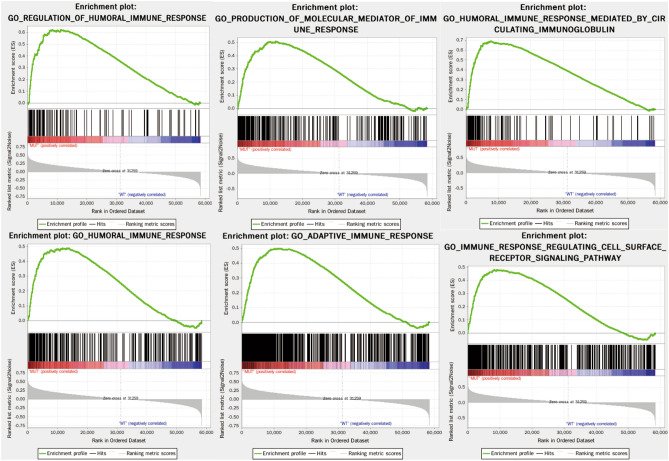
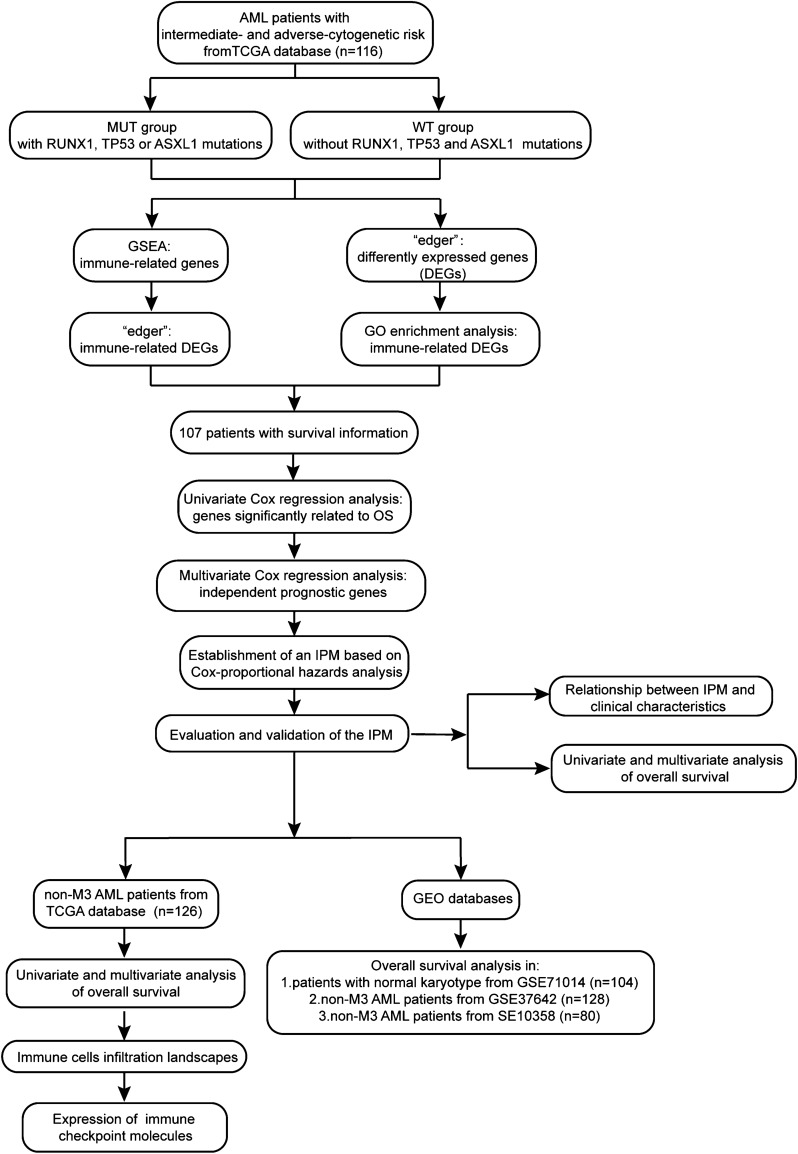
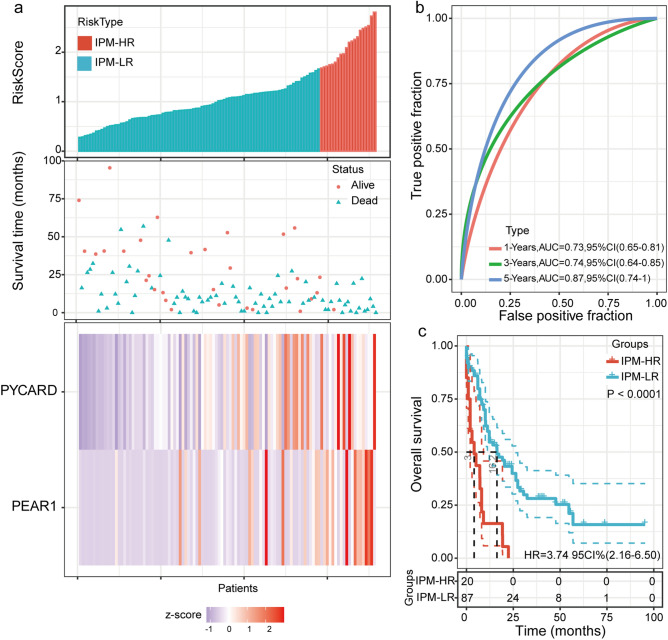
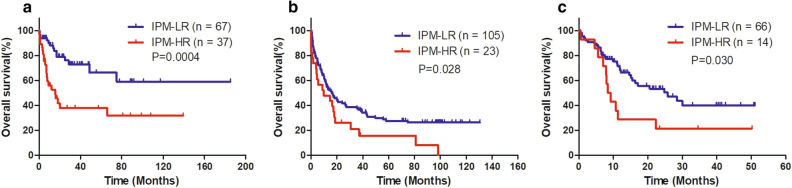
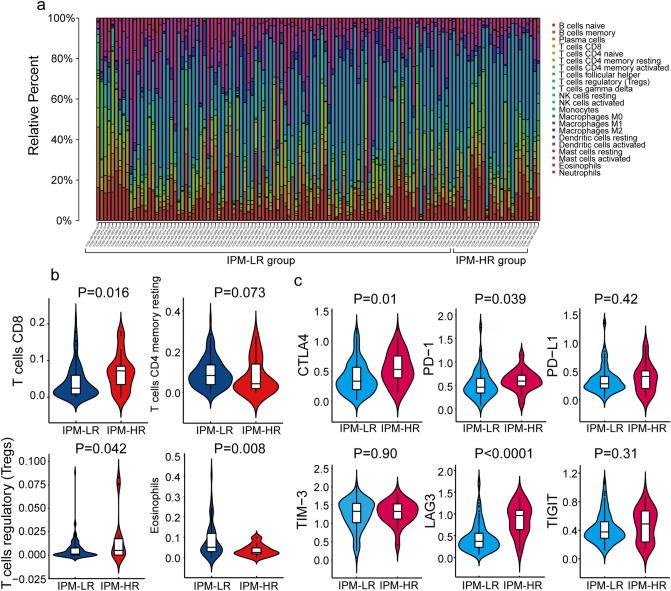
Leukemia cell-intrinsic somatic mutations and cytogenetic abnormalities have been used to define risk categories in acute myeloid leukemia (AML). In addition, since the immune microenvironment might influence prognosis and somatic mutations have been demonstrated to modulate the immune microenvironment in AML, there is need for developing and evaluating an immune prognostic model (IPM) derived from mutations associated with poor prognosis. Based on AML cases with intermediate and adverse-cytogenetic risk in the Cancer Genome Atlas (TCGA) database, 64 immune-related differentially expressed genes (DEGs) among patients with RUNX1, TP53, or ASXL1 mutations and patients without these mutations were identified. After Cox proportional hazards analysis, an IPM composed of PYCARD and PEAR1 genes was constructed. IPM defined high-risk (IPM-HR) independently predicted lower 2-year overall survival (OS) rates in both patients with intermediate and adverse-cytogenetic risks and non-M3 patients in the TCGA AML cohort. The poor prognostic impact of IPM-HR on OS was further validated by GSE71014, 37642, and 10358 downloaded from the Gene Expression Omnibus (GEO) database. Furthermore, IPM-HR was remarkably associated with higher proportions of CD8+ T cells and regulatory T cells (Tregs), lower proportions of eosinophils, and higher expression of the checkpoint molecules CTLA-4, PD-1, and LAG3 in the TCGA non-M3 AML cohort. In summary, we developed and validated an IPM derived from mutations related with poor prognosis in AML, which would provide new biomarkers for patient stratification and personalized immunotherapy.
白血病细胞内在的体细胞突变和细胞遗传学异常已被用于定义急性髓细胞白血病 (AML) 的风险类别。此外,由于免疫微环境可能影响预后,并且已经证明体细胞突变可以调节 AML 中的免疫微环境,因此需要开发和评估源自与预后不良相关的突变的免疫预后模型 (IPM)。基于癌症基因组图谱 (TCGA) 数据库中具有中间和不良细胞遗传学风险的 AML 病例,鉴定了 RUNX1、TP53 或 ASXL1 突变患者和无这些突变患者之间的 64 个免疫相关差异表达基因 (DEG)。经过 Cox 比例风险分析,构建了由 PYCARD 和 PEAR1 基因组成的 IPM。IPM-HR 独立预测 TCGA AML 队列中具有中间和不良细胞遗传学风险的患者和非 M3 患者的 2 年总生存率 (OS) 较低,该模型定义了高危 (IPM-HR)。通过从基因表达综合数据库 (GEO) 下载的 GSE71014、37642 和 10358 进一步验证了 IPM-HR 对 OS 的不良预后影响。此外,在 TCGA 非 M3 AML 队列中,IPM-HR 与 CD8+T 细胞和调节性 T 细胞 (Tregs) 的比例较高、嗜酸性粒细胞的比例较低以及检查点分子 CTLA-4、PD-1 和 LAG3 的表达较高显著相关。总之,我们开发并验证了源自 AML 中与预后不良相关的突变的 IPM,这将为患者分层和个性化免疫治疗提供新的生物标志物。