Hospices Civils de Lyon, Lyon Sud Hospital, 165 Chemin du Grand Revoyet, 69310, Pierre-Bénite, France.
CHU Dijon, 10 Boulevard Maréchal De Lattre De Tassigny, 21000, Dijon, France.
BMC Public Health. 2021 Mar 2;21(1):432. doi: 10.1186/s12889-021-10433-4.
Age-adjusted lymphoma incidence rates continue to rise in France since the early 80's, although rates have slowed since 2010 and vary across subtypes. Recent improvements in patient survival in major lymphoma subtypes at population level raise new questions about patient outcomes (i.e. quality of life, long-term sequelae). Epidemiological studies have investigated factors related to lymphoma risk, but few have addressed the extent to which socioeconomic status, social institutional context (i.e. healthcare system), social relationships, environmental context (exposures), individual behaviours (lifestyle) or genetic determinants influence lymphoma outcomes, especially in the general population. Moreover, the knowledge of the disease behaviour mainly obtained from clinical trials data is partly biased because of patient selection.
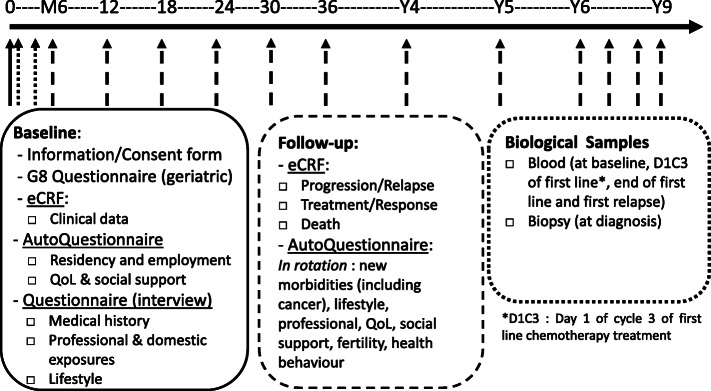
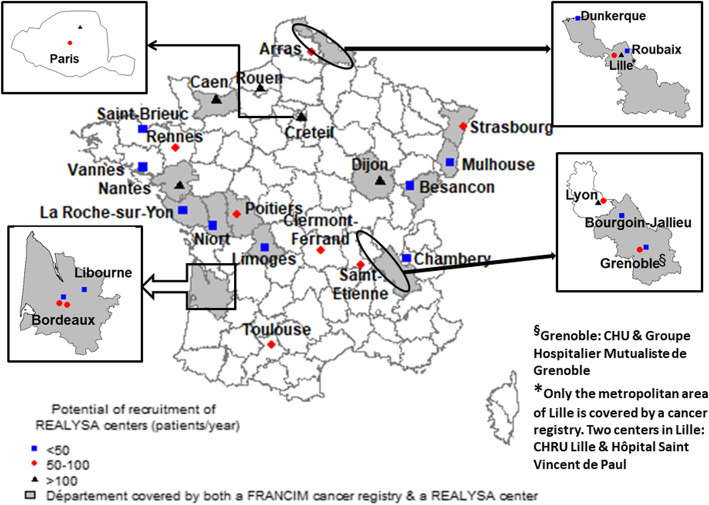
The REALYSA ("REal world dAta in LYmphoma and Survival in Adults") study is a real-life multicentric cohort set up in French areas covered by population-based cancer registries to study the prognostic value of epidemiological, clinical and biological factors with a prospective 9-year follow-up. We aim to include 6000 patients over 4 to 5 years. Adult patients without lymphoma history and newly diagnosed with one of the following 7 lymphoma subtypes (diffuse large B-cell, follicular, marginal zone, mantle cell, Burkitt, Hodgkin, mature T-cell) are invited to participate during a medical consultation with their hematologist. Exclusion criteria are: having already received anti-lymphoma treatment (except pre-phase) and having a documented HIV infection. Patients are treated according to the standard practice in their center. Clinical data, including treatment received, are extracted from patients' medical records. Patients' risk factors exposures and other epidemiological data are obtained at baseline by filling out a questionnaire during an interview led by a clinical research assistant. Biological samples are collected at baseline and during treatment. A virtual tumor biobank is constituted for baseline tumor samples. Follow-up data, both clinical and epidemiological, are collected every 6 months in the first 3 years and every year thereafter.
This cohort constitutes an innovative platform for clinical, biological, epidemiological and socio-economic research projects and provides an opportunity to improve knowledge on factors associated to outcome of lymphoma patients in real life.
2018-A01332-53, ClinicalTrials.gov identifier: NCT03869619 .
自 80 年代初以来,法国的年龄调整淋巴瘤发病率持续上升,尽管自 2010 年以来发病率有所放缓,并且在不同亚型之间存在差异。主要淋巴瘤亚型在人群水平上的患者生存率的最近提高引发了关于患者结局(即生活质量、长期后遗症)的新问题。流行病学研究已经调查了与淋巴瘤风险相关的因素,但很少有研究涉及社会经济地位、社会制度背景(即医疗保健系统)、社会关系、环境背景(暴露)、个人行为(生活方式)或遗传决定因素对淋巴瘤结局的影响,特别是在一般人群中。此外,主要从临床试验数据中获得的疾病行为知识部分存在偏倚,因为患者选择。
REALYSA(“成人淋巴瘤真实世界数据和生存研究”)是一项真实世界的多中心队列研究,在覆盖人群癌症登记处的法国地区设立,旨在前瞻性随访 9 年,研究流行病学、临床和生物学因素的预后价值。我们的目标是在 4 到 5 年内纳入 6000 名患者。无淋巴瘤病史且新诊断为以下 7 种淋巴瘤亚型之一的成年患者(弥漫性大 B 细胞、滤泡性、边缘区、套细胞、伯基特、霍奇金、成熟 T 细胞)在与血液科医生进行医学咨询时被邀请参加。排除标准是:已经接受过抗淋巴瘤治疗(除预治疗外)和有记录的 HIV 感染。患者根据其中心的标准治疗进行治疗。临床数据,包括接受的治疗,从患者的病历中提取。患者的危险因素暴露和其他流行病学数据在基线时通过临床研究助理主导的访谈填写问卷获得。基线时和治疗期间收集生物样本。为基线肿瘤样本建立虚拟肿瘤生物库。在最初的 3 年内,每 6 个月收集一次临床和流行病学随访数据,此后每年收集一次。
该队列构成了临床、生物学、流行病学和社会经济研究项目的创新平台,为改善真实生活中淋巴瘤患者结局相关因素的知识提供了机会。
2018-A01332-53,临床试验.gov 标识符:NCT03869619。