Department of Internal Medicine, Healthcare Research Institute, Healthcare System Gangnam Center, Seoul National University Hospital, 152, Teheran-ro, Gangnam-gu, Seoul, 06236, South Korea.
Department of Internal Medicine and Liver Research Institute, Seoul National University College of Medicine, 101, Daehak-ro, Jongno-gu, Seoul, 03080, South Korea.
BMC Cancer. 2021 Mar 2;21(1):218. doi: 10.1186/s12885-021-07929-y.
In Korea, where gastric cancer is highly prevalent, biennial endoscopy is recommended among individuals over 40. Even under regular screening, some are still diagnosed at advanced stages. We aimed to identify characteristics of interval gastric neoplasms (IGNs) with rapid progression.
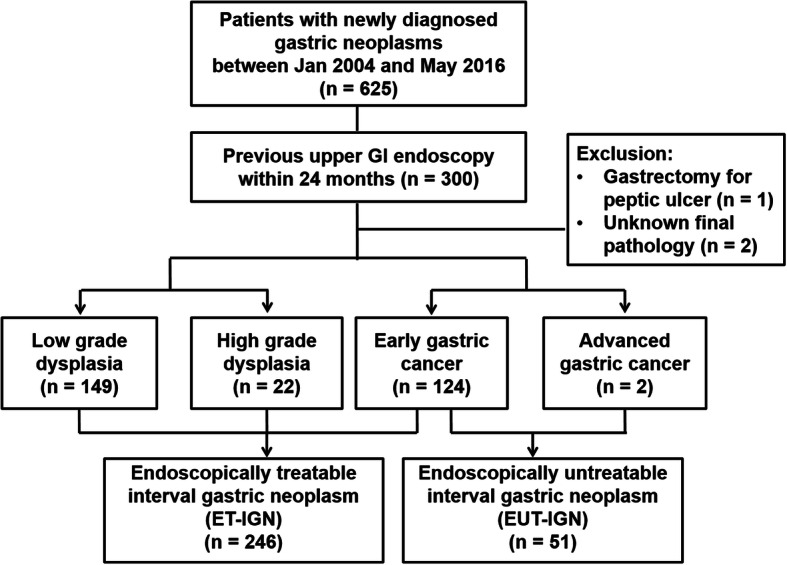
Newly-diagnosed gastric neoplasms detected in screening endoscopy between January 2004 and May 2016 were reviewed. Among them, those who had previous endoscopy within 2 years were enrolled. Endoscopic findings, family history of gastric cancer, smoking, and H. pylori status were analysed. Totally, 297 IGN cases were enrolled. Among them, 246 were endoscopically treatable IGN (ET-IGN) and 51 were endoscopically untreatable IGNs (EUT-IGN) by the expanded criteria for endoscopic submucosal dissection. Among EUT-IGNs, 78% were undifferentiated cancers (40/51) and 33% showed submucosal invasion (13/40). They were median 2.0 cm in size and more commonly located in the proximal stomach than ET-IGNs (70.6% vs. 41.9%, p < 0.001). EUT-IGN was independently related with age < 60 (OR, 2.09; 95%CI, 1.03-4.26, p = 0.042), H. pylori (OR, 2.81; 95%CI, 1.20-6.63, p = 0.018), and absent/mild gastric atrophy (OR, 2.67; 95%CI, 1.25-5.72, p = 0.011). Overall and disease-specific survival were not significantly different between the two groups, however EUT-IGN tended to have short disease-specific survival (overall survival, p = 0.143; disease-specific survival, p = 0.083).
Uniform screening endoscopy with two-year interval seems not enough for rapid-growing gastric neoplasms, such as undifferentiated cancers. They tended to develop in adults younger than 60 with H. pylori infection without severe gastric atrophy. More meticulous screening, especially for proximal lesions is warranted for adults younger than 60 with H. pylori infection before development of gastric atrophy.
在胃癌高发的韩国,建议 40 岁以上人群每两年进行一次内镜检查。即使进行了常规筛查,仍有部分患者被诊断为晚期胃癌。本研究旨在明确进展迅速的间隔期胃肿瘤(interval gastric neoplasms,IGN)的特征。
回顾 2004 年 1 月至 2016 年 5 月期间筛查内镜检查中新诊断的胃肿瘤患者。将在 2 年内有既往内镜检查史的患者纳入研究。分析内镜表现、胃癌家族史、吸烟史、幽门螺杆菌(helicobacter pylori,H. pylori)状态。共纳入 297 例 IGN 患者,其中 246 例为内镜下可治疗 IGN(endoscopically treatable IGN,ET-IGN),51 例为内镜下不可治疗 IGN(endoscopically untreatable IGN,EUT-IGN),符合内镜黏膜下剥离术的扩大适应证。EUT-IGN 中,未分化癌占 78%(40/51),黏膜下浸润占 33%(13/40)。EUT-IGN 肿瘤直径中位数为 2.0cm,较 ET-IGN 更常见于近端胃(70.6% vs. 41.9%,p<0.001)。EUT-IGN 与年龄<60 岁(比值比,2.09;95%置信区间,1.03-4.26,p=0.042)、H. pylori 感染(比值比,2.81;95%置信区间,1.20-6.63,p=0.018)和无/轻度胃萎缩(比值比,2.67;95%置信区间,1.25-5.72,p=0.011)独立相关。两组患者的总生存率和疾病特异性生存率无显著差异,但 EUT-IGN 疾病特异性生存率有缩短趋势(总生存率,p=0.143;疾病特异性生存率,p=0.083)。
每两年进行一次间隔期内镜检查可能不足以发现进展迅速的胃肿瘤,如未分化癌。它们往往发生在年龄<60 岁、感染 H. pylori 且无严重胃萎缩的成年人中。对于感染 H. pylori 且在胃萎缩发生前未出现胃萎缩的<60 岁成年人,需要进行更细致的筛查,特别是近端病变的筛查。