Infectious Diseases and Epidemiology Unit, Department of Animal Health, Faculty of Veterinary Medicine, University of León, León, Spain.
Department of Anatomy and Comparative Pathology and Toxicology, Faculty of Veterinary Medicine, University of Córdoba, International Excellence Agrifood Campus 'ceiA3', Córdoba, Spain.
Microb Biotechnol. 2022 Mar;15(3):1007-1016. doi: 10.1111/1751-7915.13757. Epub 2021 Mar 3.
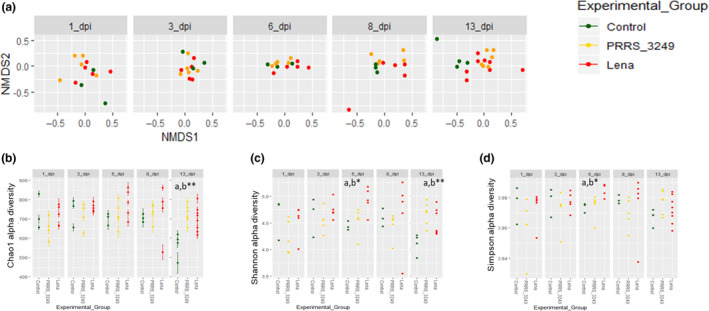
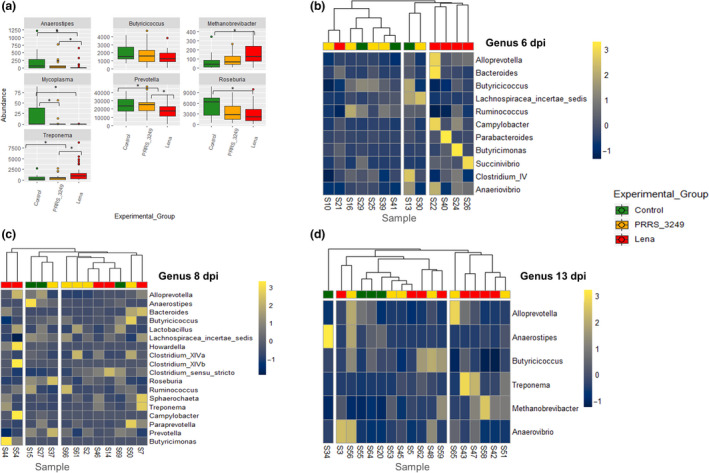
Porcine reproductive and respiratory syndrome (PRRS) is a viral disease defined by reproductive problems, respiratory distress and a negative impact on growth rate and general condition. Virulent PRRS virus (PRRSV) strains have emerged in the last years with evident knowledge gaps in their impact on the host immune response. Thus, the present study examines the impact of acute PRRS virus (PRRSV) infection, with two strains of different virulence, on selected immune parameters and on the gut microbiota composition of infected pigs using 16S rRNA compositional sequencing. Pigs were infected with a low virulent (PRRS_3249) or a virulent (Lena) PRRSV-1 strain and euthanized at 1, 3, 6, 8 or 13 days post-inoculation (dpi). Faeces were collected from each animal at the necropsy time-point. Alpha and beta diversity analyses demonstrated that infection, particularly with the Lena strain, impacted the microbiome composition from 6 dpi onwards. Taxonomic differences revealed that infected pigs had higher abundance of Treponema and Methanobrevibacter (FDR < 0.05). Differences were more considerable for Lena- than for PRRS_3249-infected pigs, showing the impact of strain virulence in the intestinal changes. Lena-infected pigs had reduced abundancies of anaerobic commensals such as Roseburia, Anaerostipes, Butyricicoccus and Prevotella (P < 0.05). The depletion of these desirable commensals was significantly correlated to infection severity measured by viraemia, clinical signs, lung lesions and immune parameters (IL-6, IFN-γ and Hp serum levels). Altogether, the results from this study demonstrate the indirect impact of PRRSV infection on gut microbiome composition in a strain virulence-dependent fashion and its association with selected immune markers.
猪繁殖与呼吸综合征(PRRS)是一种由生殖问题、呼吸窘迫以及生长速度和总体状况下降引起的病毒性疾病。近年来,强毒 PRRS 病毒(PRRSV)株的出现,导致人们对其宿主免疫反应的影响知之甚少。因此,本研究通过 16S rRNA 组成测序,使用两种不同毒力的急性 PRRS 病毒(PRRSV)株,检查了所选免疫参数和感染猪肠道微生物群落组成的变化。猪被感染低毒(PRRS_3249)或强毒(Lena)PRRSV-1 株,并在感染后 1、3、6、8 或 13 天(dpi)安乐死。在解剖时从每只动物收集粪便。α和β多样性分析表明,感染特别是 Lena 株,从 6dpi 开始影响微生物群落组成。分类差异表明,感染猪的 Treponema 和 Methanobrevibacter 丰度更高(FDR<0.05)。与 PRRS_3249 感染猪相比,Lena 感染猪的差异更为显著,表明了菌株毒力对肠道变化的影响。Lena 感染猪的厌氧共生菌如 Roseburia、Anaerostipes、Butyricicoccus 和 Prevotella 的丰度降低(P<0.05)。这些理想共生菌的消耗与通过病毒血症、临床症状、肺部病变和免疫参数(IL-6、IFN-γ 和 Hp 血清水平)测量的感染严重程度显著相关。总的来说,本研究结果表明,PRRSV 感染以菌株毒力依赖的方式间接影响肠道微生物群落组成,并与选定的免疫标志物相关。