Ibis Reproductive Health, Oakland, CA, United States of America.
Harvard T. H. Chan School of Public Health, Cambridge, MA, United States of America.
PLoS One. 2021 Mar 3;16(3):e0247201. doi: 10.1371/journal.pone.0247201. eCollection 2021.
Accurately measuring abortion incidence poses many challenges. The list experiment is a method designed to increase the reporting of sensitive or stigmatized behaviors in surveys, but has only recently been applied to the measurement of abortion. To further test the utility of the list experiment for measuring abortion incidence, we conducted list experiments in two countries, over two time periods.
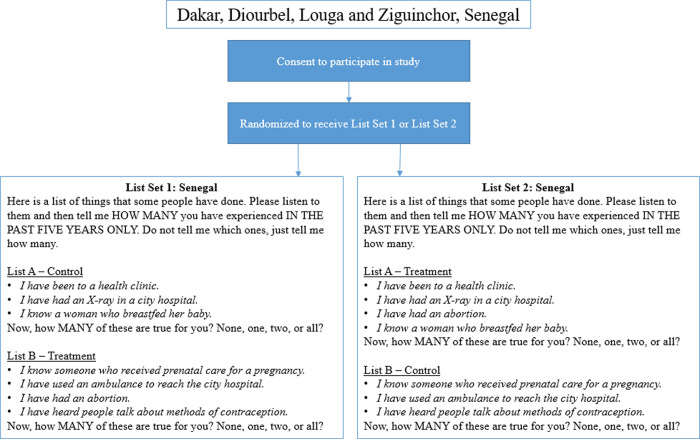
The list experiment is an indirect method of measuring sensitive experiences that protects respondent confidentiality by hiding individual responses to a binary sensitive item (i.e., abortion) by combining this response with answers to other non-sensitive binary control items. Respondents report the number of list items that apply to them, not which ones. We conducted a list experiment to measure cumulative lifetime incidence of abortion in Malawi, and separately to measure cumulative five-year incidence of abortion in Senegal, among cisgender women of reproductive age.
Among 810 eligible respondents in Malawi, list experiment results estimated a cumulative lifetime incidence of abortion of 0.9% (95%CI: 0.0, 7.6). Among 1016 eligible respondents in Senegal, list experiment estimates indicated a cumulative five-year incidence of abortion of 2.8% (95%CI: 0.0, 10.4) which, while lower than anticipated, is seven times the proportion estimated from a direct question on abortion (0.4%).
Two test applications of the list experiment to measure abortion experiences in Malawi and Senegal likely underestimated abortion incidence. Future efforts should include context-specific formative qualitative research for the development and selection of list items, enumerator training, and method delivery to assess if and how these changes can improve method performance.
准确测量堕胎发生率面临诸多挑战。列表实验是一种旨在增加对调查中敏感或污名化行为报告的方法,但最近才被应用于堕胎的测量。为了进一步测试列表实验在测量堕胎发生率方面的效用,我们在两个国家、两个时间段进行了列表实验。
列表实验是一种间接测量敏感体验的方法,通过将对二项敏感项(即堕胎)的个人回答与其他非敏感二项控制项的回答结合起来,保护受访者的机密性,从而隐藏对该敏感项的单独回答。受访者报告适用于他们的列表项的数量,而不是报告哪些项。我们进行了一项列表实验,以衡量马拉维育龄女性的累积终身堕胎发生率,并分别衡量塞内加尔育龄女性的累积五年堕胎发生率。
在马拉维的 810 名符合条件的受访者中,列表实验结果估计累积终身堕胎发生率为 0.9%(95%CI:0.0,7.6)。在塞内加尔的 1016 名符合条件的受访者中,列表实验估计表明,累积五年堕胎发生率为 2.8%(95%CI:0.0,10.4),虽然低于预期,但却是直接询问堕胎问题(0.4%)估计比例的七倍。
列表实验在马拉维和塞内加尔两次测试应用中可能低估了堕胎发生率。未来的工作应包括针对列表项的开发和选择进行特定于背景的定性研究、对普查员进行培训以及方法实施,以评估这些变化是否以及如何可以提高方法的性能。