Kaizerman-Kane Dana, Hadar Maya, Joseph Roymon, Logviniuk Dana, Zafrani Yossi, Fridman Micha, Cohen Yoram
School of Chemistry, Sackler Faculty of Exact Sciences, Tel Aviv University, Ramat Aviv, Tel Aviv 69978, Israel.
Department of Organic Chemistry, Israel Institute for Biological Research, Ness-Ziona 74000, Israel.
ACS Infect Dis. 2021 Mar 12;7(3):579-585. doi: 10.1021/acsinfecdis.0c00662. Epub 2021 Mar 3.
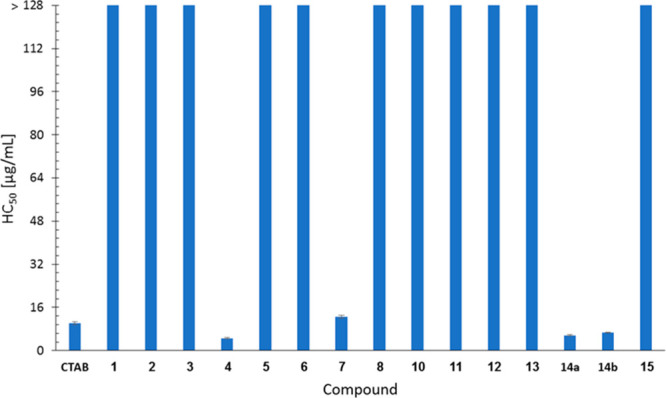
Bacterial biofilms are a major threat to human health, causing persistent infections that lead to millions of fatalities worldwide every year. Biofilms also cause billions of dollars of damage annually by interfering with industrial processes. Recently, cationic pillararenes were found to be potent inhibitors of biofilm formation in Gram-positive bacteria. To identify the structural features of pillararenes that result in antibiofilm activity, we evaluated the activity of 16 cationic pillar[5]arene derivatives including that of the first cationic water-soluble pillar[5]arene-based rotaxane. Twelve of the derivatives were potent inhibitors of biofilm formation by Gram-positive pathogens. Structure activity analyses of our pillararene derivatives indicated that positively charged head groups are critical for the observed antibiofilm activity. Although certain changes in the lipophilicity of the substituents on the positively charged head groups are tolerated, dramatic elevation in the hydrophobicity of the substituents or an increase in steric bulk on these positive charges abolishes the antibiofilm activity. An increase in the overall positive charge from 10 to 20 did not affect the activity significantly, but pillararenes with 5 positive charges and 5 long alkyl chains had reduced activity. Surprisingly, the cavity of the pillar[n]arene is not essential for the observed activity, although the macrocyclic structure of the pillar[n]arene core, which facilitates the clustering of the positive charges, appears important. Interestingly, the compounds found to be efficient inhibitors of biofilm formation were nonhemolytic at concentrations that are ∼100-fold of their MBIC (the minimal concentration of a compound at which at least 50% inhibition of biofilm formation was observed compared to untreated cells). The structure-activity relationship guidelines established here pave the way for a rational design of potent cationic pillar[n]arene-based antibiofilm agents.
细菌生物膜是对人类健康的重大威胁,每年导致全球数百万例致命感染。生物膜还通过干扰工业生产过程,每年造成数十亿美元的损失。最近,发现阳离子柱芳烃是革兰氏阳性菌生物膜形成的有效抑制剂。为了确定导致抗生物膜活性的柱芳烃结构特征,我们评估了16种阳离子[5]柱芳烃衍生物的活性,包括首个基于阳离子水溶性[5]柱芳烃的轮烷的活性。其中12种衍生物是革兰氏阳性病原体生物膜形成的有效抑制剂。我们对柱芳烃衍生物的构效分析表明,带正电荷的头部基团对于观察到的抗生物膜活性至关重要。虽然带正电荷头部基团上取代基的亲脂性有一定变化时仍可接受,但取代基疏水性的显著提高或这些正电荷上空间位阻的增加会消除抗生物膜活性。总正电荷从10增加到20对活性没有显著影响,但带有5个正电荷和5条长烷基链的柱芳烃活性降低。令人惊讶的是,[n]柱芳烃的空腔对于观察到的活性并非必不可少,尽管[n]柱芳烃核心的大环结构有助于正电荷聚集,似乎很重要。有趣的是,被发现是生物膜形成有效抑制剂的化合物在浓度约为其MBIC(与未处理细胞相比,观察到至少50%生物膜形成抑制的化合物的最低浓度)的100倍时无溶血作用。这里建立的构效关系指南为合理设计有效的基于阳离子[n]柱芳烃的抗生物膜剂铺平了道路。