Tokuda Kazunori, Morine Yuji, Miyazaki Katsuki, Yamada Shinichiro, Saito Yu, Nishi Masaaki, Tokunaga Takuya, Ikemoto Tetsuya, Imura Satoru, Shimada Mitsuo
Department of Surgery, Institute of Biomedical Sciences, Tokushima University Graduate School, Tokushima 770-8503, Japan.
Oncotarget. 2021 Feb 16;12(4):333-343. doi: 10.18632/oncotarget.27881.
Cancer-tumor associated macrophage (TAM)-cancer associated fibroblast (CAF) interactions are an important factor in the tumor microenvironment of hepatocellular carcinoma.
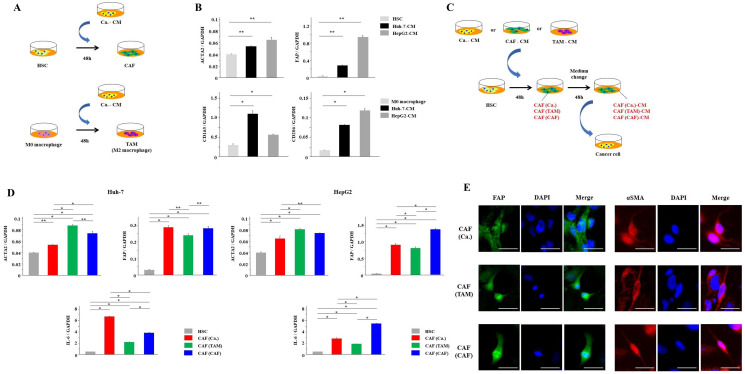
Hepatic stellate cells (HSCs) were cultured with cancer cell-conditioned medium (Ca.-CM), TAM-CM and CAF-CM, and the expression of CAF markers were evaluated by RT-PCR. Whether HSCs cultured with Ca.-CM, TAM-CM and CAF-CM contributed to the enhanced malignancy of cancer cells was examined using proliferation, invasion and migration assays. Furthermore, the differences between these three types of CM were evaluated using cytokine arrays.
HSCs cultured with Ca.-CM, TAM-CM and CAF-CM showed significantly increased mRNA expression of αSMA, FAP and IL-6. All HSCs cultured with each CM exhibited significantly increased proliferation, invasion and migration of cancer cells. The osteopontin concentration was significantly higher in HSCs cultured with TAM-CM than the other CAF-CMs. Osteopontin inhibition significantly reduced osteopontin secretion from HSCs cultured with TAM-CM and suppressed the proliferation and invasion of cancer cells enhanced by HSCs cultured with TAM-CM.
We observed enhanced osteopontin secretion from TAMs, and this increased osteopontin further promoted osteopontin secretion from HSCs cultured with TAM-CM, leading to increased malignancy. For the first time, we demonstrated the importance of cancer-TAM-CAF interactions via osteopontin in hepatocellular carcinoma.
癌症-肿瘤相关巨噬细胞(TAM)-癌症相关成纤维细胞(CAF)相互作用是肝细胞癌肿瘤微环境中的一个重要因素。
将肝星状细胞(HSCs)与癌细胞条件培养基(Ca.-CM)、TAM-CM和CAF-CM一起培养,通过逆转录聚合酶链反应(RT-PCR)评估CAF标志物的表达。使用增殖、侵袭和迁移试验检测用Ca.-CM、TAM-CM和CAF-CM培养的HSCs是否导致癌细胞恶性程度增强。此外,使用细胞因子阵列评估这三种类型的条件培养基之间的差异。
用Ca.-CM、TAM-CM和CAF-CM培养的HSCs显示αSMA、FAP和IL-6的mRNA表达显著增加。用每种条件培养基培养的所有HSCs均显示癌细胞的增殖、侵袭和迁移显著增加。用TAM-CM培养的HSCs中骨桥蛋白浓度显著高于其他CAF条件培养基。骨桥蛋白抑制显著降低了用TAM-CM培养的HSCs的骨桥蛋白分泌,并抑制了用TAM-CM培养的HSCs增强的癌细胞增殖和侵袭。
我们观察到TAMs的骨桥蛋白分泌增强,这种增加的骨桥蛋白进一步促进了用TAM-CM培养的HSCs的骨桥蛋白分泌,导致恶性程度增加。我们首次证明了在肝细胞癌中通过骨桥蛋白的癌症-TAM-CAF相互作用的重要性。