University Medical Center Groningen, University Center Psychiatry (UCP) Interdisciplinary Center Psychopathology and Emotion Regulation (ICPE), University of Groningen, Groningen, The Netherlands.
Department of Research and Education, Friesland Mental Health Care Services, Leeuwarden, The Netherlands.
PLoS One. 2021 Mar 4;16(3):e0247458. doi: 10.1371/journal.pone.0247458. eCollection 2021.
Recent theories argue that an interplay between (i.e., network of) experiences, thoughts and affect in daily life may underlie the development of psychopathology.
To prospectively examine whether network dynamics of everyday affect states are associated with a future course of psychopathology in adolescents at an increased risk of mental disorders.
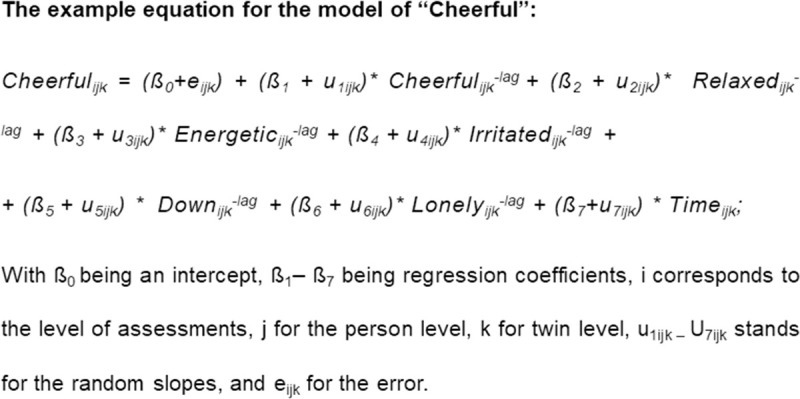
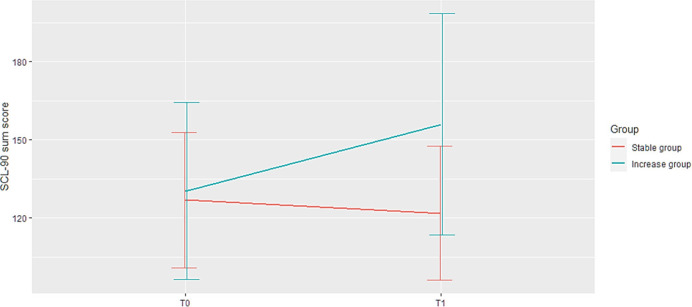
159 adolescents from the East-Flanders Prospective Twin Study cohort participated in the study. At baseline, their momentary affect states were assessed using the Experience Sampling Method (ESM). The course of psychopathology was operationalized as the change in the Symptom Checklist-90 sum score after 1 year. Two groups were defined: one with a stable level (n = 81) and one with an increasing level (n = 78) of SCL-symptom severity. Group-level network dynamics of momentary positive and negative affect states were compared between groups.
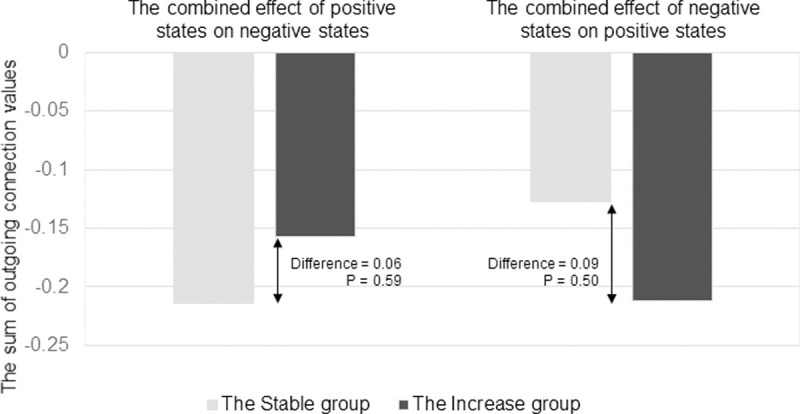
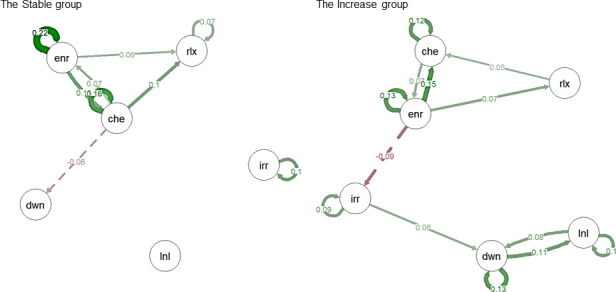
The group with increasing symptoms showed a stronger connections between negative affect states and their higher influence on positive states, as well as higher proneness to form 'vicious cycles', compared to the stable group. Based on permutation tests, these differences were not statistically significant.
Although not statistically significant, some qualitative differences were observed between the networks of the two groups. More studies are needed to determine the value of momentary affect networks for predicting the course of psychopathology.
最近的理论认为,日常生活中的经历、思想和情感之间的相互作用(即网络)可能是精神病理学发展的基础。
前瞻性研究日常生活中情绪状态的网络动态是否与处于精神障碍高风险的青少年的精神病理学未来病程有关。
159 名来自东佛兰德前瞻性双胞胎研究队列的青少年参加了这项研究。在基线时,他们的即时情绪状态使用经验采样法(ESM)进行评估。精神病理学的病程表现为 1 年后症状清单-90 总分的变化。定义了两组:一组是症状严重程度稳定组(n=81),另一组是症状严重程度增加组(n=78)。比较两组之间瞬间积极和消极情绪状态的组级网络动态。
与稳定组相比,症状加重组的负性情绪状态之间的联系更强,对正性情绪状态的影响更大,并且更容易形成“恶性循环”。基于置换检验,这些差异没有统计学意义。
尽管没有统计学意义,但两组之间的网络还是存在一些定性差异。需要进一步的研究来确定瞬间情绪网络对预测精神病理学病程的价值。