Department of Infectious Diseases, Tokyo Metropolitan Cancer and Infectious Diseases Center Komagome Hospital, 3-18, Honkomagome, Bunkyou-ku, Tokyo, 113-0021, Japan.
Emergency and Critical Care Center, Tokyo Metropolitan Hiroo Hospital, 2-34-10, Ebisu, Shibuya-ku, Tokyo, 150-0013, Japan; Department of Trauma and Critical Care Medicine, Kyorin University School of Medicine, 2-34-10, Ebisu, Shibuya-ku, Tokyo, 150-0013, Japan.
J Infect Chemother. 2021 Jun;27(6):869-875. doi: 10.1016/j.jiac.2021.02.019. Epub 2021 Feb 19.
One of the most prominent and concerning complications associated with coronavirus disease 2019 (COVID-19) is venous and arterial thromboembolisms. The aim of the present study was to delineate the prevalence of thromboembolic events and the current status of prophylactic anticoagulation therapy in patients with COVID-19 in Japan.
Between February 1 and August 31, 2020, we performed a dual-center, retrospective cohort study based on data obtained from the medical charts of COVID-19 patients admitted to healthcare facilities in Japan. The primary outcome was any thromboembolic event including pulmonary embolism (PE), deep vein thrombosis (DVT), myocardial infarction, ischemic stroke and other systemic thromboemboli.
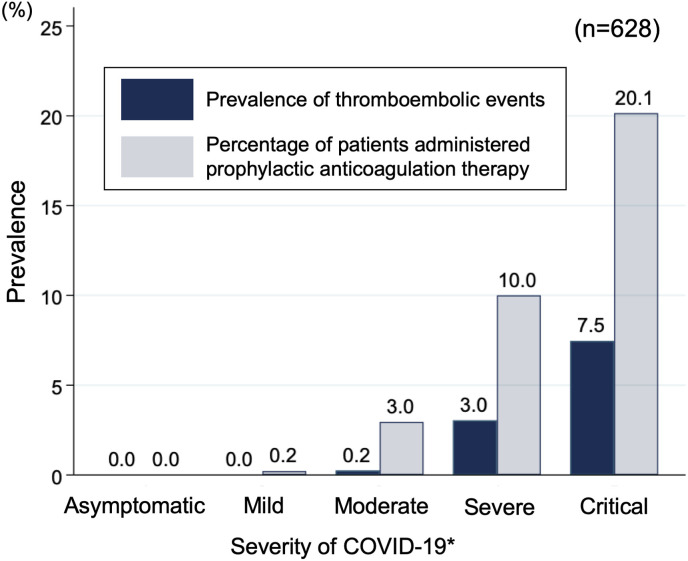
During the study period, we extracted 628 consecutive patients admitted for COVID-19. Prophylactic anticoagulant therapy was administered in 63 (10%) patients of whom 20 (31.7%) were admitted to the intensive care unit (ICU). Thromboembolic events occurred in 18 (2.9%) patients (14.3% of patients in ICU and 2.2% of patients in the general wards). DVT were detected in 13 (2.1%) patients, PE in 11 (1.8%), and both DVT and PE in 6 (0.96%) patients. An increasing prevalence in thromboembolic events was noted with progressive clinical severity. Overall in-hospital mortality was 4.8%.
Prophylactic anticoagulation therapy was administered in only 10% of all hospitalized COVID-19 patients. The prevalence of any thromboembolic events was 2.9% in COVID-19 patients with most events occurring in severe and critical patients. Therefore, prophylactic anticoagulation therapy may be warranted in severe and critical patients but in asymptomatic to moderate patients the practice remains controversial.
与 2019 年冠状病毒病(COVID-19)相关的最突出和令人关注的并发症之一是静脉和动脉血栓栓塞。本研究的目的是描述 COVID-19 患者中血栓栓塞事件的发生率和预防性抗凝治疗的现状。
2020 年 2 月 1 日至 8 月 31 日,我们对日本医疗机构收治的 COVID-19 患者的病历数据进行了一项双中心回顾性队列研究。主要结局是包括肺栓塞(PE)、深静脉血栓形成(DVT)、心肌梗死、缺血性卒中和其他全身性血栓栓塞在内的任何血栓栓塞事件。
研究期间,我们提取了 628 例连续入院的 COVID-19 患者。63 例(10%)患者接受了预防性抗凝治疗,其中 20 例(31.7%)患者入住重症监护病房(ICU)。18 例(2.9%)患者发生血栓栓塞事件(ICU 患者为 14.3%,普通病房患者为 2.2%)。13 例(2.1%)患者检测到 DVT,11 例(1.8%)患者检测到 PE,6 例(0.96%)患者同时检测到 DVT 和 PE。随着临床严重程度的进展,血栓栓塞事件的发生率呈上升趋势。总体住院死亡率为 4.8%。
仅对 10%的住院 COVID-19 患者进行了预防性抗凝治疗。COVID-19 患者中任何血栓栓塞事件的发生率为 2.9%,大多数事件发生在重症和危重症患者中。因此,预防性抗凝治疗可能对重症和危重症患者有效,但在无症状至中度患者中,这一做法仍存在争议。