Selter Jessica, Huang Yongmei, Williams S Zev, Brady Paula C, Melamed Alexander, Hershman Dawn L, Wright Jason D
Department of Obstetrics and Gynecology, Columbia University College of Physicians and Surgeons, United States.
New York Presbyterian Hospital, United States.
Gynecol Oncol Rep. 2021 Feb 10;36:100716. doi: 10.1016/j.gore.2021.100716. eCollection 2021 May.
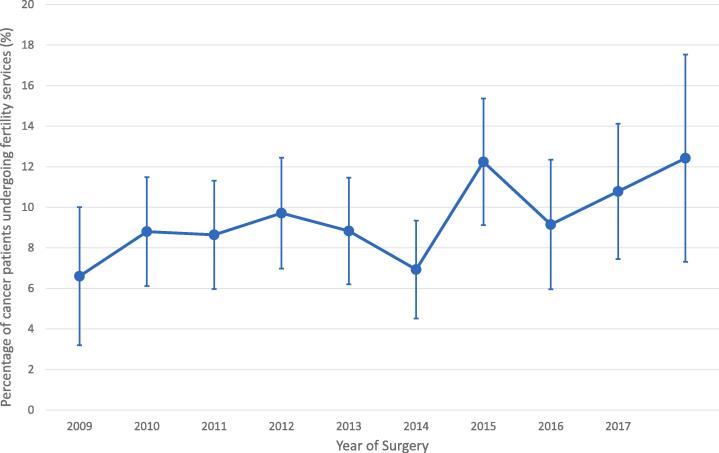
While fertility preservation is a major concern among reproductive age cancer patients, little is known about access and use of fertility preserving services. We examined use of fertility preserving services among men with common solid tumors. A total of 3648 men age 18-40 including 2610 (71.6%) with testicular cancer, 939 (25.7%) with colorectal and 99 (2.7%) with prostate cancer were identified. Fertility preservation services were utilized in 9.3% of men overall including 4.1% who underwent fertility evaluation only and 7.8% who had a fertility preservation procedure. The rate of fertility preservation services rose from 6.6% (95%CI, 3.2-10.0) in 2008 to 12.4% (95%CI, 7.3-17.5) in 2017 (P = 0.04). Use of fertility preservation service was more common in patients with testicular (11.6%, aRR = 3.31; 95% CI 2.22-4.92) and prostate cancer (6.1%, aRR = 3.14; 95% CI 1.28-7.70) compared to those with colon cancer (3.4%). Younger men were more likely to utilize fertility preservation services. 11.5% of men age ≤ 35 years vs. 5.2% of men 36-40 used these services (P < 0.0001). Fertility preservation services were used in 10.8% of those who received chemotherapy (aRR = 1.81; 95% CI, 1.45-2.27) and in 8.1% of those who received radiation (aRR = 1.30 95% CI, 0.98-1.73). Medicaid patients were less likely to receive fertility preservation services than those with commercial insurance (0.7% vs. 10.1%; aRR = 11.58, 95%CI 2.10-63.69). These data indicate that while use of fertility preserving services is increasing, overall use of services is low among reproductive age males with cancer.
虽然生育力保存是育龄期癌症患者的主要关注点,但对于生育力保存服务的可及性和使用情况却知之甚少。我们研究了患有常见实体瘤的男性对生育力保存服务的使用情况。共确定了3648名年龄在18至40岁之间的男性,其中2610名(71.6%)患有睾丸癌,939名(25.7%)患有结直肠癌,99名(2.7%)患有前列腺癌。总体而言,9.3%的男性使用了生育力保存服务,其中4.1%仅接受了生育力评估,7.8%进行了生育力保存程序。生育力保存服务的使用率从2008年的6.6%(95%CI,3.2 - 10.0)上升至2017年的12.4%(95%CI,7.3 - 17.5)(P = 0.04)。与结肠癌患者(3.4%)相比,睾丸癌(11.6%,aRR = 3.31;95%CI 2.22 - 4.92)和前列腺癌患者(6.1%,aRR = 3.14;95%CI 1.28 - 7.70)使用生育力保存服务更为常见。年轻男性更有可能使用生育力保存服务。35岁及以下男性中有11.5%使用了这些服务,而36 - 40岁男性中这一比例为5.2%(P < 0.0001)。接受化疗的患者中有10.8%使用了生育力保存服务(aRR = 1.81;95%CI,1.45 - 2.27),接受放疗的患者中有8.1%使用了该服务(aRR = 1.30,95%CI,0.98 - 1.73)。与商业保险患者相比,医疗补助患者接受生育力保存服务的可能性较小(0.7%对10.1%;aRR = 11.58,95%CI 2.10 - 63.69)。这些数据表明,虽然生育力保存服务的使用在增加,但癌症育龄期男性对该服务的总体使用率较低。