Nguyen Tu, Clark Nicholas, Jones Malcolm K, Herndon Aaron, Mallyon John, Soares Magalhaes Ricardo J, Abdullah Swaid
The University of Queensland, School of Veterinary Science, Gatton 4343, Queensland, Australia.
The University of Queensland UQ, School of Veterinary Science, Spatial Epidemiology Laboratory, Gatton 4343, Queensland, Australia.
One Health. 2021 Feb 16;12:100226. doi: 10.1016/j.onehlt.2021.100226. eCollection 2021 Jun.
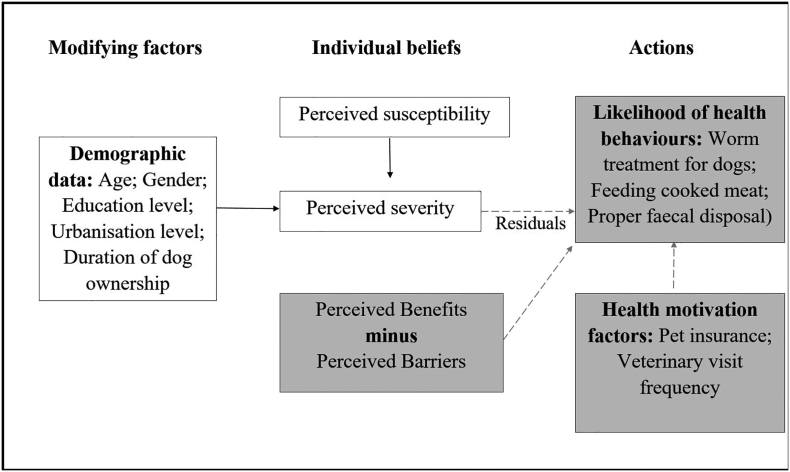
Canine companion animals can carry a number of zoonotic parasites which can adversely impact both human and animal health. Previous studies in Australia indicated that while parasitic infections in dogs are still common and there is variability in the awareness and perception of zoonotic risks among pet owners, the likely contribution of sociodemographic factors to the variation in awareness and perception needs to be further explored. The primary objective of this study is to quantify the relationship between dog owners' knowledge and beliefs about dog parasites and their sociodemographic characteristics. In this study, we surveyed a total of 281 dog owners in SE Queensland between April 2019 to March 2020 and the relationship between dog owners' perception of gastrointestinal parasite infection was assessed using an adaptation of the Health Belief Model, social cognitive framework for health protection. The model looked into the role of dog owners' demography on their perceived severity and susceptibility to zoonotic canine parasites and their likelihood of performing actions associated with worm control of their pets. Our results indicate that owners perceptions about parasitic disease severity in their pets was 26% higher in female dog owners compared to males, in respondents owning dogs over 10 years (27% higher than those owning a dog <3 years) and those owners that regularly deworm their pets and report faeces disposal. Our study indicates that the perceptions of pet owners towards zoonotic canine parasites varies demographically and owner education is important to prevent infection among dogs and control the zoonotic transmission to owners and the community. Finally, there was evidence that increased frequency of visits to veterinary clinics can increase the likelihood of owners performing worm treatment, proper faecal disposal, and cooking meat before feeding it to dogs.
犬类伴侣动物可携带多种人畜共患寄生虫,这会对人类和动物健康产生不利影响。澳大利亚此前的研究表明,虽然犬类寄生虫感染仍然很常见,而且宠物主人对人畜共患风险的认知和看法存在差异,但社会人口学因素对认知和看法差异的可能影响仍需进一步探讨。本研究的主要目的是量化狗主人对犬类寄生虫的知识和信念与其社会人口学特征之间的关系。在本研究中,我们于2019年4月至2020年3月期间对昆士兰州东南部的281名狗主人进行了调查,并采用健康信念模型(一种用于健康保护的社会认知框架)的改编版评估了狗主人对胃肠道寄生虫感染的认知情况。该模型研究了狗主人的人口统计学特征在其对人畜共患犬类寄生虫的感知严重程度、易感性以及采取与宠物驱虫相关行动的可能性方面所起的作用。我们的结果表明,与男性狗主人相比,女性狗主人对其宠物寄生虫病严重程度的认知高出26%;养狗超过10年的受访者(比养狗<3年的受访者高27%)以及那些定期给宠物驱虫并报告粪便处理情况的主人也是如此。我们的研究表明,宠物主人对人畜共患犬类寄生虫的认知在人口统计学上存在差异,主人教育对于预防犬类感染以及控制向主人和社区的人畜共患传播非常重要。最后,有证据表明,增加去兽医诊所的就诊频率可以增加主人进行驱虫治疗、正确处理粪便以及在喂狗前将肉煮熟的可能性。