
用于表征拉挤玻璃纤维增强塑料(GFRP)复合材料中冲击型缺陷的超声非接触空气耦合技术比较
Comparison of Ultrasonic Non-Contact Air-Coupled Techniques for Characterization of Impact-Type Defects in Pultruded GFRP Composites.
作者信息
Asokkumar Aadhik, Jasiūnienė Elena, Raišutis Renaldas, Kažys Rymantas Jonas
机构信息
K. Baršauskas Ultrasound Research Institute, Kaunas University of Technology, K. Baršausko St. 59, LT, 51423 Kaunas, Lithuania.
Department of Electronics Engineering, Kaunas University of Technology, Studentų St. 48, LT, 51367 Kaunas, Lithuania.
出版信息
Materials (Basel). 2021 Feb 24;14(5):1058. doi: 10.3390/ma14051058.
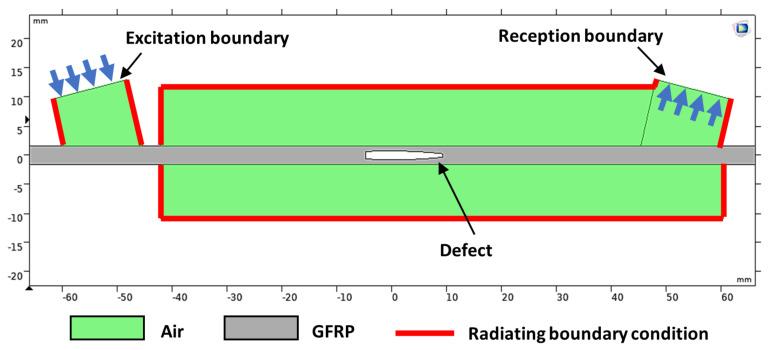
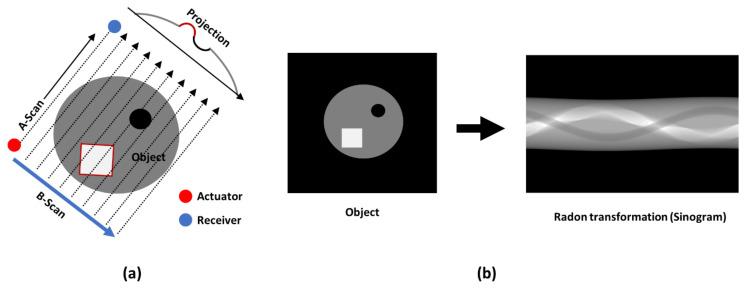
This article compares different air-coupled ultrasonic testing methods to characterize impact-type defects in a pultruded quasi-isotropic glass fiber-reinforced plastic (GFRP) composite plate. Using the air-coupled transducers, comparisons among three methods were performed, namely, bulk-wave through transmission, single-side access using guided waves, and ultrasonic-guided wave tomography. The air coupled through transmission technique can determine the size and shape of impact-type defects with a higher resolution, but with the consequence of time consumption and, more importantly, the necessity of access to both sides of the sample. The guided wave technique on the other hand, allows a single-side inspection and is relatively fast. It can be used to determine the size of the defect using ultrasonic B-scan, but the exact shape of the defect will be compromised. Thus, in this article, to determine the shape of the defect, application of the parallel beam tomographic reconstruction technique using guided Lamb waves is demonstrated. Furthermore, a numerical finite element simulation was performed to study the effects of guided wave propagation in the composite sample and interaction with the internal defect. Lastly, the results from the experiments of different techniques were compared according to possibilities of defect sizing and determination of its shape.
本文比较了不同的空气耦合超声检测方法,以表征拉挤准各向同性玻璃纤维增强塑料(GFRP)复合板中的冲击型缺陷。使用空气耦合换能器,对三种方法进行了比较,即体波穿透传输法、利用导波的单面检测法和超声导波层析成像法。空气耦合穿透传输技术能够以更高的分辨率确定冲击型缺陷的尺寸和形状,但存在耗时的问题,更重要的是需要对样品的两面进行检测。另一方面,导波技术允许单面检测且相对快速。它可用于通过超声B扫描确定缺陷的尺寸,但缺陷的精确形状会受到影响。因此,在本文中,为了确定缺陷的形状,展示了使用导波兰姆波的平行束层析重建技术的应用。此外,进行了数值有限元模拟,以研究导波在复合样品中的传播及其与内部缺陷的相互作用。最后,根据缺陷尺寸测量和形状确定的可能性,比较了不同技术的实验结果。






 Zotero 插件