The Shmunis School of Biomedicine & Cancer Research, Tel Aviv University, Ramat Aviv 69978, Israel.
Genes (Basel). 2021 Feb 25;12(3):342. doi: 10.3390/genes12030342.
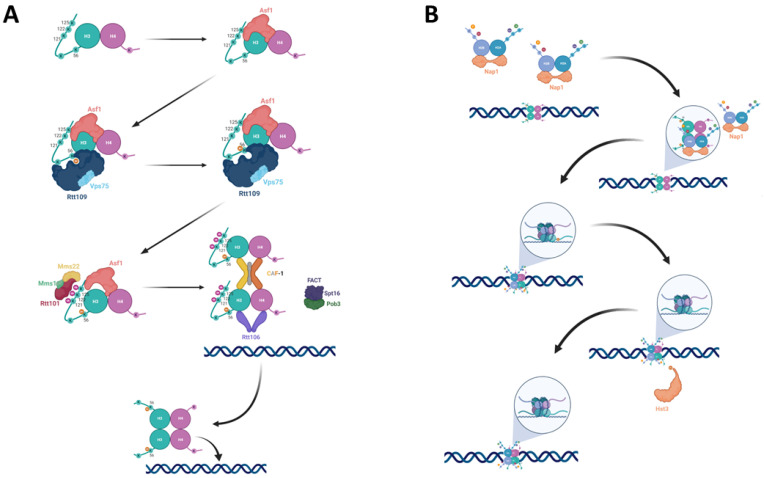
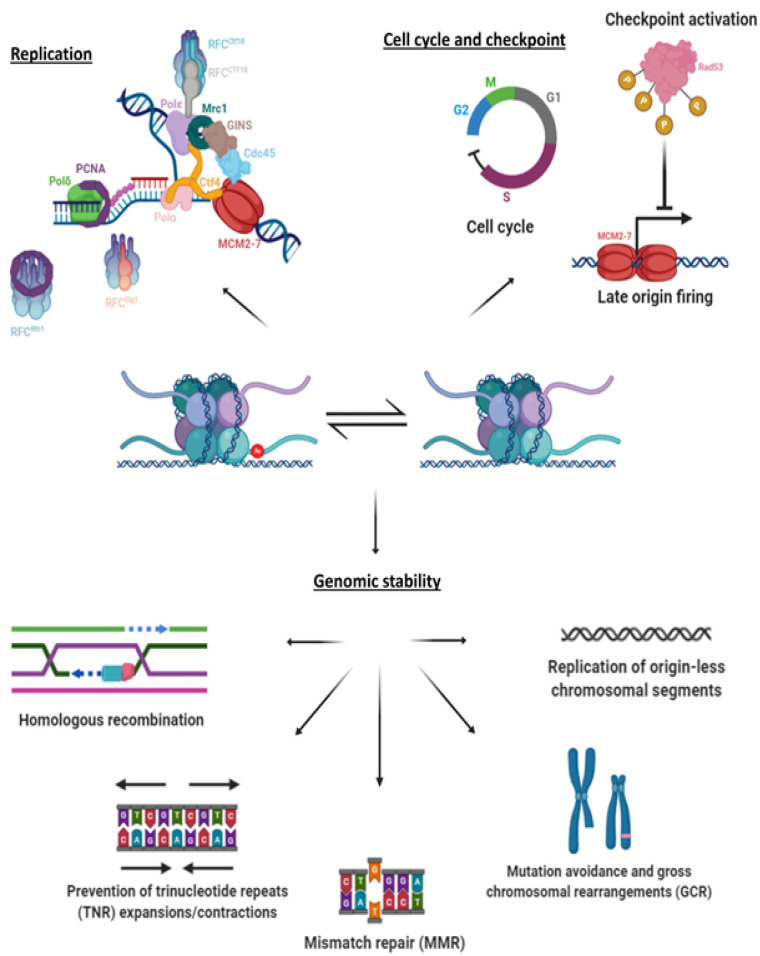
Acetylation on lysine 56 of histone H3 of the yeast has been implicated in many cellular processes that affect genome stability. Despite being the object of much research, the complete scope of the roles played by K56 acetylation is not fully understood even today. The acetylation is put in place at the S-phase of the cell cycle, in order to flag newly synthesized histones that are incorporated during DNA replication. The signal is removed by two redundant deacetylases, Hst3 and Hst4, at the entry to G2/M phase. Its crucial location, at the entry and exit points of the DNA into and out of the nucleosome, makes this a central modification, and dictates that if acetylation and deacetylation are not well concerted and executed in a timely fashion, severe genomic instability arises. In this review, we explore the wealth of information available on the many roles played by H3K56 acetylation and the deacetylases Hst3 and Hst4 in DNA replication and repair.
酵母组蛋白 H3 赖氨酸 56 的乙酰化作用与许多影响基因组稳定性的细胞过程有关。尽管已经进行了大量的研究,但即使在今天,K56 乙酰化所起的作用的完整范围也尚未完全了解。乙酰化作用发生在细胞周期的 S 期,目的是标记在 DNA 复制过程中掺入的新合成的组蛋白。进入 G2/M 期时,由两个冗余的去乙酰化酶 Hst3 和 Hst4 将其去除。其关键位置在 DNA 进入和离开核小体的入口和出口处,这使其成为一种核心修饰,并且决定了如果乙酰化和去乙酰化不能很好地协调并及时执行,就会出现严重的基因组不稳定性。在这篇综述中,我们探讨了大量关于 H3K56 乙酰化作用以及去乙酰化酶 Hst3 和 Hst4 在 DNA 复制和修复中的多种作用的信息。