Kumar Anil, Kumar Santosh, Mukhopadhyay Nilay Krishna, Yadav Anshul, Kumar Virendra, Winczek Jerzy
Department of Mechanical Engineering, Kamla Nehru Institute of Technology, Sultanpur 228118, India.
Department of Mechanical Engineering, Indian Institute of Technology (BHU), Varanasi 221005, India.
Materials (Basel). 2021 Feb 19;14(4):990. doi: 10.3390/ma14040990.
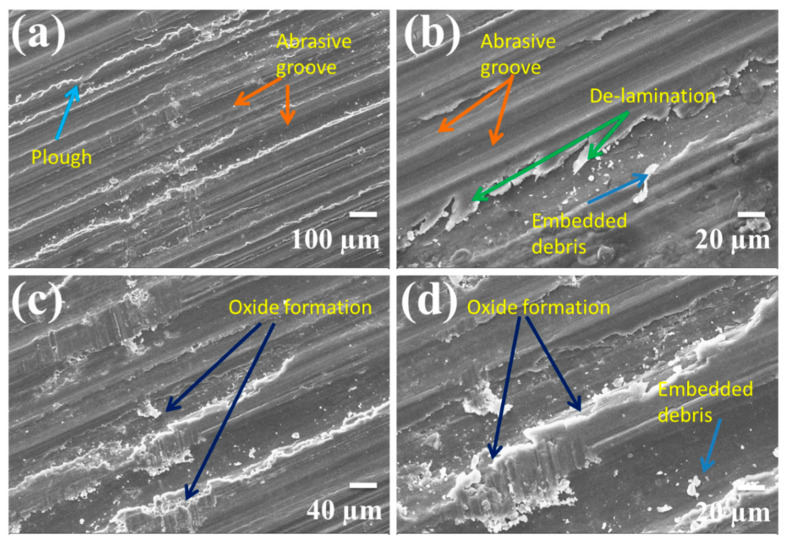
In this investigation, the extensive wear behaviour of materials was studied using SiC reinforced magnesium alloy composites fabricated through the stir casting process. The wear properties of AZ91 alloy composites with a small variation (i.e., 3%, 6%, 9% and 12%) of SiC particulates were evaluated by varying the normal load with sliding velocity and sliding distance. The worn surfaces were examined by scanning electron microscope to predict the different wear mechanisms on the pin while sliding on the hard disk in the dry sliding wear test condition. The microhardness of the SiC reinforced AZ91 composites was found to be more than the un-reinforced AZ91 alloy. Pins tested at load 19.62 N, and 2.6 m/s exhibited a series of short cracks nearly perpendicular to the sliding direction. At higher speed and load, the oxidation and delamination were observed to be fully converted into adhesion wear. Abrasion, oxidation, and delamination wear mechanisms were generally dominant in lower sliding velocity and lower load region, while adhesion and thermal softening/melting were dominant in higher sliding velocity and loads. The wear rate and coefficient of friction of the SiC reinforced composites were lower than that of the unreinforced alloy. This is due to the fact of higher hardness exhibited by the composites. The wear behaviour at the velocity of 1.39 m/s was dominated by oxidation and delamination wear, whereas at the velocity of 2.6 m/s the wear behaviour was dominated by abrasion and adhesion wear. It was also found that the plastic deformation and smearing occurred at higher load and sliding velocity.
在本研究中,采用搅拌铸造工艺制备的碳化硅增强镁合金复合材料,对材料的广泛磨损行为进行了研究。通过改变法向载荷、滑动速度和滑动距离,评估了碳化硅颗粒含量有小幅度变化(即3%、6%、9%和12%)的AZ91合金复合材料的磨损性能。在干滑动磨损试验条件下,通过扫描电子显微镜检查磨损表面,以预测销在硬盘上滑动时的不同磨损机制。发现碳化硅增强AZ91复合材料的显微硬度高于未增强的AZ91合金。在19.62 N载荷和2.6 m/s速度下测试的销呈现出一系列几乎垂直于滑动方向的短裂纹。在更高的速度和载荷下,观察到氧化和分层完全转变为粘着磨损。在较低的滑动速度和较低的载荷区域,磨损、氧化和分层磨损机制通常占主导地位,而在较高的滑动速度和载荷下,粘着和热软化/熔化占主导地位。碳化硅增强复合材料的磨损率和摩擦系数低于未增强合金。这是由于复合材料表现出更高的硬度。在1.39 m/s速度下的磨损行为以氧化和分层磨损为主,而在2.6 m/s速度下的磨损行为以磨损和粘着磨损为主。还发现,在较高的载荷和滑动速度下会发生塑性变形和涂抹现象。