Abramovitz Itzhak, Zini Avraham, Atzmoni Matan, Kedem Ron, Zur Dorit, Protter Noam E, Almoznino Galit
Department of Endodontics, Hadassah School of Dental Medicine, Hebrew University, Jerusalem 91120, Israel.
Department of Community Dentistry, Hadassah School of Dental Medicine, Hebrew University, Jerusalem 91120, Israel.
Biology (Basel). 2021 Feb 28;10(3):178. doi: 10.3390/biology10030178.
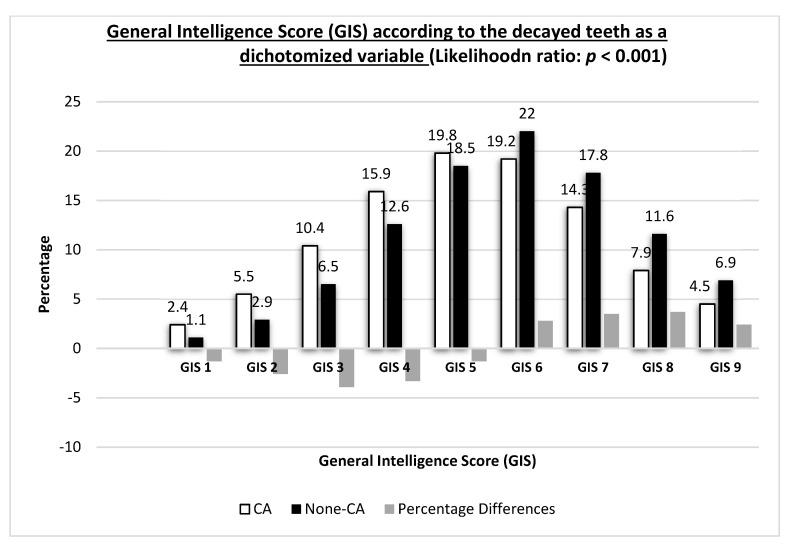
Relatively few studies have analyzed the association between cognitive performance and dental status. This study aimed to analyze the association between cognitive performance and dental caries. Included were data from the dental, oral, medical epidemiological (DOME) study; cross-sectional records-based research, which integrated large socio-demographic, medical, and dental databases of a nationally representative sample of young to middle-aged military personnel (N = 131,927, mean age: 21.8 ± 5.9 years, age range: 18-50). The cognitive function of draftees is routinely measured at age 17 years using a battery of psychometric tests termed general intelligence score (GIS). The mean number of decayed teeth exhibited a gradient trend from the lowest (3.14 ± 3.58) to the highest GIS category (1.45 ± 2.19) (odds ratio (OR) lowest versus highest = 5.36 (5.06-5.68), < 0.001). A similar trend was noted for the other dental parameters. The associations between GIS and decayed teeth persisted even after adjusting for socio-demographic parameters and health-related habits. The adjustments attenuated the OR but did not eliminate it (OR lowest versus highest = 3.75 (3.38-4.16)). The study demonstrates an association between cognitive performance and caries, independent of the socio-demographic and health-related habits that were analyzed. Better allocation of resources is recommended, focusing on populations with impaired cognitive performance in need of dental care.
相对较少的研究分析了认知表现与牙齿状况之间的关联。本研究旨在分析认知表现与龋齿之间的关联。研究纳入了来自牙科、口腔、医学流行病学(DOME)研究的数据;这是一项基于记录的横断面研究,整合了具有全国代表性的年轻至中年军事人员样本(N = 131,927,平均年龄:21.8 ± 5.9岁,年龄范围:18 - 50岁)的大型社会人口统计学、医学和牙科数据库。应征入伍者的认知功能在17岁时通过一系列心理测量测试进行常规测量,这些测试被称为一般智力得分(GIS)。龋齿的平均数量呈现出从最低GIS类别(3.14 ± 3.58)到最高GIS类别(1.45 ± 2.19)的梯度趋势(最低与最高的比值比(OR)= 5.36(5.06 - 5.68),P < 0.001)。其他牙齿参数也呈现出类似趋势。即使在对社会人口统计学参数和健康相关习惯进行调整后,GIS与龋齿之间的关联仍然存在。调整后OR有所降低,但并未消除(最低与最高的OR = 3.75(3.38 - 4.16))。该研究表明认知表现与龋齿之间存在关联,且独立于所分析的社会人口统计学和健康相关习惯。建议更好地分配资源,重点关注需要牙科护理的认知表现受损人群。