Laboratory of Cytogenetics, Vavilov Institute of General Genetics, Russian Academy of Sciences, 119991 Moscow, Russia.
Department of Animal Diversity and Resources, Institute of Biodiversity and Ecosystem Research, Bulgarian Academy of Science, 1000 Sofia, Bulgaria.
Int J Mol Sci. 2021 Feb 17;22(4):1969. doi: 10.3390/ijms22041969.
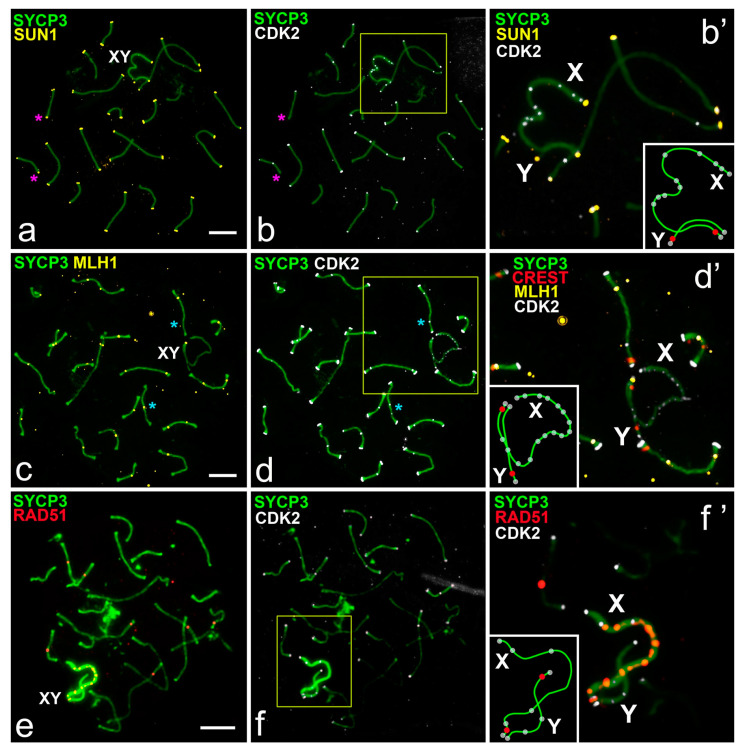
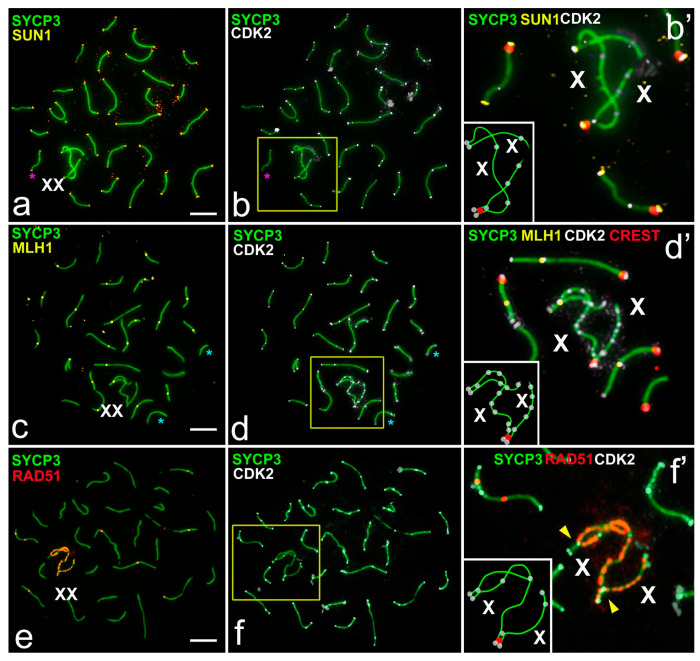
Cyclin-dependent kinases (CDKs) are crucial regulators of the eukaryotic cell cycle. The critical role of CDK2 in the progression of meiosis was demonstrated in a single mammalian species, the mouse. We used immunocytochemistry to study the localization of CDK2 during meiosis in seven rodent species that possess hetero- and homomorphic male sex chromosomes. To compare the distribution of CDK2 in XY and XX male sex chromosomes, we performed multi-round immunostaining of a number of marker proteins in meiotic chromosomes of the rat and subterranean mole voles. Antibodies to the following proteins were used: RAD51, a member of the double-stranded DNA break repair machinery; MLH1, a component of the DNA mismatch repair system; and SUN1, which is involved in the connection between the meiotic telomeres and nuclear envelope, alongside the synaptic protein SYCP3 and kinetochore marker CREST. Using an enhanced protocol, we were able to assess the distribution of as many as four separate proteins in the same meiotic cell. We showed that during prophase I, CDK2 localizes to telomeric and interstitial regions of autosomes in all species investigated (rat, vole, hamster, subterranean mole voles, and mole rats). In sex bivalents following synaptic specificity, the CDK2 signals were distributed in three different modes. In the XY bivalent in the rat and mole rat, we detected numerous CDK2 signals in asynaptic regions and a single CDK2 focus on synaptic segments, similar to the mouse sex chromosomes. In the mole voles, which have unique XX sex chromosomes in males, CDK2 signals were nevertheless distributed similarly to the rat XY sex chromosomes. In the vole, sex chromosomes did not synapse, but demonstrated CDK2 signals of varying intensity, similar to the rat X and Y chromosomes. In female mole voles, the XX bivalent had CDK2 pattern similar to autosomes of all species. In the hamster, CDK2 signals were revealed in telomeric regions in the short synaptic segment of the sex bivalent. We found that CDK2 signals colocalize with SUN1 and MLH1 signals in meiotic chromosomes in rats and mole voles, similar to the mouse. The difference in CDK2 manifestation at the prophase I sex chromosomes can be considered an example of the rapid chromosome evolution in mammals.
细胞周期蛋白依赖性激酶(CDKs)是真核细胞周期的关键调节因子。在单一哺乳动物物种——小鼠中,已经证明 CDK2 在减数分裂的进展中起着至关重要的作用。我们使用免疫细胞化学技术研究了七种具有异型和同型雄性性染色体的啮齿动物物种减数分裂过程中 CDK2 的定位。为了比较 CDK2 在 XY 和 XX 雄性性染色体中的分布,我们对大鼠和地下鼹形田鼠减数分裂染色体中的多个标记蛋白进行了多轮免疫染色。使用了以下几种蛋白质的抗体:RAD51,双链 DNA 断裂修复机制的成员;MLH1,DNA 错配修复系统的组成部分;SUN1,参与减数分裂端粒与核膜的连接,以及突触蛋白 SYCP3 和着丝粒标记物 CREST。使用增强的方案,我们能够在同一减数分裂细胞中评估多达四种不同蛋白质的分布。我们表明,在所有研究的物种(大鼠、田鼠、仓鼠、地下鼹形田鼠和鼹鼠)中,CDK2 在前期 I 时定位于常染色体的端粒和间质区域。在突触特异性后的性二价体中,CDK2 信号以三种不同的模式分布。在大鼠和鼹鼠的 XY 二价体中,我们在非突触区域检测到大量 CDK2 信号,而在突触片段上仅检测到一个 CDK2 焦点,类似于小鼠的性染色体。在具有独特 XX 性染色体的鼹鼠中,CDK2 信号的分布仍然类似于大鼠的 XY 性染色体。在田鼠中,性染色体不进行突触连接,但表现出强度不同的 CDK2 信号,类似于大鼠的 X 和 Y 染色体。在雌性鼹鼠中,XX 二价体的 CDK2 模式与所有物种的常染色体相似。在仓鼠中,CDK2 信号在性二价体的短突触片段的端粒区域被揭示出来。我们发现,在大鼠和鼹鼠的减数分裂染色体中,CDK2 信号与 SUN1 和 MLH1 信号共定位,与小鼠类似。在前期 I 性染色体上 CDK2 表达的差异可以被认为是哺乳动物中快速染色体进化的一个例子。