
青光眼初诊560眼内微钩小梁切开术的中期结果
Midterm Results of Microhook ab Interno Trabeculotomy in Initial 560 Eyes with Glaucoma.
作者信息
Tanito Masaki, Sugihara Kazunobu, Tsutsui Aika, Hara Katsunori, Manabe Kaoru, Matsuoka Yotaro
机构信息
Department of Ophthalmology, Faculty of Medicine, Shimane University, Izumo 693-8501, Japan.
Division of Ophthalmology, Matsue Red Cross Hospital, Matsue 690-8506, Japan.
出版信息
J Clin Med. 2021 Feb 17;10(4):814. doi: 10.3390/jcm10040814.
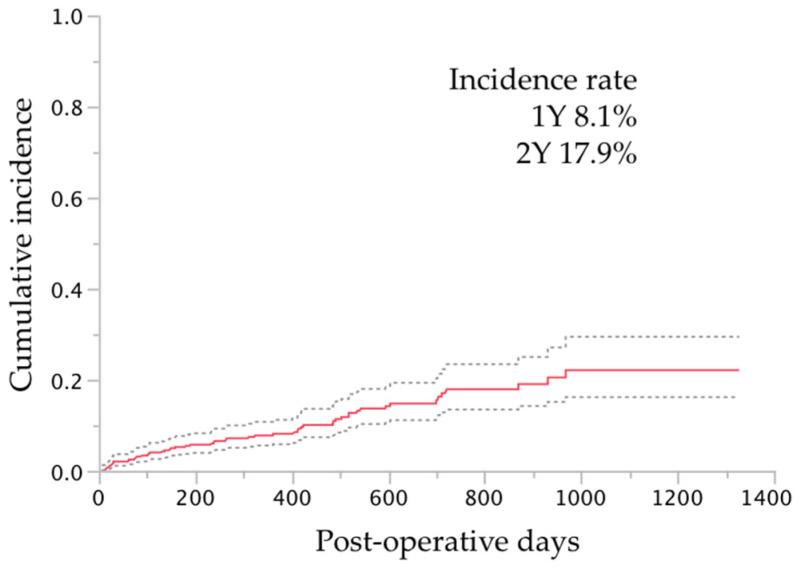
All the 560 glaucomatous eyes of 375 Japanese subjects (181 men, 194 women; mean age ± standard deviation, 76.0 ± 13.2 years) who underwent microhook ab interno trabeculotomy (µLOT) alone (159 eyes, 28%) or combined µLOT and cataract surgery (401 eyes, 72%) performed by one surgeon at Matsue Red Cross Hospital between May 2015 and March 2018 to control intraocular pressure (IOP) were retrospectively assessed. Preoperative and postoperative IOPs, numbers of antiglaucoma medications, the logarithm of the minimum angle of resolution visual acuity (logMAR VA), anterior chamber (AC) flare, visual field mean deviation (MD), and corneal endothelial cell density (CECD) were compared up to 36 months. Surgical complications and required interventions were described. The duration of the follow-up was 405 ± 327 (range, 2-1326) days. The mean preoperative IOP (20.2 ± 7.0 mmHg) and number of antiglaucoma medications (2.8 ± 1.1) decreased to 13.9 ± 4.5 mmHg (31% reduction, < 0.0001) and 2.5 ± 1.0 (11% reduction, < 0.0001), respectively, at the final visit. After combined surgery, compared with preoperatively, the final VA improved 0.11 logMAR ( < 0.0001), AC flare increased 4.5 photon counts/msec ( = 0.0011), MD improved 0.6 decibel ( < 0.0001), and the CECD decreased 6% ( < 0.0001). Layered hyphema (172 eyes, 31%) and hyphema washout (26 eyes, 5%) were the most common postoperative complication and intervention, respectively. At the final visit, 379 (69%) eyes achieved successful IOP control of ≤18 mmHg and ≥20% IOP reduction, and 349 (64%) eyes achieved successful IOP control of ≤15 mmHg and ≥20% IOP reduction. Older age, steroid-induced glaucoma, developmental glaucoma, and the absence of postoperative complications were associated with lower final IOP; exfoliation glaucoma, other types of glaucoma, and higher preoperative IOP were associated with higher final IOP. µLOT has a significant IOP-lowering potential in patients with glaucoma, and improves visual function when combined with cataract surgery.
对2015年5月至2018年3月期间在松江红十字医院由一名外科医生进行单纯内路微钩小梁切开术(µLOT)(159只眼,28%)或µLOT联合白内障手术(401只眼,72%)以控制眼压的375名日本受试者(181名男性,194名女性;平均年龄±标准差,76.0±13.2岁)的560只青光眼患眼进行了回顾性评估。比较了术前和术后长达36个月的眼压、抗青光眼药物数量、最小分辨角视力对数(logMAR VA)、前房(AC)闪光、视野平均偏差(MD)和角膜内皮细胞密度(CECD)。描述了手术并发症和所需干预措施。随访时间为405±327(范围,2 - 1326)天。末次随访时,术前平均眼压(20.2±7.0 mmHg)和抗青光眼药物数量(2.8±1.1)分别降至13.9±4.5 mmHg(降低31%,<0.0001)和2.5±1.0(降低11%,<0.0001)。联合手术后,与术前相比,末次视力提高了0.11 logMAR(<0.0001),AC闪光增加了4.5光子计数/毫秒(=0.0011),MD改善了0.6分贝(<0.0001),CECD降低了6%(<0.0001)。分层前房积血(172只眼,31%)和前房积血冲洗(26只眼,5%)分别是最常见的术后并发症和干预措施。末次随访时,379只(69%)眼眼压成功控制在≤18 mmHg且眼压降低≥20%,349只(64%)眼眼压成功控制在≤15 mmHg且眼压降低≥20%。年龄较大、类固醇性青光眼、发育性青光眼以及无术后并发症与较低的末次眼压相关;剥脱性青光眼、其他类型青光眼以及较高的术前眼压与较高的末次眼压相关。µLOT对青光眼患者具有显著的降眼压潜力,与白内障手术联合时可改善视觉功能。

 Zotero 插件