León-Boigues Laia, Pérez Luis Andrés, Mijangos Carmen
Instituto de Ciencia y Tecnología de Polímeros, ICTP-CSIC, Juan de la Cierva 3, 28006 Madrid, Spain.
Polymers (Basel). 2021 Feb 17;13(4):602. doi: 10.3390/polym13040602.
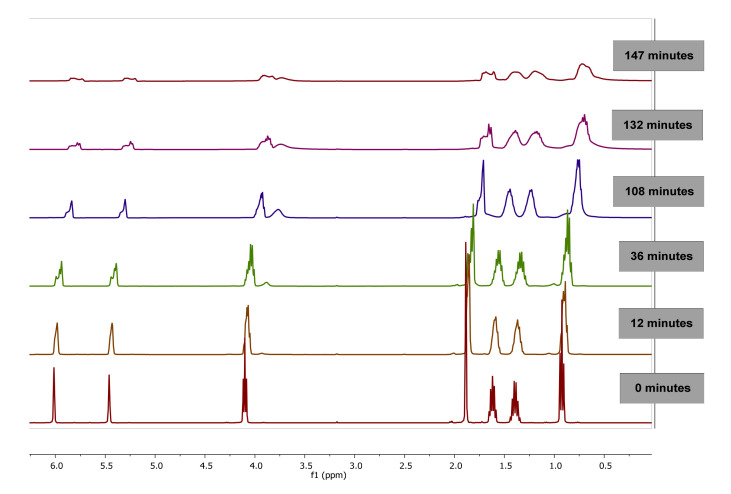
In this work, we explore the ability to generate well-defined poly(butyl methacrylate) (PBMA) nanostructures by "in situ" polymerization of butyl methacrylate monomer (BMA). PBMA nanostructures of high and low aspect ratios have been successfully obtained through the free radical polymerization (FRP) of a BMA monomer in anodic aluminum oxide (AAO) nanoreactors of suitable size. A polymerization kinetics process has been followed by differential scanning calorimetry (DSC) and proton Nuclear Magnetic Resonance spectroscopy (H-NMR).The determination of the kinetics of polymerization through DSC is based on a quick and direct analysis of the exothermic polymerization process, whereas the analysis through H-NMR also allows the unambiguous chemical analysis of the resulting polymer. When compared to bulk polymerization, both techniques demonstrate confinement effects. Moreover, DSC and H-NMR analysis give the same kinetics results and show a gel-effect in all the cases. The number average molecular weight (Mn) of the PBMA obtained in AAO of 60-300 nm are between 30·10-175·10 g/mol. Even if the Mn value is lower with respect to that obtained in bulk polymerization, it is high enough to maintain the polymer properties. As determined by SEM morphological characterization, once extracted from the AAO nanoreactor, the polymer nanostructures show controlled homogeneous aspect/size all throughout the length of nanopillar over a surface area of few cm. The Young's modulus of low aspect ratio PBMA nanopillars determined by AFM gives a value of 3.1 ± 1.1 MPa. In this work, a 100% of PBMA polymer nanostructures are obtained from a BMA monomer in AAO templates through a quick double process: 30 min of monomer immersion at room temperature and 90 min of polymerization reaction at 60 °C. While the same nanostructures are obtained by polymer infiltration of PBMA at 200 °C in about 6 h, polymerization conditions are much softer than those corresponding to the polymer infiltration process. Furthermore, the H-NMR technique has been consolidated as a tool for studying the kinetics of the copolymerization reactions in confinement and the determination of monomer reactivity ratios.
在这项工作中,我们探索了通过甲基丙烯酸丁酯单体(BMA)的“原位”聚合来生成结构明确的聚甲基丙烯酸丁酯(PBMA)纳米结构的能力。通过在合适尺寸的阳极氧化铝(AAO)纳米反应器中对BMA单体进行自由基聚合(FRP),已成功获得了高纵横比和低纵横比的PBMA纳米结构。通过差示扫描量热法(DSC)和质子核磁共振光谱(H-NMR)跟踪了聚合动力学过程。通过DSC测定聚合动力学是基于对放热聚合过程的快速直接分析,而通过H-NMR分析还可以对所得聚合物进行明确的化学分析。与本体聚合相比,这两种技术均显示出受限效应。此外,DSC和H-NMR分析给出了相同的动力学结果,并且在所有情况下均显示出凝胶效应。在60-300 nm的AAO中获得的PBMA的数均分子量(Mn)在30·10-175·10 g/mol之间。即使Mn值相对于本体聚合中获得的值较低,但仍足够高以保持聚合物性能。通过SEM形态表征确定,一旦从AAO纳米反应器中提取出来,聚合物纳米结构在几平方厘米的表面积上,在整个纳米柱的长度上都显示出可控的均匀外观/尺寸。通过AFM测定的低纵横比PBMA纳米柱的杨氏模量值为3.1±1.1 MPa。在这项工作中,通过快速的双重过程,从AAO模板中的BMA单体获得了100%的PBMA聚合物纳米结构:在室温下将单体浸泡30分钟,然后在60°C下进行90分钟的聚合反应。虽然通过在200°C下约6小时对PBMA进行聚合物渗透可获得相同的纳米结构,但聚合条件比与聚合物渗透过程相应的条件要温和得多。此外,H-NMR技术已巩固成为研究受限共聚反应动力学和确定单体反应比的工具。