Department of Obstetrics and Gynecology, Kansai Medical University, 2-5-1 Shinmachi, Hirakata, Osaka 573-1010, Japan.
Int J Mol Sci. 2021 Feb 22;22(4):2154. doi: 10.3390/ijms22042154.
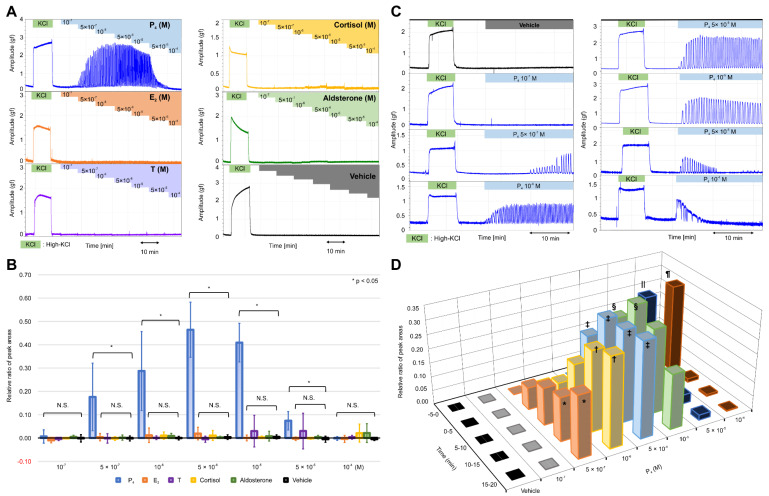
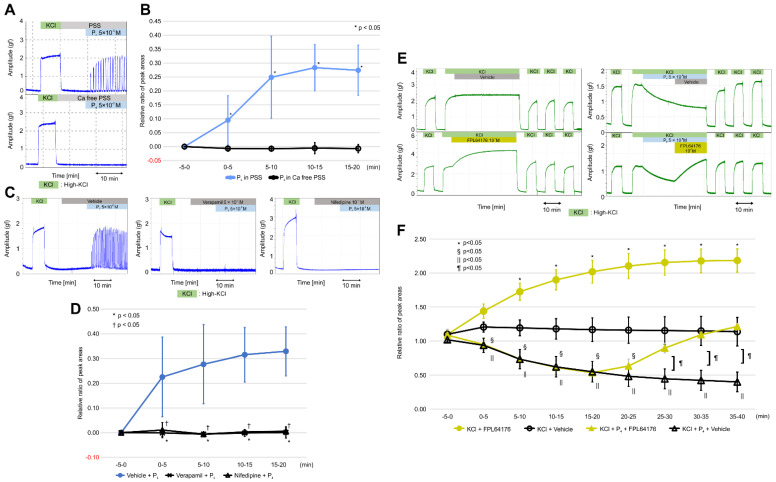
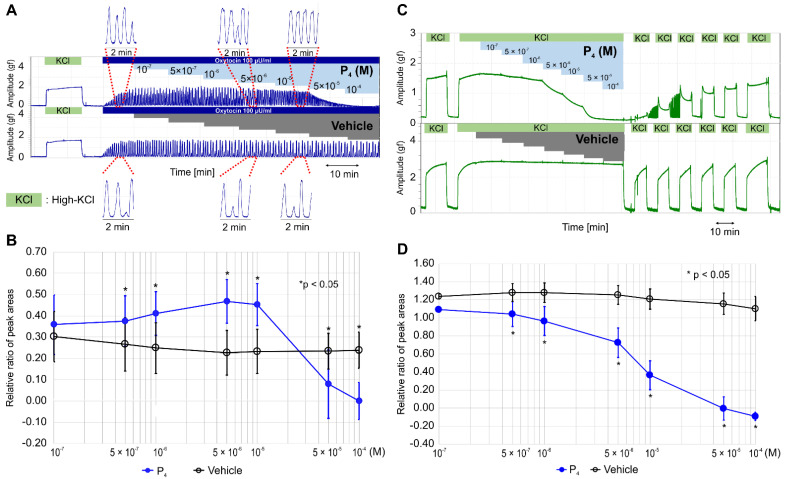
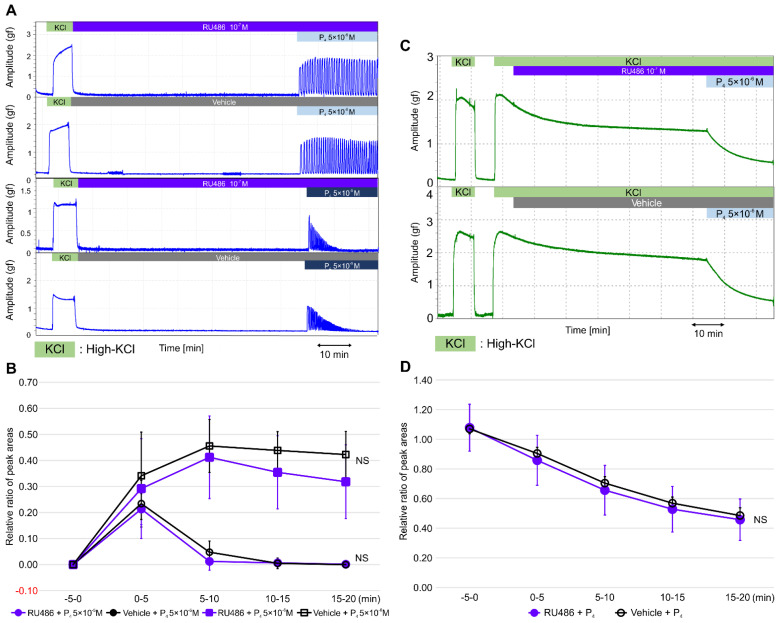
Recently, it has been suggested that progesterone affects the contractile activity of pregnant myometrium via nongenomic pathways; therefore, we aimed to clarify whether progesterone causes and/or inhibits pregnant myometrial contractions via nongenomic pathways. Our in vitro experiments using myometrial strips obtained from rats at 20 days of gestation revealed that progesterone caused myometrial contractions in a concentration- and time-dependent manner at concentrations up to 5 × 10 M; however, this effect decreased at concentrations higher than 5 × 10 M. Similarly, progesterone enhanced oxytocin-induced contractions up to 5 × 10 M and inhibited contractions at concentrations higher than 5 × 10 M. Conversely, progesterone did not enhance high-KCl-induced contractions but inhibited contractions in a concentration- and time-dependent manner at concentrations higher than 5 × 10 M. We also found that RU486 did not affect progesterone-induced contractions or the progesterone-induced inhibition of high-KCl-induced contractions; however, progesterone-induced contractions were blocked by calcium-free phosphate saline solution, verapamil, and nifedipine. In addition, FPL64176, an activator of L-type voltage-dependent calcium channels, enhanced high-KCl-induced contractions and rescued the decrease in high-KCl-induced contractions caused by progesterone. Together, these results suggest that progesterone exerts conflicting nongenomic effects on the contractions of pregnant myometrium via putative L-type voltage-dependent calcium channels.
最近有研究表明孕激素通过非基因组途径影响妊娠子宫的收缩活动;因此,我们旨在阐明孕激素是否通过非基因组途径引起和/或抑制妊娠子宫收缩。我们的体外实验使用来自妊娠 20 天大鼠的子宫带,结果表明孕激素以浓度和时间依赖的方式引起子宫收缩,浓度可达 5×10 M;然而,这种作用在高于 5×10 M 的浓度下减弱。同样,孕激素增强催产素诱导的收缩,最高可达 5×10 M,并抑制高于 5×10 M 的浓度下的收缩。相反,孕激素不会增强高 KCl 诱导的收缩,但以浓度和时间依赖的方式抑制高于 5×10 M 的浓度下的收缩。我们还发现 RU486 不影响孕激素诱导的收缩或孕激素对高 KCl 诱导的收缩的抑制作用;然而,无钙磷酸盐盐水、维拉帕米和硝苯地平阻断了孕激素诱导的收缩。此外,L 型电压依赖性钙通道的激活剂 FPL64176 增强了高 KCl 诱导的收缩,并挽救了孕激素引起的高 KCl 诱导收缩的减少。总之,这些结果表明孕激素通过推定的 L 型电压依赖性钙通道对妊娠子宫的收缩产生相互矛盾的非基因组作用。