Center of Excellence in Inflammation, Infectious Disease and Immunity, James H. Quillen College of Medicine, East Tennessee State University, Johnson City, TN 37614, USA.
Division of Infectious, Inflammatory and Immunologic Diseases, Department of Internal Medicine, Quillen College of Medicine, East Tennessee State University, Johnson City, TN 37614, USA.
Cells. 2021 Feb 23;10(2):475. doi: 10.3390/cells10020475.
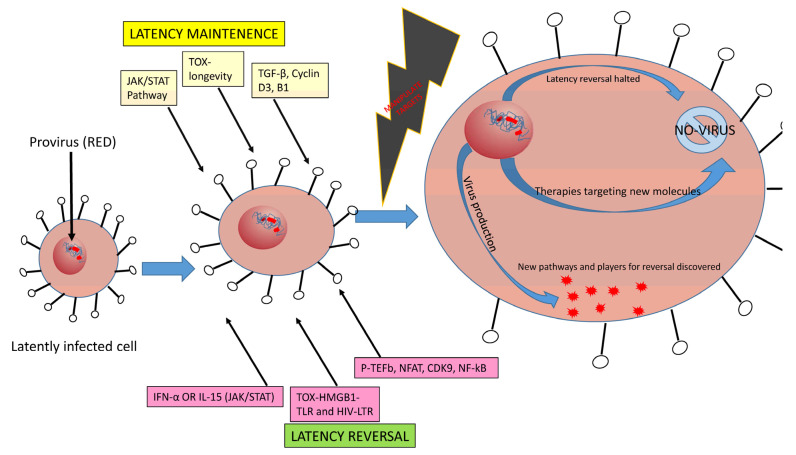
Eradication of latent human immunodeficiency virus (HIV) infection is a global health challenge. Reactivation of HIV latency and killing of virus-infected cells, the so-called "kick and kill" or "shock and kill" approaches, are a popular strategy for HIV cure. While antiretroviral therapy (ART) halts HIV replication by targeting multiple steps in the HIV life cycle, including viral entry, integration, replication, and production, it cannot get rid of the occult provirus incorporated into the host-cell genome. These latent proviruses are replication-competent and can rebound in cases of ART interruption or cessation. In general, a very small population of cells harbor provirus, serve as reservoirs in ART-controlled HIV subjects, and are capable of expressing little to no HIV RNA or proteins. Beyond the canonical resting memory CD4 T cells, HIV reservoirs also exist within tissue macrophages, myeloid cells, brain microglial cells, gut epithelial cells, and hematopoietic stem cells (HSCs). Despite a lack of active viral production, latently HIV-infected subjects continue to exhibit aberrant cellular signaling and metabolic dysfunction, leading to minor to major cellular and systemic complications or comorbidities. These include genomic DNA damage; telomere attrition; mitochondrial dysfunction; premature aging; and lymphocytic, cardiac, renal, hepatic, or pulmonary dysfunctions. Therefore, the arcane machineries involved in HIV latency and its reversal warrant further studies to identify the cryptic mechanisms of HIV reservoir formation and clearance. In this review, we discuss several molecules and signaling pathways, some of which have dual roles in maintaining or reversing HIV latency and reservoirs, and describe some evolving strategies and possible approaches to eliminate viral reservoirs and, ultimately, cure/eradicate HIV infection.
根除潜伏的人类免疫缺陷病毒 (HIV) 感染是全球健康面临的一项挑战。HIV 潜伏期的激活和感染细胞的杀伤,即所谓的“踢和杀”或“冲击和杀”方法,是 HIV 治愈的一种流行策略。虽然抗逆转录病毒疗法 (ART) 通过靶向 HIV 生命周期的多个步骤,包括病毒进入、整合、复制和产生,来阻止 HIV 复制,但它无法清除整合到宿主细胞基因组中的隐匿性前病毒。这些潜伏的前病毒具有复制能力,并且在 ART 中断或停止的情况下会反弹。一般来说,只有一小部分细胞携带前病毒,作为 ART 控制的 HIV 患者中的储库,并且能够表达很少或没有 HIV RNA 或蛋白质。除了经典的静止记忆 CD4 T 细胞外,HIV 储库还存在于组织巨噬细胞、髓样细胞、脑小胶质细胞、肠道上皮细胞和造血干细胞 (HSCs) 中。尽管没有活跃的病毒产生,但潜伏感染 HIV 的患者仍继续表现出异常的细胞信号和代谢功能障碍,导致轻微到严重的细胞和全身并发症或合并症。这些包括基因组 DNA 损伤;端粒损耗;线粒体功能障碍;过早衰老;以及淋巴细胞、心脏、肾脏、肝脏或肺部功能障碍。因此,HIV 潜伏及其逆转所涉及的神秘机制需要进一步研究,以确定 HIV 储库形成和清除的隐匿机制。在这篇综述中,我们讨论了几种分子和信号通路,其中一些在维持或逆转 HIV 潜伏和储库方面具有双重作用,并描述了一些正在发展的策略和可能的方法来消除病毒储库,并最终治愈/根除 HIV 感染。