Handke Nikolaus A, Rupp Alexander B A, Trimpop Nicolai, von Pawel Joachim, Holdenrieder Stefan
Department of Radiology, University Hospital Bonn, 53127 Bonn, Germany.
Institute of Clinical Chemistry and Clinical Pharmacology, University Hospital Bonn, 53127 Bonn, Germany.
Diagnostics (Basel). 2021 Feb 20;11(2):356. doi: 10.3390/diagnostics11020356.
High mobility group box 1 protein (HMGB1) is known for its significant elevation in a multitude of tumors and benign diseases. In this study, we investigated the relevance of soluble HMGB1 for the prediction and monitoring of therapy response as well as the estimation of prognosis in advanced lung cancer.
In a retrospective study, HMGB1 levels were assessed by an enzyme-linked immunosorbent assay (ELISA) in the sera of 96 patients with advanced lung cancer (79 non-small-cell lung carcinoma (NSCLC); 14 small cell lung carcinoma (SCLC), 3 Mesothelioma) prior to cycles 1, 2, and 3 of chemotherapy and correlated with radiological therapy response after 2 and 4 cycles as well as with overall survival. In addition, HMGB1 was compared with established tumor markers cytokeratin 19-fragments (CYFRA 21-1), carcinoembryonic antigen (CEA) and neuron specific enolase (NSE).
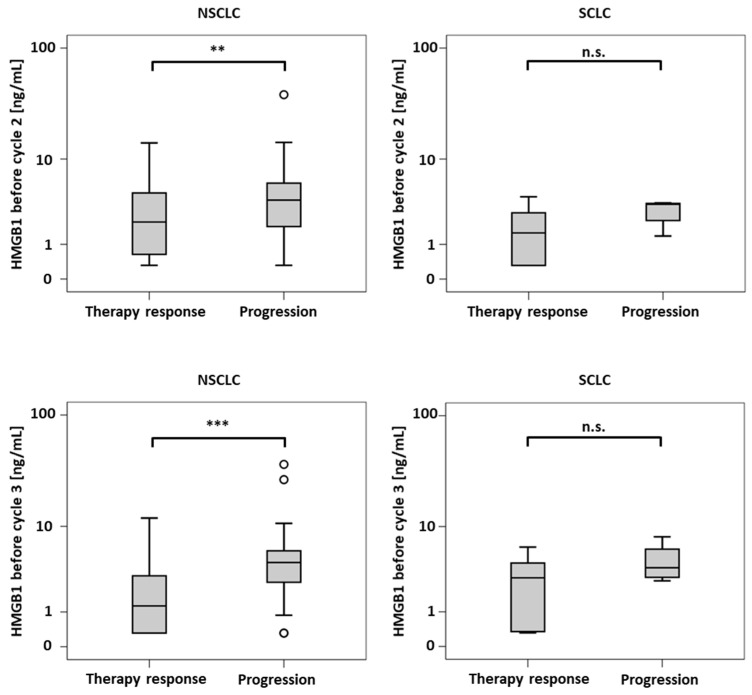
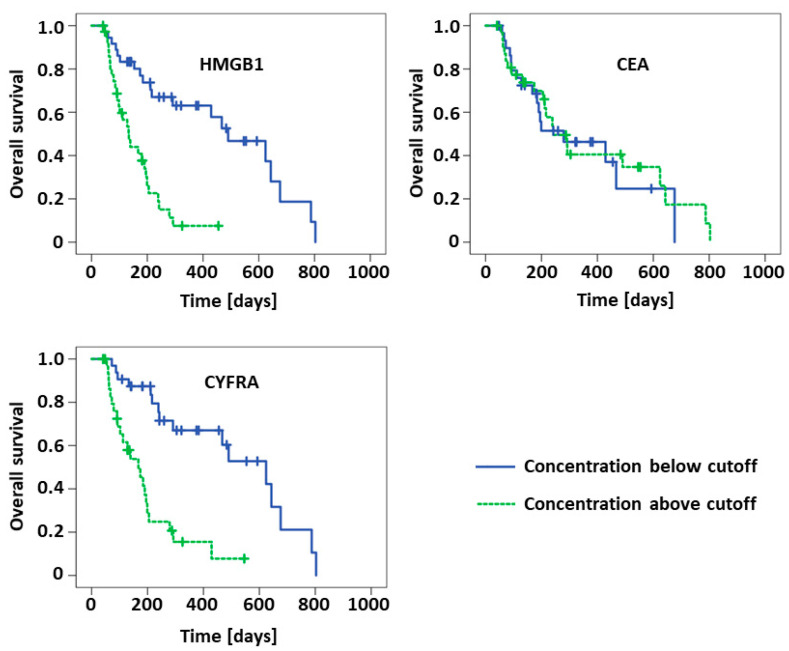
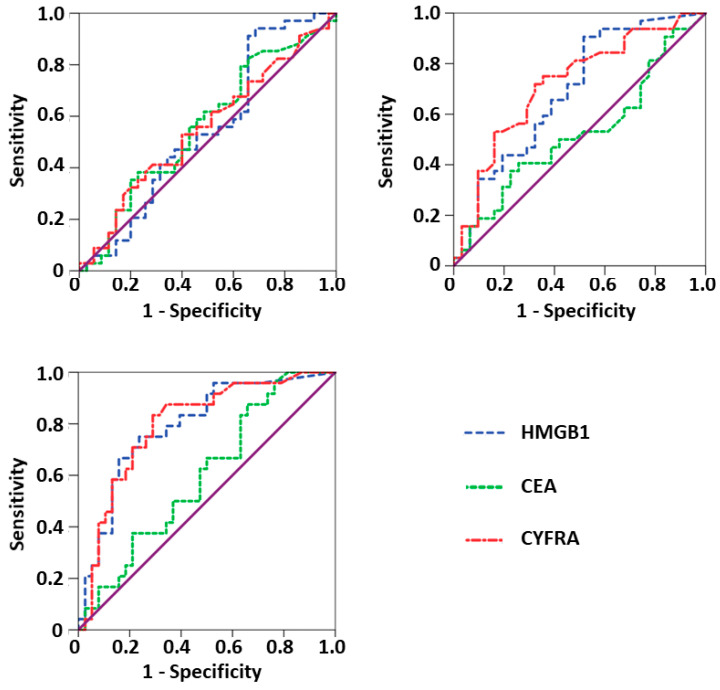
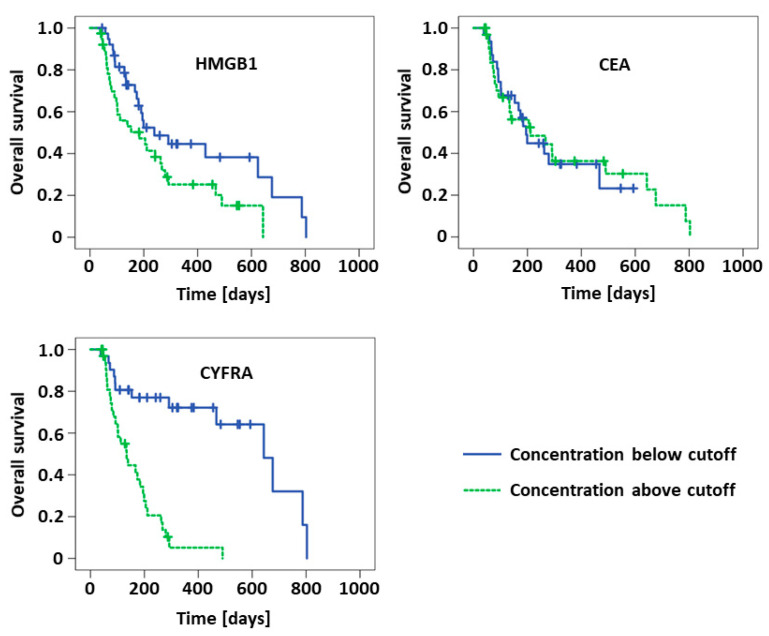
While pretherapeutic HMGB1 levels were not predictive or prognostically relevant in NSCLC patients, HMGB1 values prior to cycles 2 and 3 as well as kinetics from cycle 1 to 2 discriminated significantly between patients with good (remission and stable disease) and poor response (progression). Performance of HMGB1 in receiver operating characteristic (ROC) analyses of NSCLC patients, with areas under the curve (AUCs) of 0.690 at cycle 2 and 0.794 at cycle 3 as well as sensitivities of 34.4% and 37.5%, respectively, for progression at 90% specificity, was comparable with the best tumor-associated antigen CYFRA 21-1 (AUCs 0.719 and 0.799; sensitivities of 37.5% and 41.7%, respectively). Furthermore, high concentrations of HMGB1 at cycles 2 and 3 were associated with shorter overall survival in NSCLC patients.
Soluble HMGB1 is a promising biomarker for prediction of therapy response and prognosis in advanced NSCLC patients.
高迁移率族蛋白B1(HMGB1)在多种肿瘤和良性疾病中显著升高。在本研究中,我们调查了可溶性HMGB1与晚期肺癌治疗反应预测、监测以及预后评估的相关性。
在一项回顾性研究中,采用酶联免疫吸附测定(ELISA)法评估96例晚期肺癌患者(79例非小细胞肺癌(NSCLC);14例小细胞肺癌(SCLC),3例间皮瘤)化疗第1、2和3周期前血清中的HMGB1水平,并将其与第2和4周期后的放射治疗反应以及总生存期相关联。此外,将HMGB1与已确立的肿瘤标志物细胞角蛋白19片段(CYFRA 21-1)、癌胚抗原(CEA)和神经元特异性烯醇化酶(NSE)进行比较。
虽然治疗前HMGB1水平在NSCLC患者中无预测性或预后相关性,但第2和3周期前的HMGB1值以及从第1周期到第2周期的动力学变化在反应良好(缓解和疾病稳定)与反应不佳(进展)的患者之间有显著差异。在NSCLC患者的受试者工作特征(ROC)分析中,HMGB1的表现如下:第2周期曲线下面积(AUC)为0.690,第3周期为0.794,在90%特异性时进展的敏感性分别为34.4%和37.5%,与最佳肿瘤相关抗原CYFRA 21-1相当(AUC分别为0.719和0.799;敏感性分别为37.5%和41.7%)。此外,第2和3周期时高浓度的HMGB1与NSCLC患者较短的总生存期相关。
可溶性HMGB1是预测晚期NSCLC患者治疗反应和预后的有前景的生物标志物。