Liss Franziska, Frech Miriam, Wang Ying, Giel Gavin, Fischer Sabrina, Simon Clara, Weber Lisa Marie, Nist Andrea, Stiewe Thorsten, Neubauer Andreas, Burchert Andreas, Liefke Robert
Institute of Molecular Biology and Tumor Research (IMT), Philipps University of Marburg, 35043 Marburg, Germany.
Clinic for Hematology, Oncology, Immunology and Center for Tumor Biology and Immunology, Philipps University of Marburg, 35037 Marburg, Germany.
Cancers (Basel). 2021 Feb 12;13(4):764. doi: 10.3390/cancers13040764.
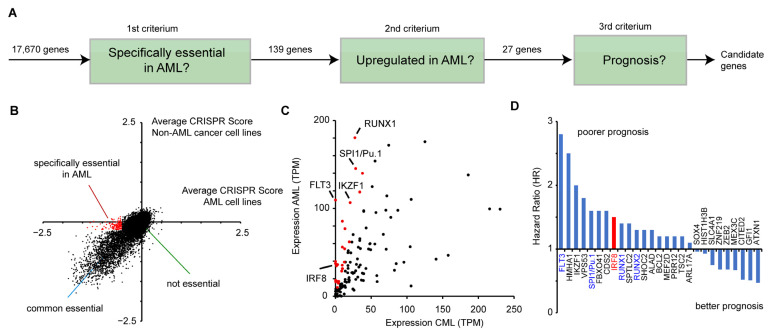
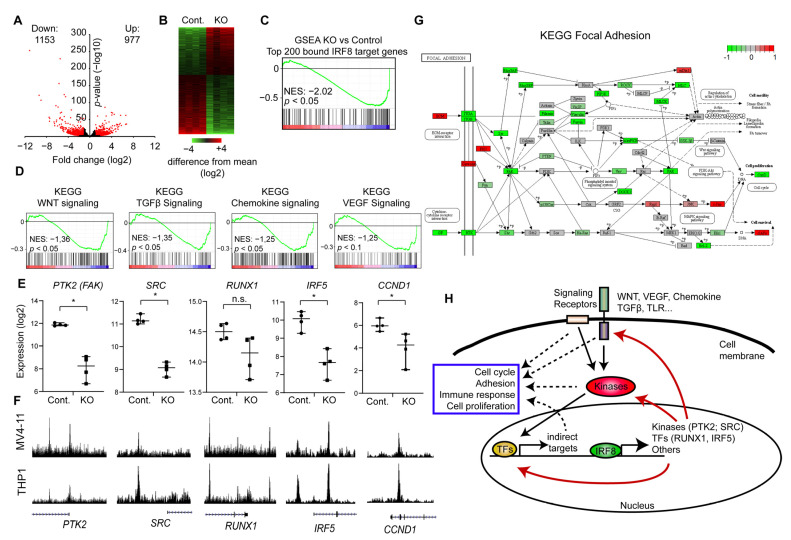
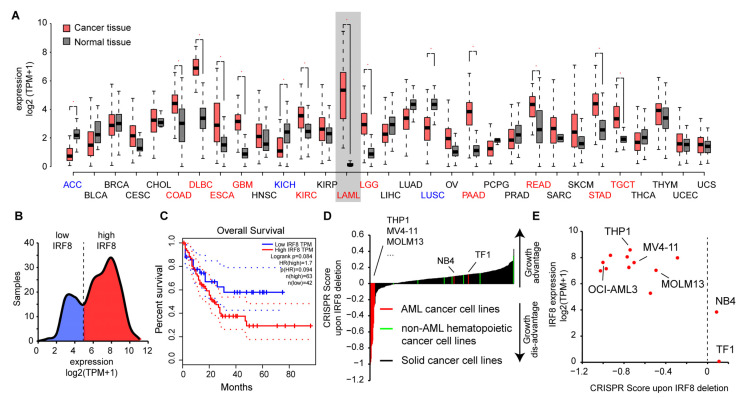
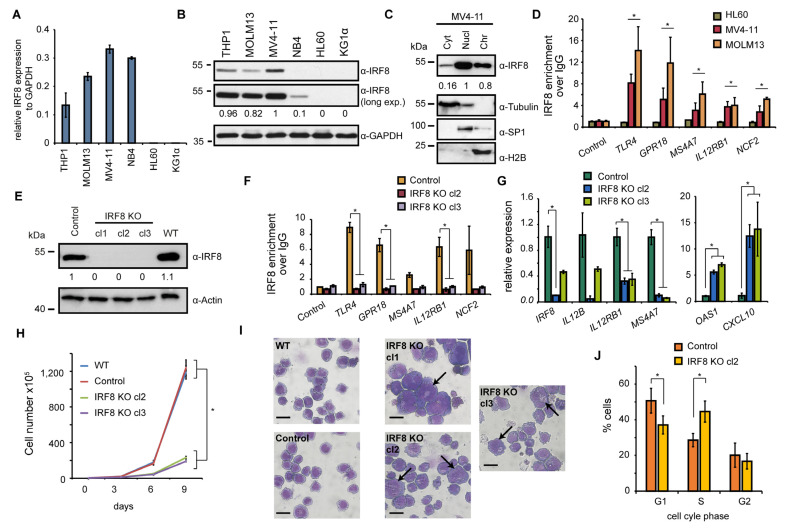
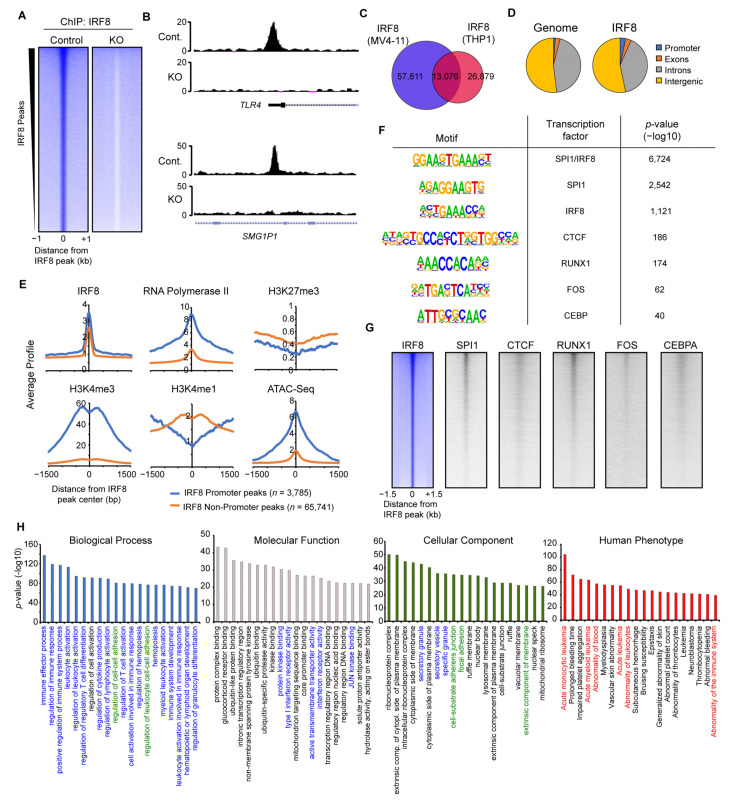
Personalized treatment of acute myeloid leukemia (AML) that target individual aberrations strongly improved the survival of AML patients. However, AML is still one of the most lethal cancer diseases of the 21st century, demonstrating the need to find novel drug targets and to explore alternative treatment strategies. Upon investigation of public perturbation data, we identified the transcription factor IRF8 as a novel AML-specific susceptibility gene in humans. IRF8 is upregulated in a subset of AML cells and its deletion leads to impaired proliferation in those cells. Consistently, high IRF8 expression is associated with poorer patients' prognoses. Combining gene expression changes upon IRF8 deletion and the genome-wide localization of IRF8 in the AML cell line MV4-11, we demonstrate that IRF8 directly regulates key signaling molecules, such as the kinases SRC and FAK, the transcription factors RUNX1 and IRF5, and the cell cycle regulator Cyclin D1. IRF8 loss impairs AML-driving signaling pathways, including the WNT, Chemokine, and VEGF signaling pathways. Additionally, many members of the focal adhesion pathway showed reduced expression, providing a putative link between high IRF8 expression and poor prognosis. Thus, this study suggests that IRF8 could serve as a biomarker and potential molecular target in a subset of human AMLs.
针对个体异常的急性髓系白血病(AML)个性化治疗显著提高了AML患者的生存率。然而,AML仍是21世纪最致命的癌症疾病之一,这表明需要寻找新的药物靶点并探索替代治疗策略。通过对公开的干扰数据进行研究,我们确定转录因子IRF8是人类一种新的AML特异性易感基因。IRF8在一部分AML细胞中上调,其缺失导致这些细胞增殖受损。一致地,IRF8高表达与患者较差的预后相关。结合IRF8缺失后的基因表达变化以及IRF8在AML细胞系MV4-11中的全基因组定位,我们证明IRF8直接调节关键信号分子,如激酶SRC和FAK、转录因子RUNX1和IRF5以及细胞周期调节因子细胞周期蛋白D1。IRF8缺失会损害AML驱动的信号通路,包括WNT、趋化因子和VEGF信号通路。此外,粘着斑通路的许多成员表达降低,这为IRF8高表达与不良预后之间提供了一种假定联系。因此,本研究表明IRF8可作为一部分人类AML的生物标志物和潜在分子靶点。