Huerta Marisol, Roselló Susana, Sabater Luis, Ferrer Ana, Tarazona Noelia, Roda Desamparados, Gambardella Valentina, Alfaro-Cervelló Clara, Garcés-Albir Marina, Cervantes Andrés, Ibarrola-Villava Maider
Department of Medical Oncology, INCLIVA Biomedical Research Institute, University of Valencia, 46010 Valencia, Spain.
CIBERONC, Medical Oncology Unit, INCLIVA Biomedical Research Institute, University of Valencia, 46010 Valencia, Spain.
Cancers (Basel). 2021 Feb 27;13(5):994. doi: 10.3390/cancers13050994.
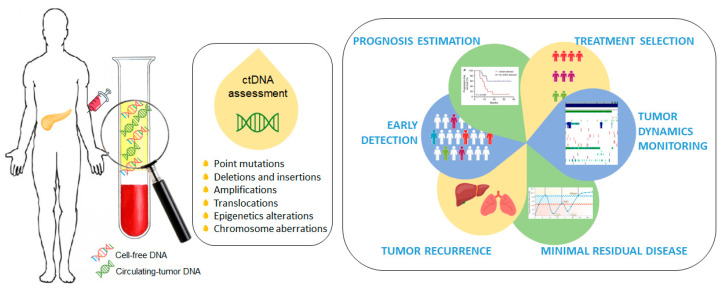
Pancreatic cancer (PC) is one of the most devastating malignant tumors, being the seventh leading cause of cancer-related death worldwide. Researchers and clinicians are endeavoring to develop strategies for the early detection of the disease and the improvement of treatment results. Adequate biopsy is still challenging because of the pancreas's poor anatomic location. Recently, circulating tumor DNA (ctDNA) could be identified as a liquid biopsy tool with huge potential as a non-invasive biomarker in early diagnosis, prognosis and management of PC. ctDNA is released from apoptotic and necrotic cancer cells, as well as from living tumor cells and even circulating tumor cells, and it can reveal genetic and epigenetic alterations with tumor-specific and individual mutation and methylation profiles. However, ctDNA sensibility remains a limitation and the accuracy of ctDNA as a biomarker for PC is relatively low and cannot be currently used as a screening or diagnostic tool. Increasing evidence suggests that ctDNA is an interesting biomarker for predictive or prognosis studies, evaluating minimal residual disease, longitudinal follow-up and treatment management. Promising results have been published and therefore the objective of our review is to understand the current role and the future perspectives of ctDNA in PC.
胰腺癌(PC)是最具毁灭性的恶性肿瘤之一,是全球癌症相关死亡的第七大主要原因。研究人员和临床医生正在努力制定早期检测该疾病和改善治疗效果的策略。由于胰腺解剖位置不佳,进行充分的活检仍然具有挑战性。最近,循环肿瘤DNA(ctDNA)可被鉴定为一种液体活检工具,在PC的早期诊断、预后和管理中作为一种非侵入性生物标志物具有巨大潜力。ctDNA从凋亡和坏死的癌细胞以及活肿瘤细胞甚至循环肿瘤细胞中释放出来,它可以揭示具有肿瘤特异性和个体突变及甲基化谱的遗传和表观遗传改变。然而,ctDNA的敏感性仍然是一个限制因素,其作为PC生物标志物的准确性相对较低,目前不能用作筛查或诊断工具。越来越多的证据表明,ctDNA是预测或预后研究、评估微小残留病、纵向随访和治疗管理的一个有趣的生物标志物。已经发表了一些有前景的结果,因此我们综述的目的是了解ctDNA在PC中的当前作用和未来前景。