De la Vieja Antonio, Riesco-Eizaguirre Garcilaso
Endocrine Tumors Unit (Unidad Funcional de Investigación en Enfermedades Endocrinas (UFIEC), Instituto de Salud Carlos III (ISCIII), Majadahonda, 28220 Madrid, Spain.
Centro de Investigación Biomédica en Red de Cáncer (CIBERONC), Instituto de Salud Carlos III (ISCIII), 28029 Madrid, Spain.
Cancers (Basel). 2021 Feb 27;13(5):995. doi: 10.3390/cancers13050995.
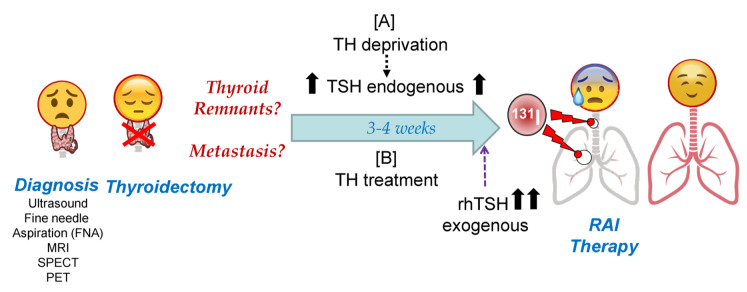
Thyroid radio-iodide therapy (RAI) is one of the oldest known and used targeted therapies. In thyroid cancer, it has been used for more than eight decades and is still being used to improve thyroid tumor treatment to eliminate remnants after thyroid surgery, and tumor metastases. Knowledge at the molecular level of the genes/proteins involved in the process has led to improvements in therapy, both from the point of view of when, how much, and how to use the therapy according to tumor type. The effectiveness of this therapy has spread into other types of targeted therapies, and this has made sodium/iodide symporter (NIS) one of the favorite theragnostic tools. Here we focus on describing the molecular mechanisms involved in radio-iodide therapy and how the alteration of these mechanisms in thyroid tumor progression affects the diagnosis and results of therapy in the clinic. We analyze basic questions when facing treatment, such as: (1) how the incorporation of radioiodine in normal, tumor, and metastatic thyroid cells occurs and how it is regulated; (2) the pros and cons of thyroid hormonal deprivation vs. recombinant human Thyroid Stimulating Hormone (rhTSH) in radioiodine residence time, treatment efficacy, thyroglobulin levels and organification, and its influence on diagnostic imaging tests and metastasis treatment; and (3) the effect of stunning and the possible causes. We discuss the possible incorporation of massive sequencing data into clinical practice, and we conclude with a socioeconomical and clinical vision of the above aspects.
甲状腺放射性碘治疗(RAI)是已知最古老且应用的靶向治疗方法之一。在甲状腺癌治疗中,它已使用了八十多年,目前仍用于改善甲状腺肿瘤治疗,以清除甲状腺手术后的残留组织及肿瘤转移灶。对该过程中涉及的基因/蛋白质分子水平的认识,从治疗时机、剂量以及根据肿瘤类型选择治疗方式等方面推动了治疗的改进。这种治疗方法的有效性已扩展到其他类型的靶向治疗中,这使得钠/碘同向转运体(NIS)成为备受青睐的诊疗工具之一。在此,我们着重描述放射性碘治疗所涉及的分子机制,以及甲状腺肿瘤进展过程中这些机制的改变如何影响临床诊断和治疗结果。我们分析治疗过程中面临的基本问题,例如:(1)放射性碘在正常甲状腺细胞、肿瘤细胞和转移甲状腺细胞中的摄取过程及其调控机制;(2)甲状腺激素剥夺与重组人促甲状腺激素(rhTSH)在放射性碘滞留时间、治疗效果、甲状腺球蛋白水平及碘化过程方面的利弊,以及它们对诊断性成像检查和转移灶治疗的影响;(3)“顿抑”效应及其可能的原因。我们探讨大规模测序数据纳入临床实践的可能性,并从社会经济和临床角度对上述方面进行总结。