Reproductive Medicine Center, Henan Provincial People's Hospital, People's Hospital of Zhengzhou University, Zhengzhou, 450003, Henan, China.
Henan Joint International Research Laboratory of Reproductive Bioengineering, Henan Provincial People's Hospital, People's Hospital of Zhengzhou University Zhengzhou, Zhengzhou, 450003, Henan, China.
Reprod Biol Endocrinol. 2021 Mar 6;19(1):41. doi: 10.1186/s12958-021-00714-3.
Spent culture medium (SCM) as a source of DNA for preimplantation genetic tests aneuploidy (PGT-A) has been widely discussed.
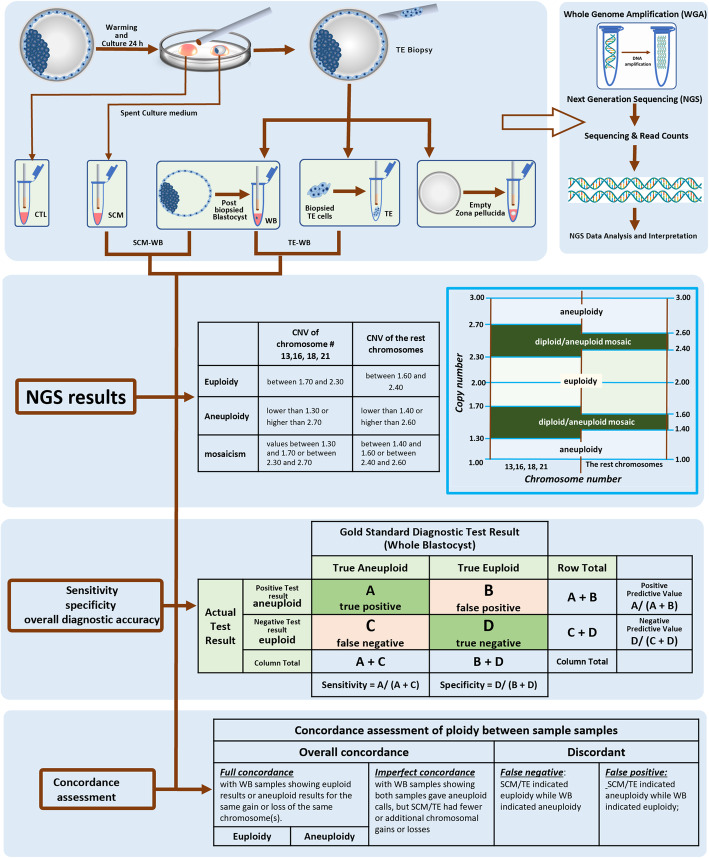
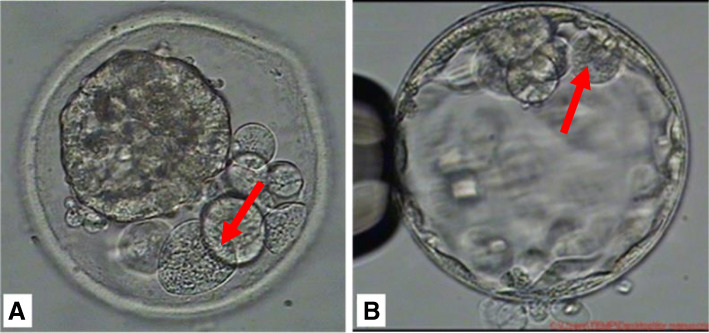
Seventy-five blastocysts that were donated for research provided a unique possibility in which multiple specimens, including trophectoderm (TE) biopsy, SCM, and paired corresponding whole blastocyst (WB) specimens from the same blastocyst source, could be utilized for the purpose of this preclinical validation.
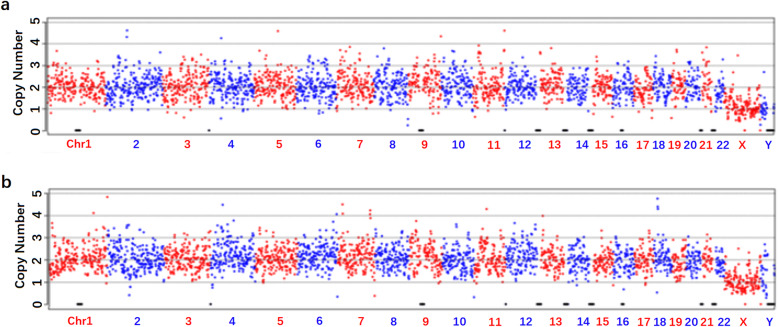
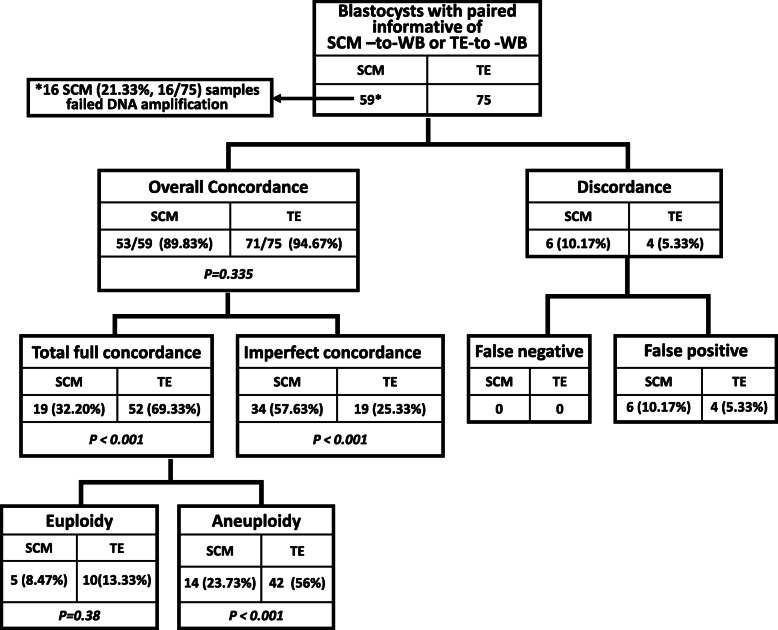
To conduct a validation ploidy concordance assessment, we evaluated the full chromosomal concordance rates between SCM and WB (SCM-to-WB), and between TE and WB (TE-to-WB) as well as sensitivity, specificity and overall diagnostic accuracy. 78.67% (59/75) of NGS results in the SCM group were interpretable, a significantly lower percentage than their corresponding TE and WB groups. This discrepancy manifests itself in intrinsically low quantity and poor integrity DNA from SCM. Subsequently, remarkable differences in full concordance rates (including mosaicism, and segmental aneuploidies) are seen as follows: 32.2% (SCM-to-WB, 19/59) and 69.33% (TE-to-WB, 52/75), (p < 0.001). In such cases, full concordance rates were 27.27% (15/55) in SCM-to-WB, and, 76% (57/75) in TE-to-WB (p < 0.001). Collectively, the NGS data from SCM also translated into lower sensitivities, Positive Predictive Value (PPV), Negative Predictive Value (NPV), overall diagnostic accuracies, and higher Negative Likelihood Ratio (NLR).
Our study reveals that DNA is detectable in the majority of SCM samples. Individual chromosomal aberration, such as segmental aneuploidy and mosaicism, can be quantitatively and qualitatively measured. However, TE still provides a more accurate and reliable high-throughput methodology for PGT-A. Meanwhile, cell-free DNA in SCM reporting lacks uniform diagnostic interpretations. Considering that this test is meant to determine which embryos are relegated to be discarded, PGT-A with cell-free DNA in SCM should not be permitted to be applied in routine clinical settings for diagnosis purpose.
用于植入前遗传学检测非整倍体(PGT-A)的胚胎培养液(SCM)已被广泛讨论。
75 个用于研究的囊胚提供了一个独特的可能性,即可以利用多个标本,包括滋养外胚层(TE)活检、SCM 以及来自同一囊胚来源的配对完整囊胚(WB)标本,进行这种临床前验证。
为了进行染色体整倍性一致性评估,我们评估了 SCM 和 WB(SCM-to-WB)之间、TE 和 WB(TE-to-WB)之间的全染色体一致性率以及敏感性、特异性和总体诊断准确性。NGS 结果在 SCM 组的可解释率为 78.67%(59/75),明显低于其相应的 TE 和 WB 组。这一差异表现在 SCM 中内在的低数量和较差的 DNA 完整性。随后,在全一致性率(包括镶嵌和片段性非整倍体)方面出现显著差异:32.2%(SCM-to-WB,19/59)和 69.33%(TE-to-WB,52/75),(p<0.001)。在这种情况下,SCM-to-WB 的全一致性率为 27.27%(15/55),而 TE-to-WB 的全一致性率为 76%(57/75)(p<0.001)。总的来说,SCM 的 NGS 数据也转化为较低的敏感性、阳性预测值(PPV)、阴性预测值(NPV)、总体诊断准确性和较高的阴性似然比(NLR)。
我们的研究表明,SCM 中的大多数样本都可检测到 DNA。个体染色体异常,如片段性非整倍体和镶嵌,可进行定量和定性测量。然而,TE 仍然为 PGT-A 提供了更准确和可靠的高通量方法。同时,SCM 中的无细胞 DNA 报告缺乏统一的诊断解释。鉴于该测试旨在确定哪些胚胎被淘汰,不允许将 SCM 中的无细胞 DNA 应用于常规临床环境中的诊断目的。