Humanities and Social Sciences, California Institute of Technology, Pasadena, CA 91125, USA.
Humanities and Social Sciences, California Institute of Technology, Pasadena, CA 91125, USA.
Trends Cogn Sci. 2021 May;25(5):342-354. doi: 10.1016/j.tics.2021.01.013. Epub 2021 Mar 2.
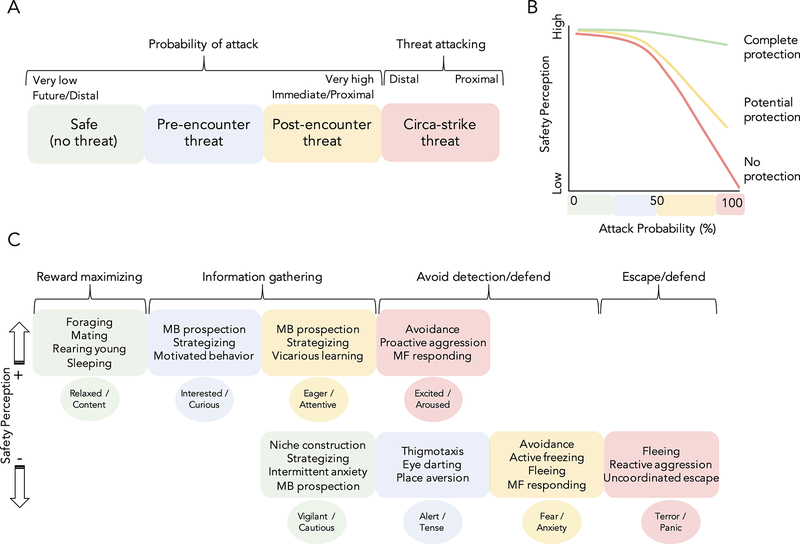
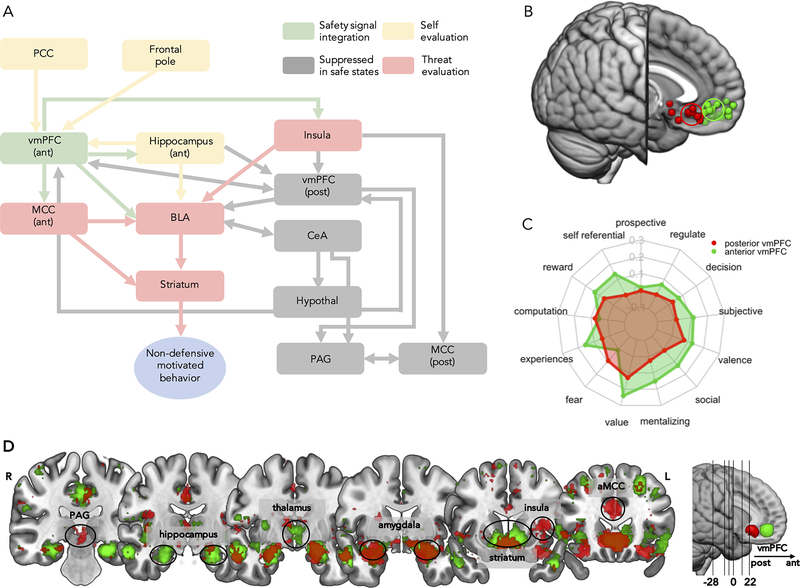
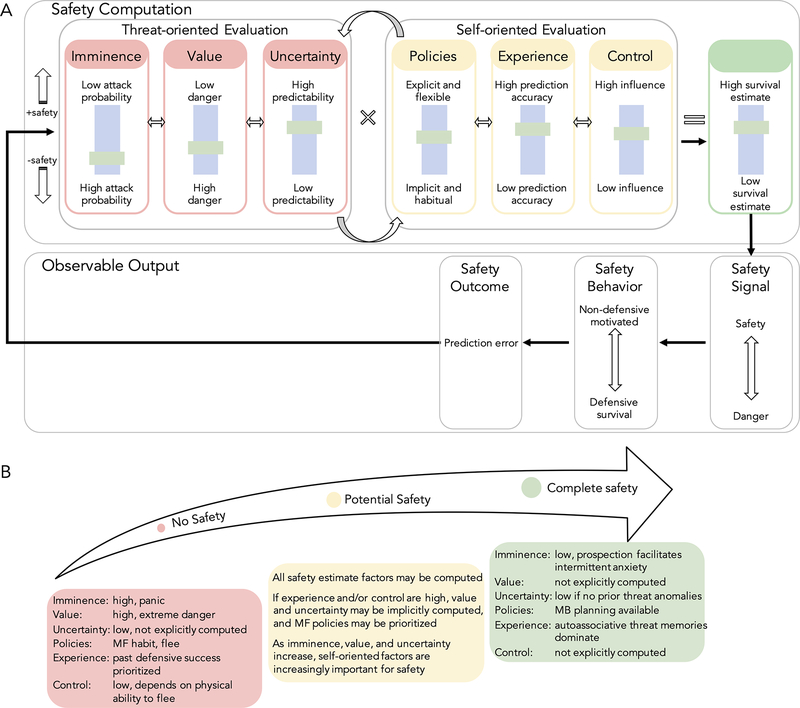
Accurately estimating safety is critical to pursuing nondefensive survival behaviors. However, little attention has been paid to how the human brain computes safety. We conceptualize a model that consists of two components: (i) threat-oriented evaluations that focus on threat value, imminence, and predictability; and (ii) self-oriented evaluations that focus on the agent's experience, strategies, and ability to control the situation. Our model points to the dynamic interaction between these two components as a mechanism of safety estimation. Based on a growing body of human literature, we hypothesize that distinct regions of the ventromedial prefrontal cortex (vmPFC) respond to threat and safety to facilitate survival decisions. We suggest safety is not an inverse of danger, but reflects independent computations that mediate defensive circuits and behaviors.
准确估计安全性对于追求非防御性生存行为至关重要。然而,人们很少关注人类大脑如何计算安全性。我们提出了一个由两个组成部分构成的模型:(i)面向威胁的评估,侧重于威胁值、迫近性和可预测性;以及(ii)面向自我的评估,侧重于主体的经验、策略和控制情况的能力。我们的模型指出,这两个组成部分之间的动态相互作用是安全估计的机制。基于越来越多的人类文献,我们假设腹内侧前额叶皮层(vmPFC)的不同区域会对威胁和安全做出反应,以促进生存决策。我们认为安全不是危险的反面,而是反映了介导防御性回路和行为的独立计算。