Department of Rheumatology, Odense Universitetshospital, Odense, Denmark
Section of Rheumatology, Department of Medicine, Svendborg Hospital, Odense University Hospital, Svendborg, Denmark.
RMD Open. 2021 Mar;7(1). doi: 10.1136/rmdopen-2020-001494.
To correlate the level of fibrocytes in peripheral blood, synovial tissue and in vitro culture in rheumatoid arthritis (RA) with changes in disease activity, imaging and pulmonary function.
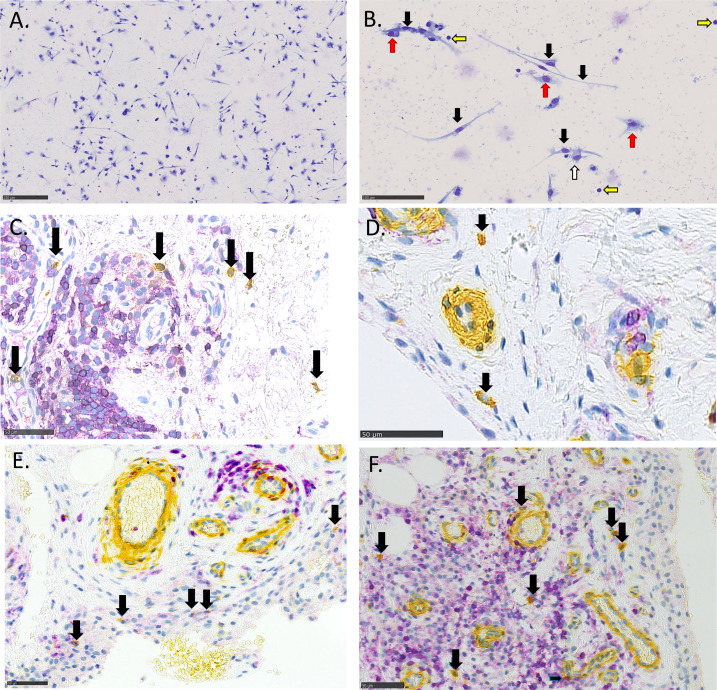
Twenty patients with early RA (ERA) and 20 patients with long-standing RA (LRA) were enrolled in a 6-month prospective study. Sixteen patients undergoing wrist arthroscopy were healthy controls. Patients with RA underwent pulmonary function tests, ultrasound and synovial ultrasound-guided needle biopsy of the same wrist at baseline and 6 months. Wrist MRI was performed at baseline (all) and 6 months (ERA). Circulating fibrocytes were measured by flow cytometry, in vitro by the number of monocytes that were differentiated to fibrocytes and in synovial biopsies by counting in histological sections.
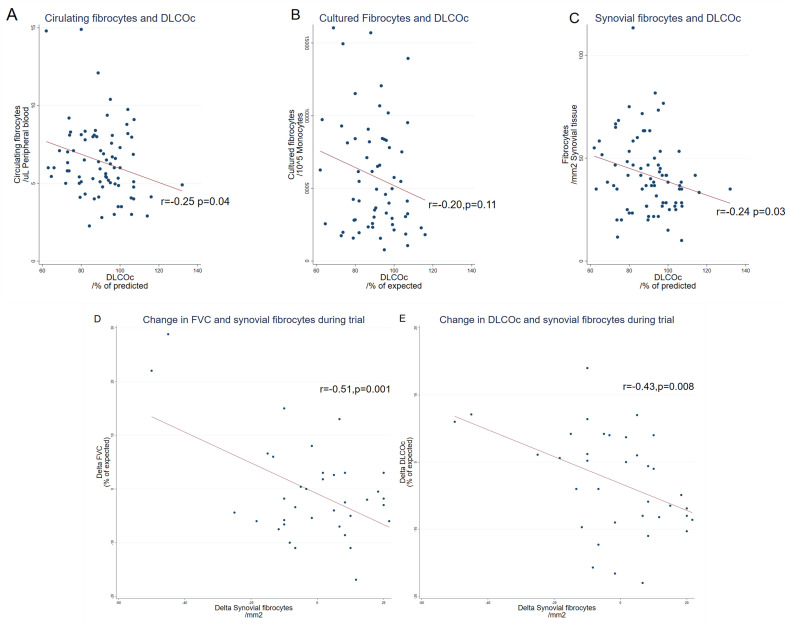
Fibrocytes were primarily located around vessels and in the subintimal area in the synovium. Fibrocyte levels did not decline during the trial despite effective RA treatment. In the ERA group, increased synovitis assessed by ultrasound was moderate and strongly correlated with an increase in circulating and synovial fibrocyte levels, respectively. Increased synovitis assessed by MRI during the trial in the ERA group was moderately correlated with both increased numbers of circulating and cultured fibrocytes. Absolute diffusion capacity level was overall weakly negatively correlated with the level of circulating and synovial fibrocytes. The decline in diffusion capacity during the trial was moderately correlated with increased levels of synovial fibrocytes.
Our findings suggest that fibrocytes are involved in RA pathogenesis, both in the synovium and the reduction in lung function seen in a part of patients with RA.
NCT02652299.
将类风湿关节炎(RA)患者外周血、滑膜组织和体外培养的纤维细胞水平与疾病活动度、影像学和肺功能变化相关联。
纳入 20 例早期 RA(ERA)患者和 20 例长期 RA(LRA)患者进行 6 个月的前瞻性研究。16 例接受腕关节镜检查的患者为健康对照。RA 患者在基线和 6 个月时进行肺功能检查、超声检查和同一腕关节滑膜超声引导下的活检。基线(所有患者)和 6 个月(ERA 患者)进行腕关节 MRI 检查。通过流式细胞术测量循环纤维细胞,体外通过分化为纤维细胞的单核细胞数量测量,以及在滑膜活检中通过组织学切片计数测量。
纤维细胞主要位于滑膜中的血管周围和内膜下区域。尽管 RA 治疗有效,但在试验过程中纤维细胞水平并未下降。在 ERA 组中,超声评估的滑膜炎增加是中度的,与循环和滑膜纤维细胞水平的增加分别呈强烈相关。在 ERA 组中,试验期间 MRI 评估的滑膜炎增加与循环和培养的纤维细胞数量增加均呈中度相关。总的来说,弥散量水平与循环和滑膜纤维细胞水平呈弱负相关。试验过程中弥散量的下降与滑膜纤维细胞水平的增加中度相关。
我们的研究结果表明,纤维细胞参与了 RA 的发病机制,不仅在滑膜中,而且在部分 RA 患者的肺功能下降中也发挥了作用。
NCT02652299。