Orthopedics and Trauma Department, SS Annunziata Hospital, ASL CN1, Savigliano (CN), Italy.
Orthopeadics and Traumatology Department, Faculty of Medicine and Surgery, CTO Hospital, University of Turin, Turin, Italy.
J Orthop Traumatol. 2021 Mar 6;22(1):8. doi: 10.1186/s10195-021-00567-x.
In the last decade, the increase in the use of the direct anterior approach to the hip has contributed to the diffusion of the use of short stems in orthopedic surgery. The aim of the study is to verify the medium-term clinical and radiographic results of a cementless anatomic short stem in the anterior approach to the hip. We also want to verify whether the use of the standard operating room table or the leg positioner can affect the incidence of pre- and postoperative complications.
All total hip arthroplasty patients with a 1-year minimum follow-up who were operated using the MiniMAX stem between January 2010 and December 2019 were included in this study. Clinical evaluation included the Harris Hip Score (HHS), Western Ontario and McMaster Universities Hip Outcome Assessment (WOMAC) Score, and Short Form-36 (SF-36) questionnaires. Bone resorption and remodeling, radiolucency, osteolysis, and cortical hypertrophy were analyzed in the postoperative radiograph and were related to the final follow-up radiographic results. Complications due to the use of the standard operating room table or the leg positioner were evaluated.
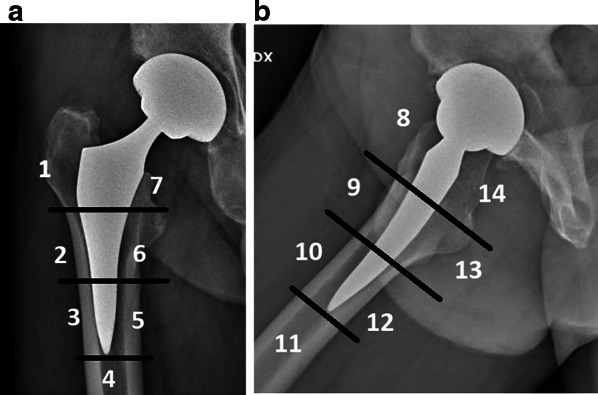
A total of 227 patients (238 hips) were included in the study. Average age at time of surgery was 62 years (range 38-77 years). Mean follow-up time was 67.7 months (range 12-120 months). Kaplan-Meier survivorship analysis after 10 years revealed 98.2% survival rate with revision for loosening as endpoint. The mean preoperative and postoperative HHS were 38.35 and 94.2, respectively. The mean preoperative and postoperative WOMAC Scores were 82.4 and 16.8, respectively. SF-36 physical and mental scores averaged 36.8 and 42.4, respectively, before surgery and 72.4 and 76.2, respectively, at final follow-up. The radiographic change around the stem showed bone hypertrophy in 55 cases (23%) at zone 3. In total, 183 surgeries were performed via the direct anterior approach (DAA) on a standard operating room table, and 44 surgeries were performed on the AMIS mobile leg positioner. Comparison between the two patient groups did not reveal significant differences.
In conclusion, a short, anatomic, cementless femoral stem provided stable metaphyseal fixation in younger patients. Our clinical and radiographic results support the use of this short stem in the direct anterior approach.
IV.
在过去的十年中,髋关节直接前入路的应用增加促进了矫形外科中短柄的应用扩散。本研究的目的是验证在髋关节前入路中使用非骨水泥解剖型短柄的中期临床和影像学结果。我们还想验证使用标准手术台或腿部定位器是否会影响术前和术后并发症的发生率。
本研究纳入了 2010 年 1 月至 2019 年 12 月期间使用 MiniMAX 柄进行全髋关节置换术且随访至少 1 年的所有患者。临床评估包括 Harris 髋关节评分(HHS)、西安大略和麦克马斯特大学髋关节评分(WOMAC)和简明健康状况调查问卷 36 项(SF-36)。术后 X 线片分析了骨吸收和重塑、透光性、骨溶解和皮质肥厚,并将其与最终随访的影像学结果相关联。评估了因使用标准手术台或腿部定位器引起的并发症。
本研究共纳入 227 例患者(238 髋)。手术时的平均年龄为 62 岁(38-77 岁)。平均随访时间为 67.7 个月(12-120 个月)。10 年后的 Kaplan-Meier 生存分析显示,以翻修为终点的生存率为 98.2%。术前和术后平均 HHS 分别为 38.35 和 94.2。术前和术后 WOMAC 评分分别为 82.4 和 16.8。术前和术后 SF-36 生理和心理评分分别为 36.8 和 42.4,最终随访时分别为 72.4 和 76.2。柄周围的影像学变化显示 3 区有 55 例(23%)出现骨肥大。共有 183 例手术在标准手术台上通过直接前入路(DAA)进行,44 例手术在 AMIS 移动腿部定位器上进行。对两组患者进行比较,未发现显著差异。
总之,一种短的、解剖学的、非骨水泥股骨柄为年轻患者提供了稳定的干骺端固定。我们的临床和影像学结果支持在直接前入路中使用这种短柄。
IV 级。