Keski Hakan
Department of Hematology, Umraniye Training and Research Hospital, Elmalıkent Mh. Adem Yavuz Cd. No: 1 Ümraniye, İstanbul, Turkey.
Indian J Hematol Blood Transfus. 2021 Oct;37(4):534-542. doi: 10.1007/s12288-021-01407-y. Epub 2021 Feb 27.
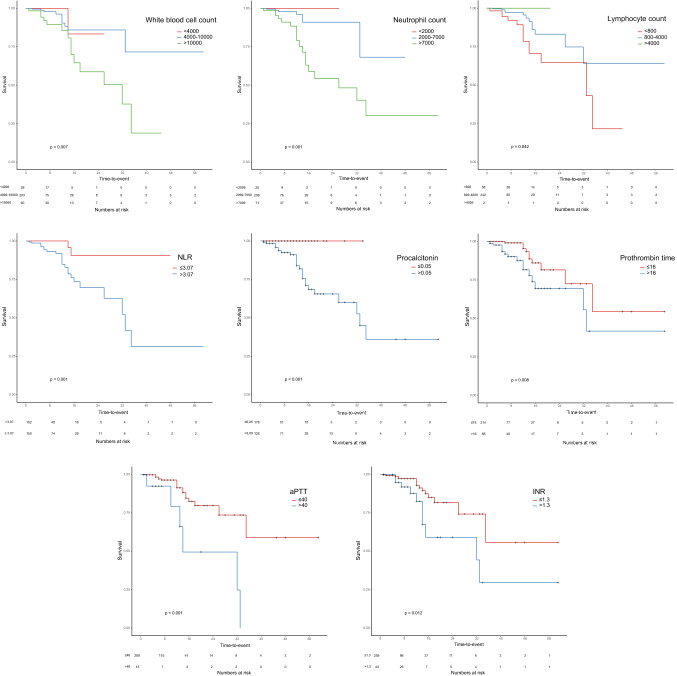
We aimed to evaluate the predictive ability of hematological and inflammatory parameters for mortality in COVID-19 patients. This was a retrospective study of hospitalized COVID-19 patients over 18 years old between March 2020 and May 2020. Patients were diagnosed to have COVID-19 based either on chest computed tomography findings or reverse transcriptase-polymerase chain reaction test. Age, gender, chronic medical conditions, and laboratory values including hemogram parameters (white blood cell, neutrophil, lymphocyte, and platelet counts), neutrophil to lymphocyte ratio, D-dimer, ferritin, fibrinogen, C-reactive protein, procalcitonin, prothrombin time, activated partial thromboplastin time and the international normalized ratio were recorded. Overall, we included 302 patients. Of these, 148 patients were male; the male to female ratio was 0.961. The mean age of the entire study cohort was 57.1 ± 17.6 years. The most common chronic medical condition was hypertension (38.1%). Half of the patients received low molecular weight heparin. During the study period, 25 patients (8.2%) died. White blood cell count and neutrophil count were significantly higher, whereas lymphocyte count was significantly lower in the deceased patients. The median neutrophil to lymphocyte ratio was 11.6 in the deceased patients, it was significantly higher than the surviving patients ( < 0.001). The values of C-reactive protein, procalcitonin, D-dimer, and ferritin were significantly higher among the deceased patients. Prothrombin time, activated partial thromboplastin time and the international normalized ratio were significantly longer in the deceased group compared with the surviving group. Logistic regression analysis showed age > 65 years, neutrophil to lymphocyte ratio, activated partial thromboplastin time, and hypertension as the independent predictors of mortality. The rate of abnormal inflammatory and hematologic-coagulation parameters increased with the COVID-19 severity. Age > 65 years, hypertension, activated partial thromboplastin time and neutrophil to lymphocyte ratio were the independent predictors of mortality.
我们旨在评估血液学和炎症参数对COVID-19患者死亡率的预测能力。这是一项对2020年3月至2020年5月期间住院的18岁以上COVID-19患者的回顾性研究。患者根据胸部计算机断层扫描结果或逆转录聚合酶链反应检测被诊断为患有COVID-19。记录年龄、性别、慢性疾病状况以及实验室值,包括血常规参数(白细胞、中性粒细胞、淋巴细胞和血小板计数)、中性粒细胞与淋巴细胞比值、D-二聚体、铁蛋白、纤维蛋白原、C反应蛋白、降钙素原、凝血酶原时间、活化部分凝血活酶时间和国际标准化比值。总体而言,我们纳入了302例患者。其中,148例为男性;男女比例为0.961。整个研究队列的平均年龄为57.1±17.6岁。最常见的慢性疾病状况是高血压(38.1%)。一半的患者接受了低分子量肝素治疗。在研究期间,25例患者(8.2%)死亡。死亡患者的白细胞计数和中性粒细胞计数显著更高,而淋巴细胞计数显著更低。死亡患者的中性粒细胞与淋巴细胞比值中位数为11.6,显著高于存活患者(<0.001)。死亡患者中C反应蛋白、降钙素原、D-二聚体和铁蛋白的值显著更高。与存活组相比,死亡组的凝血酶原时间、活化部分凝血活酶时间和国际标准化比值显著更长。逻辑回归分析显示年龄>65岁、中性粒细胞与淋巴细胞比值、活化部分凝血活酶时间和高血压是死亡率的独立预测因素。炎症和血液学-凝血参数异常的发生率随COVID-19严重程度增加而升高。年龄>65岁、高血压、活化部分凝血活酶时间和中性粒细胞与淋巴细胞比值是死亡率的独立预测因素。