Subramani Prabu, K Srinivas, B Kavitha Rani, R Sujatha, B D Parameshachari
Department of Electronics and Communication Engineering, Mahendra Institute of Technology, Namakkal, Tamil Nadu India.
Department of Computer Science and Engineering, CMR Technical Campus, Kandlakoya, Hyderabad, India.
Pers Ubiquitous Comput. 2023;27(3):831-844. doi: 10.1007/s00779-021-01531-6. Epub 2021 Mar 3.
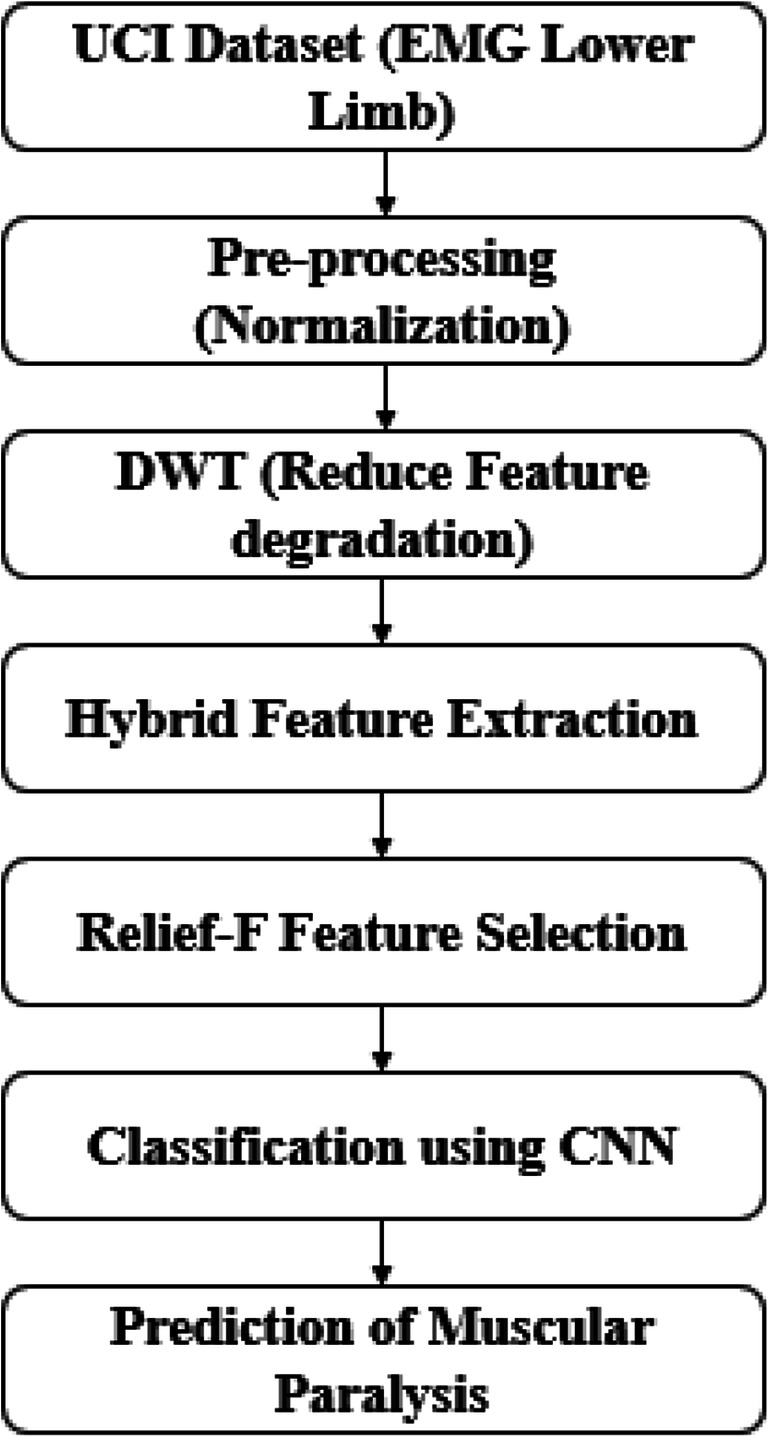
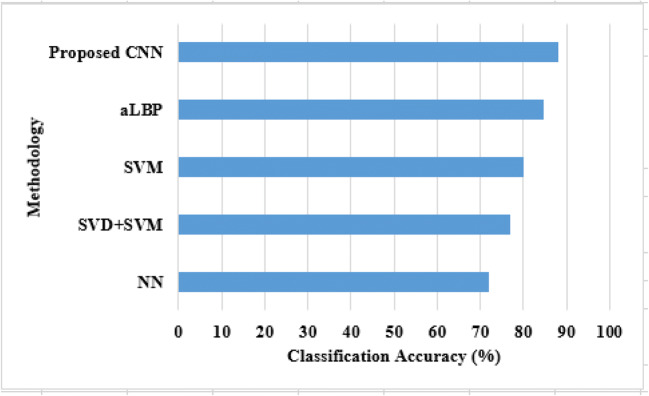
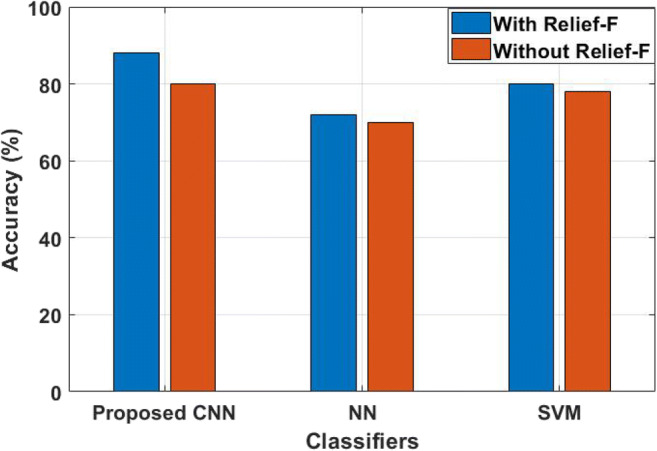
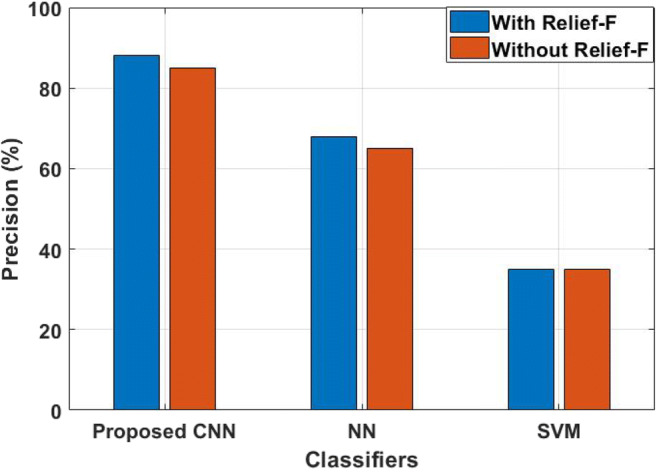
Many Coronavirus disease 2019 (COVID-19) and post-COVID-19 patients experience muscle fatigues. Early detection of muscle fatigue and muscular paralysis helps in the diagnosis, prediction, and prevention of COVID-19 and post-COVID-19 patients. Nowadays, the biomedical and clinical domains widely used the electromyography (EMG) signal due to its ability to differentiate various neuromuscular diseases. In general, nerves or muscles and the spinal cord influence numerous neuromuscular disorders. The clinical examination plays a major role in early finding and diagnosis of these diseases; this research study focused on the prediction of muscular paralysis using EMG signals. Machine learning-based diagnosis of the diseases has been widely used due to its efficiency and the hybrid feature extraction (FE) methods with deep learning classifier are used for the muscular paralysis disease prediction. The discrete wavelet transform (DWT) method is applied to decompose the EMG signal and reduce feature degradation. The proposed hybrid FE method consists of Yule-Walker, Burg's method, Renyi entropy, mean absolute value, min-max voltage FE, and other 17 conventional features for prediction of muscular paralysis disease. The hybrid FE method has the advantage of extract the relevant features from the signals and the Relief-F feature selection (FS) method is applied to select the optimal relevant feature for the deep learning classifier. The University of California, Irvine (UCI), EMG-Lower Limb Dataset is used to determine the performance of the proposed classifier. The evaluation shows that the proposed hybrid FE method achieved 88% of precision, while the existing neural network (NN) achieved 65% of precision and the support vector machine (SVM) achieved 35% of precision on whole EMG signal.
许多2019冠状病毒病(COVID-19)患者和COVID-19康复患者都经历过肌肉疲劳。早期检测肌肉疲劳和肌肉麻痹有助于COVID-19患者和COVID-19康复患者的诊断、预测和预防。如今,生物医学和临床领域广泛使用肌电图(EMG)信号,因为它能够区分各种神经肌肉疾病。一般来说,神经、肌肉和脊髓会引发多种神经肌肉疾病。临床检查在这些疾病的早期发现和诊断中起着重要作用;本研究聚焦于使用EMG信号预测肌肉麻痹。基于机器学习的疾病诊断因其高效性而被广泛应用,并且将深度学习分类器与混合特征提取(FE)方法相结合用于肌肉麻痹疾病预测。应用离散小波变换(DWT)方法对EMG信号进行分解并减少特征退化。所提出的混合FE方法包括尤尔-沃克方法、伯格方法、雷尼熵、平均绝对值、最小-最大电压FE以及其他17种用于预测肌肉麻痹疾病的传统特征。混合FE方法具有从信号中提取相关特征的优势,并且应用了Relief-F特征选择(FS)方法为深度学习分类器选择最优相关特征。使用加利福尼亚大学欧文分校(UCI)的EMG下肢数据集来确定所提出分类器的性能。评估结果表明,所提出的混合FE方法在整个EMG信号上的精度达到了88%,而现有的神经网络(NN)精度为65%,支持向量机(SVM)精度为35%。