Hamza Hazem, Shehata Mahmoud M, Mostafa Ahmed, Pleschka Stephan, Planz Oliver
Department of Immunology, Institute for Cell Biology, Eberhard Karls University of Tübingen, Tübingen, Germany.
Virology Laboratory, Environmental Research Division, National Research Centre, Giza, Egypt.
Front Microbiol. 2021 Feb 12;12:611958. doi: 10.3389/fmicb.2021.611958. eCollection 2021.
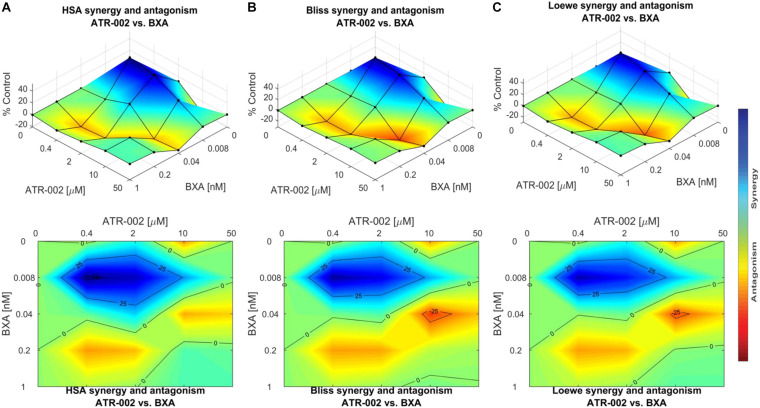
Currently, all available antiviral drugs against influenza virus (IV) that target the virus proteins directly, like Baloxavir acid (BXA), lead to viral resistance. Therefore, cellular mechanisms and factors essential for IV replication are promising antiviral targets. As IV strongly depends on the virus-induced Raf/MEK/ERK signal pathway for efficient generation of infectious progeny virions, this pathway represents an important target. We aimed to determine whether the MEK inhibitor ATR-002 (PD0184264) is able to impair replication of BXA-resistant influenza A virus (IAV) and whether a treatment combining BXA and ATR-002 improves the therapeutic efficiency . A549 cells infected with different IAV strains including BXA-resistant variants were treated with ATR-002 or BXA and the effect on virus titer reduction was determined. The synergistic effect of ATR-002 and BXA was also analyzed using different evaluation methods. The data demonstrated that ATR-002 has a significant and dose-dependent inhibitory effect on IAV replication across different strains and subtypes. IAV with the PA-I38T mutation shows resistance against BXA, but is still susceptible toward ATR-002. The combination of ATR-002 and BXA exhibited a synergistic potency reflected by low combination index values. In conclusion, we show that ATR-002 permits to counteract the limitations of BXA against BXA-resistant IAV. Moreover, the results support the use of ATR-002 (i) in a mono-therapy, as well as (ii) in a combined approach together with BXA. These findings might also apply to the treatment of infections with IAV, resistant against other direct-acting antiviral compounds.
目前,所有现有的直接靶向病毒蛋白的抗流感病毒(IV)药物,如巴洛沙韦酸(BXA),都会导致病毒耐药。因此,IV复制所必需的细胞机制和因子是很有前景的抗病毒靶点。由于IV高效产生感染性子代病毒粒子强烈依赖于病毒诱导的Raf/MEK/ERK信号通路,该通路是一个重要靶点。我们旨在确定MEK抑制剂ATR-002(PD0184264)是否能够损害对BXA耐药的甲型流感病毒(IAV)的复制,以及BXA与ATR-002联合治疗是否能提高治疗效果。用ATR-002或BXA处理感染了包括BXA耐药变体在内的不同IAV毒株的A549细胞,并确定其对病毒滴度降低的影响。还使用不同的评估方法分析了ATR-002和BXA的协同作用。数据表明,ATR-002对不同毒株和亚型的IAV复制具有显著的剂量依赖性抑制作用。具有PA-I38T突变的IAV对BXA耐药,但对ATR-002仍敏感。ATR-002和BXA的组合表现出协同效力,表现为低组合指数值。总之,我们表明ATR-002能够克服BXA对BXA耐药IAV的局限性。此外,结果支持ATR-002(i)用于单一疗法,以及(ii)与BXA联合使用。这些发现可能也适用于治疗对其他直接作用抗病毒化合物耐药的IAV感染。