Kollárová Eva, Baquero Forero Anežka, Cvrčková Fatima
Department of Experimental Plant Biology, Faculty of Science, Charles University, Prague, Czechia.
Front Plant Sci. 2021 Feb 18;12:599961. doi: 10.3389/fpls.2021.599961. eCollection 2021.
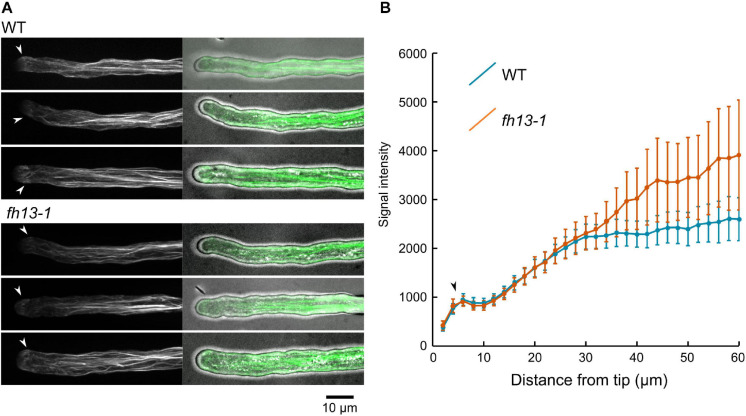
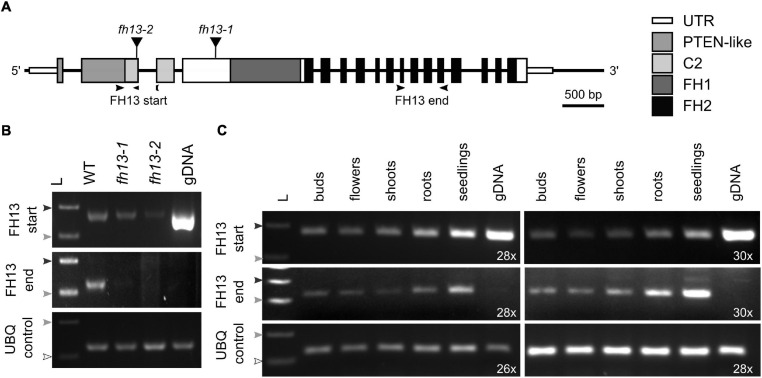
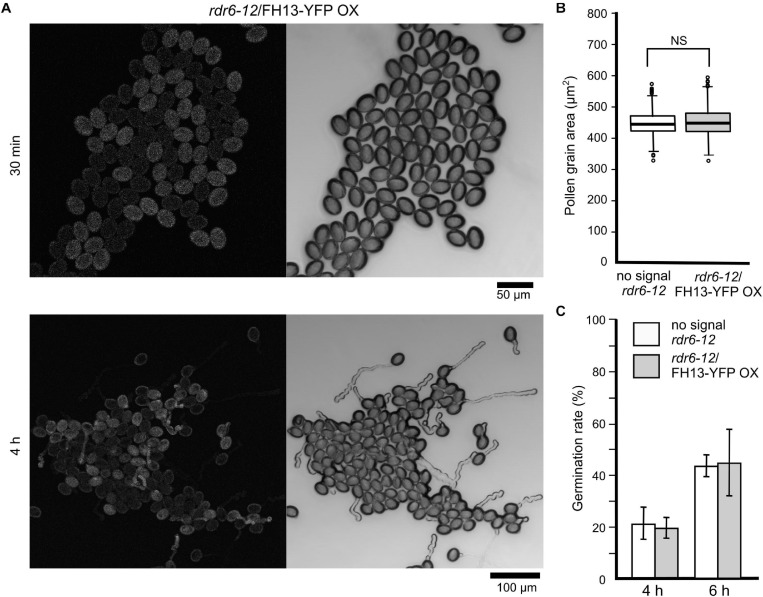
Formins are a large, evolutionarily conserved family of actin-nucleating proteins with additional roles in regulating microfilament, microtubule, and membrane dynamics. Angiosperm formins, expressed in both sporophytic and gametophytic tissues, can be divided into two subfamilies, Class I and Class II, each often exhibiting characteristic domain organization. Gametophytically expressed Class I formins have been documented to mediate plasma membrane-based actin assembly in pollen grains and pollen tubes, contributing to proper pollen germination and pollen tube tip growth, and a rice Class II formin, FH5/RMD, has been proposed to act as a positive regulator of pollen tube growth based on mutant phenotype and overexpression data. Here we report functional characterization of the pollen-expressed typical Class II formin FH13 (At5g58160). Consistent with published transcriptome data, live-cell imaging in transgenic plants expressing fluorescent protein-tagged FH13 under the control of the FH13 promoter revealed expression in pollen and pollen tubes with non-homogeneous signal distribution in pollen tube cytoplasm, suggesting that this formin functions in the male gametophyte. Surprisingly, loss of function mutations do not affect plant fertility but result in stimulation of pollen tube growth, while tagged FH13 overexpression inhibits pollen tube elongation. Pollen tubes of mutants expressing a fluorescent actin marker exhibited possible minor alterations of actin organization. Our results thus indicate that FH13 controls or limits pollen tube growth, or, more generally, that typical Class II formins should be understood as modulators of pollen tube elongation rather than merely components of the molecular apparatus executing tip growth.
formin蛋白是一个庞大的、在进化上保守的肌动蛋白成核蛋白家族,在调节微丝、微管和膜动力学方面还具有其他作用。被子植物的formin蛋白在孢子体和配子体组织中均有表达,可分为两个亚家族,即I类和II类,每个亚家族通常都具有特征性的结构域组织。文献记载,配子体表达的I类formin蛋白可介导花粉粒和花粉管中基于质膜的肌动蛋白组装,有助于花粉正常萌发和花粉管顶端生长,并且基于突变体表型和过表达数据,有人提出水稻II类formin蛋白FH5/RMD可作为花粉管生长的正调控因子。在此,我们报道了花粉表达的典型II类formin蛋白FH13(At5g58160)的功能特性。与已发表的转录组数据一致,在FH13启动子控制下表达荧光蛋白标记的FH13的转基因植物中的活细胞成像显示,FH13在花粉和花粉管中表达,在花粉管细胞质中的信号分布不均匀,这表明该formin蛋白在雄配子体中发挥作用。令人惊讶的是,功能缺失突变并不影响植物育性,但会导致花粉管生长受到刺激,而标记的FH13过表达则会抑制花粉管伸长。表达荧光肌动蛋白标记的突变体的花粉管显示肌动蛋白组织可能有轻微改变。因此,我们的结果表明,FH13控制或限制花粉管生长,或者更普遍地说,典型的II类formin蛋白应被理解为花粉管伸长的调节剂,而不仅仅是执行顶端生长的分子机制的组成部分。