Goudarzi Negin, Mohammad Valipour Sanaz, Nooritahneh Akram, Motaghinejad Majid, Motevalian Manijeh, Safari Sepideh, Gholami Mina, Vatandour Safieh, Hekmati Malak
Department of Veterinary and Biomedical Science University of Minnesota, USA.
Department of Pharmaceutics, Faculty of Pharmacy, Tabriz University of Medical Sciences, Tabriz, Iran .
Iran J Pharm Res. 2020 Summer;19(3):494-508. doi: 10.22037/ijpr.2020.1101210.
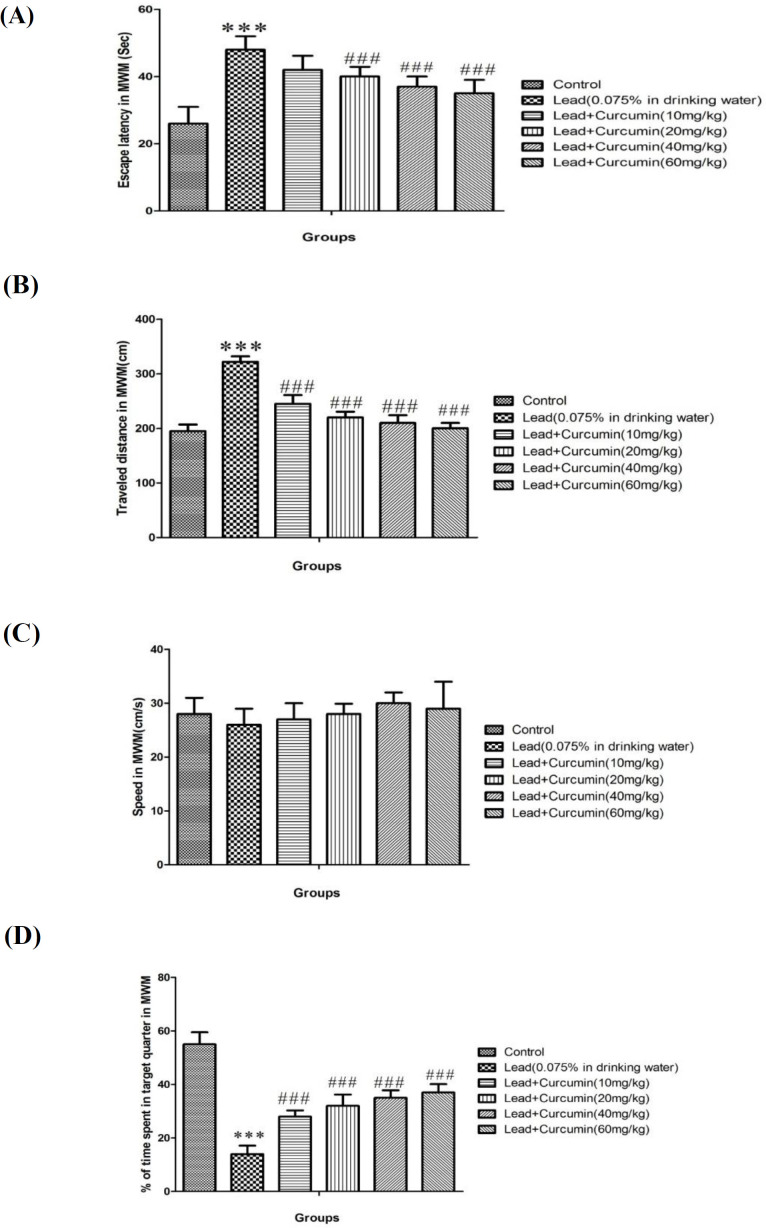
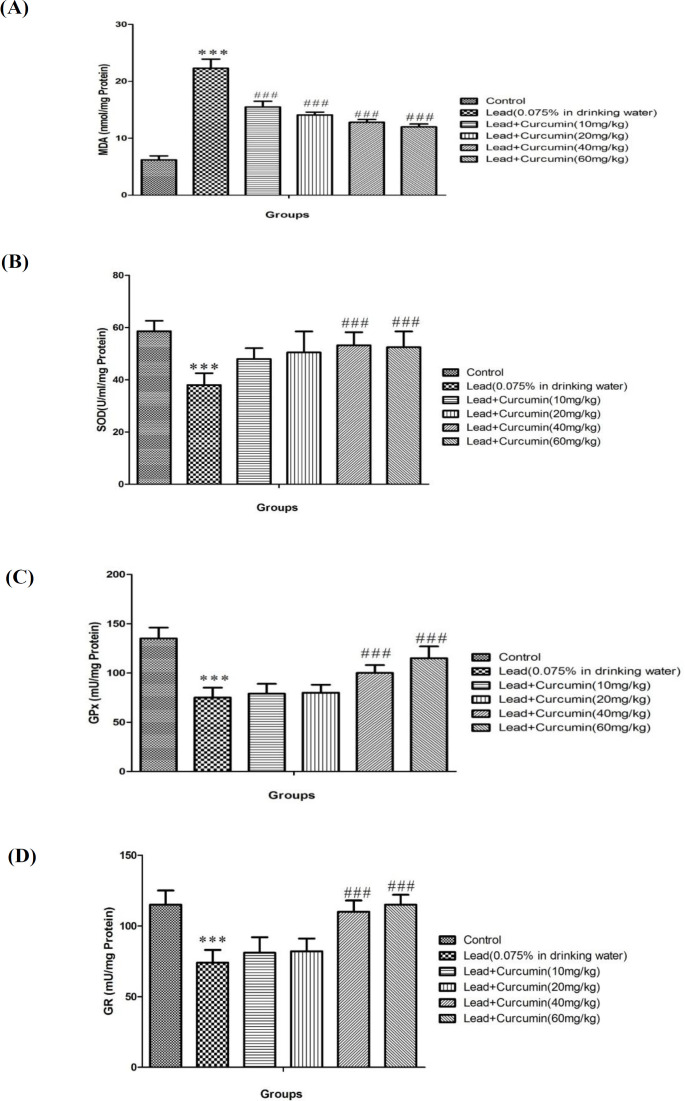
One of main herbal compounds with neuroprotective effects is curcumin. Lead poisoning cause neurodegeneration effect but its clear mechanism remains unknown. The current study evaluates the role of Akt/GSK3 signaling pathway in mediating the neuroprotective effects of curcumin against lead -induced neurodegeneration in rats. Sixty adult male rats were divided to: Group 1 and 2 receiving normal saline and drinking water containing 0.075% of lead acetate. Groups 3, 4, 5, and 6 were treated concurrently with lead acetate (0.075% in drinking water) and Curcumin (10, 20, 40, and 80 mg/kg I.P, respectively). Morris water maze (MWM) was used to evaluate cognitive activity, Hippocampal oxidative, anti-oxidant, as well as inflammatory and apoptotic factors and also Akt and GSK3 protein levels were studied. We found that lead poisoning disturbed the learning and memory and simultaneous treatment with Curcumin reduced the lead -induced cognition disturbances. In addition, lead acetate treatment increased lipid peroxidation and the levels of IL-1β, TNF-α , , GSK3 (total and phosphorylated) while reducing reduced form of GSH, , and Akt3 (total and phosphorylated) levels in the hippocampus. Lead also reduced the activity of SOD, GPx, and GR in the hippocampus. In contrast, various doses of Curcumin attenuated lead -induced apoptosis, oxidative stress and inflammation; while elevating P-Akt and reduced of GSK3 levels. Thus, Curcumin via mediation of Akt/GSK3 signaling pathway confers neuroprotection against lead-induced neurodegeneration in hippocampus.
具有神经保护作用的主要草药化合物之一是姜黄素。铅中毒会导致神经退行性变,但其确切机制尚不清楚。本研究评估Akt/GSK3信号通路在介导姜黄素对大鼠铅诱导的神经退行性变的神经保护作用中的作用。将60只成年雄性大鼠分为:第1组和第2组接受生理盐水和含0.075%醋酸铅的饮用水。第3、4、5和6组同时用醋酸铅(饮用水中0.075%)和姜黄素(分别为10、20、40和80mg/kg腹腔注射)处理。采用莫里斯水迷宫(MWM)评估认知活动、海马氧化、抗氧化以及炎症和凋亡因子,并研究Akt和GSK3蛋白水平。我们发现铅中毒扰乱了学习和记忆,同时用姜黄素治疗可减少铅诱导的认知障碍。此外,醋酸铅处理增加了脂质过氧化以及IL-1β、TNF-α、GSK3(总蛋白和磷酸化蛋白)的水平,同时降低了海马中还原型谷胱甘肽、Akt3(总蛋白和磷酸化蛋白)的水平。铅还降低了海马中SOD、GPx和GR的活性。相反,不同剂量的姜黄素减轻了铅诱导的细胞凋亡、氧化应激和炎症;同时提高了P-Akt水平并降低了GSK3水平。因此,姜黄素通过介导Akt/GSK3信号通路对海马中铅诱导的神经退行性变具有神经保护作用。