Khajehnoori Sahel, Zarei Fatemeh, Mazaheri Mahta, Dehghani-Firoozabadi Ali
Department of Medical Genetics, School of Medicine, Shahid Sadoughi University of Medical Sciences,Yazd, Iran.
S. K. and F. Z. contributed equally to this work.
Iran J Pharm Res. 2020 Summer;19(3):509-519. doi: 10.22037/ijpr.2020.15450.13217.
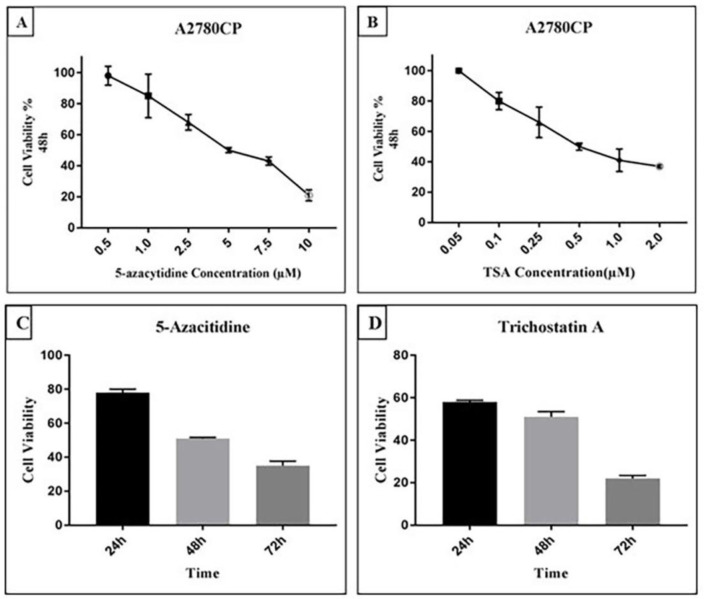
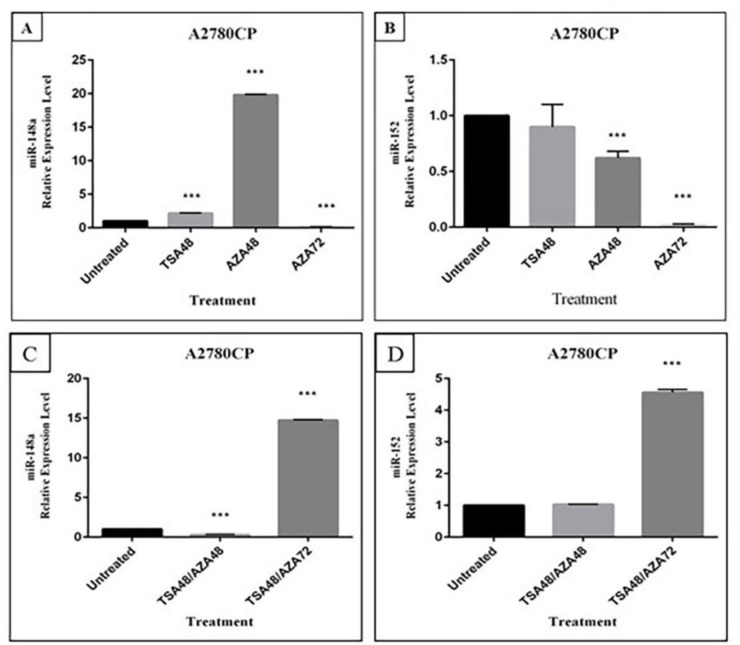
Cisplatin is a common agent which is used to treat Epithelial Ovarian Cancer (EOC), but cisplatin resistance is a major obstacle in successful treatment of ovarian cancer. Aberration in epigenetic changes play an important role in disregulation of gene expression. MiR-152 and miR-148a are frequently down-regulated in EOC due to promoter hyper-methylation. DNA methyltransferase1 (DNMT1), the main enzyme in maintenance of the pattern of DNA methylation, is one of the targets of miR-152 and miR-148a. Aberrantly up-regulation of DNMT1 is responsible for silencing of tumor suppressor genes in carcinogenesis. We hypothesized that re-expression of miR-152 and miR-148a and consequently down-regulation of DNMT1 may resensitize cancerous cells to chemotherapeutics agents. The aim of the present study is to investigate the effect of 5-azacytidine (5-Aza) and Trichostatin A on miR-152 and miR-148a expression in A2780CP ovarian cancer cell line. Optimal doses of 5-Azacitidine and TSA were measured by 3-(4,5-dimethylthazol-2-yl)-2,5-diphenyltetrazolium bromide (MTT) assay. A2780CP cell line was treated by each drugs, alone or in combination and the expression of miR-148a, miR-152 and DNMT1 was evaluated by - - The results revealed that TSA and 5-Azacytidine are able to revive the expression of miR-148a and miR-152 genes and mediate growth inhibition of epithelial ovarian cancer cells. The present study suggests that re-expression of miR-148a and miR-152 by epigenetic therapy aiming to DNMT1 suppression might resensitize resistant ovarian tumors to conventional chemotherapy.
顺铂是一种用于治疗上皮性卵巢癌(EOC)的常用药物,但顺铂耐药是卵巢癌成功治疗的主要障碍。表观遗传变化异常在基因表达失调中起重要作用。由于启动子高甲基化,miR-152和miR-148a在EOC中经常下调。DNA甲基转移酶1(DNMT1)是维持DNA甲基化模式的主要酶,是miR-152和miR-148a的靶标之一。DNMT1异常上调导致肿瘤抑制基因在致癌过程中沉默。我们假设miR-152和miR-148a的重新表达以及随后DNMT1的下调可能使癌细胞对化疗药物重新敏感。本研究的目的是研究5-氮杂胞苷(5-Aza)和曲古抑菌素A对A2780CP卵巢癌细胞系中miR-152和miR-148a表达的影响。通过3-(4,5-二甲基噻唑-2-基)-2,5-二苯基四氮唑溴盐(MTT)法测定5-氮杂胞苷和TSA的最佳剂量。用每种药物单独或联合处理A2780CP细胞系,并通过- -评估miR-148a、miR-152和DNMT1的表达。结果显示,TSA和5-氮杂胞苷能够恢复miR-148a和miR-152基因的表达,并介导上皮性卵巢癌细胞的生长抑制。本研究表明,旨在抑制DNMT1的表观遗传疗法使miR-148a和miR-152重新表达可能使耐药卵巢肿瘤对传统化疗重新敏感。